
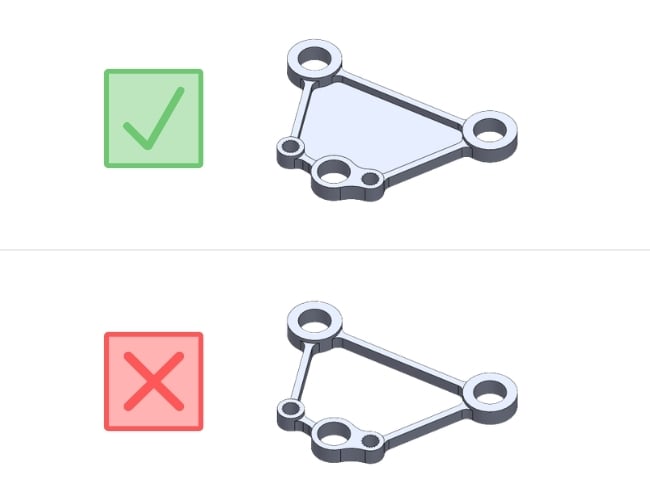
Geometric Dimensioning & Tolerancing
Treating GD&T as a design decision tool, not just documentation, lets engineers loosen unnecessary constraints, put tolerance where it matters, and boost yield without losing performance.
GD&T exists to translate ideal design intent into functional manufactured output, not to describe nominal geometry more precisely.
Geometric Dimensioning and Tolerancing occupies a strange place in mechanical engineering. While it’s universally acknowledged as important, formally standardized, and sometimes even heavily taught, it’s routinely misunderstood, inconsistently applied, and often treated as a downstream documentation task rather than a core design activity.
That tension is not accidental. GD&T is frequently introduced through symbols, rules, and compliance with ASME Y14.5, when in reality it’s best understood as a functional decision‑making framework. Most of the struggles surrounding GD&T can be traced back to not having a clear model for what problem GD&T is solving.
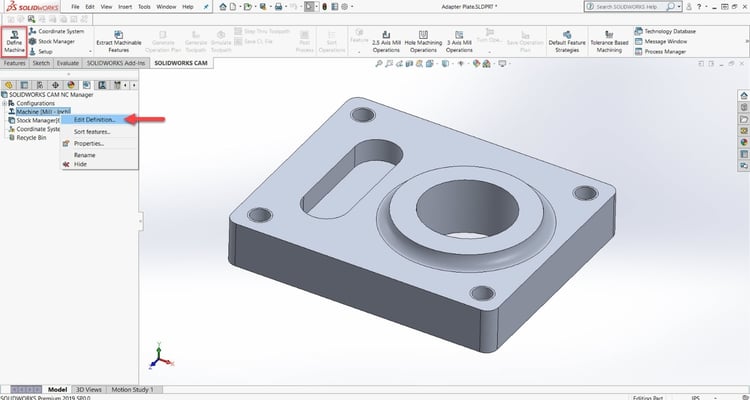
Modern CAD environments are idealized by definition: faces are perfectly planar, cylinders are perfectly round, and axes are perfectly coincident. These assumptions are useful for design, but they are entirely detached from manufacturing reality. No process produces perfect geometry.
- Machining introduces tool deflection and fixturing error
- Castings warp during cooling
- Molded parts shrink non‑uniformly
- Additive processes introduce anisotropy and distortion
Variation is not an avoidable defect; it’s an inherent part of hardware product development and manufacturing.
The purpose of GD&T is not to eliminate variation, but to define which variation matters and which does not, in a way that preserves function while enabling manufacturability and inspection repeatability.
Linear dimensions alone are insufficient for this task because they describe size without adequately describing shape, orientation, or location relative to functional references. Two parts can satisfy every ± tolerance on a drawing and still fail in assembly. GD&T exists to close that gap.
Before we jump into what GD&T is, and what it is not, let’s begin with a basic overview of GD&T.
An Overview of Geometric Dimensioning and Tolerancing
GD&T communicates design intent in ways that basic coordinate dimensions and tolerances cannot. It does this by defining how a part’s size, location, form, and orientation must relate to each other and then applying the right geometric controls to the drawing.
.jpg?width=750&height=401&name=GD%26T%20feature%20categories%20(1).jpg)
Size is the actual physical dimension of a feature. It is usually controlled with standard ± tolerances, although profile can also be used to control size.
Location is where a feature sits in 3D space relative to other features on the part. In GD&T, this is most often controlled with the Position tolerance.
Orientation describes how a feature is angled in 3D space relative to other features. It further refines location and is typically controlled with Parallelism, Perpendicularity, or Angularity, though other symbols, such as Runout, can also influence orientation.
Form describes the basic shape of a feature. Form controls such as straightness, flatness, circularity, and cylindricity are used as final refinements and are applied only when they are functionally necessary.
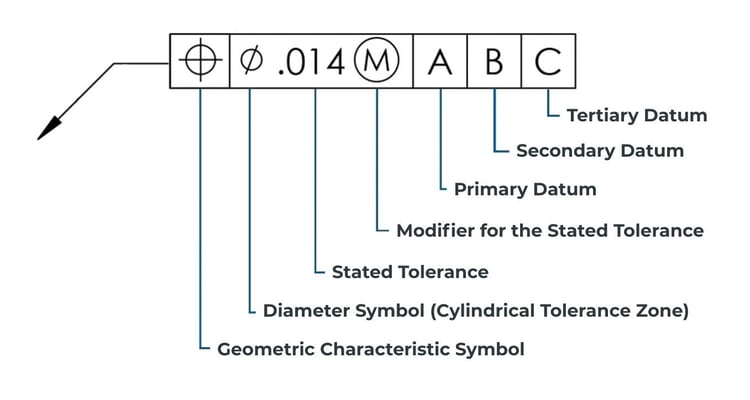
To apply the geometric controls to a feature on a GD&T drawing, a feature control frame is used. A feature control frame includes four pieces of information – the GD&T symbol, the tolerance zone type and dimensions, tolerance zone modifiers, and datum references (when required).
The GD&T symbols are straightness, flatness, roundness, cylindricity, angularity, parallelism, perpendicularity, concentricity, coaxiality, symmetry, circular runout, total runout, line profile, and surface profile.
GD&T symbols, datums, and feature control frames are all covered in significant detail in their respective Knowledge Base articles.
What GD&T Is
A Language for Communicating Design Intent
At its core, GD&T is a communication system. It’s a standardized symbolic language that allows an engineer to state unambiguously which geometric characteristics are functionally critical and how much variation is acceptable before performance degrades.
That distinction—functionally critical—is the key. GD&T does not exist to fully constrain geometry. It exists to constrain only what must be constrained.
GD&T focuses on the function of the part, not the geometry for its own sake. When applied correctly, it allows non‑critical features to float while tightly controlling only those that influence fit, alignment, sealing, motion, or load transfer.
This is why experienced engineers often describe GD&T as “design intent captured symbolically.” The symbols themselves are not the value. The value is the decision that precedes them.
A Shared Contract Across Disciplines
Another critical aspect of GD&T is that it creates a shared contract between design, manufacturing, and inspection.
Without GD&T, design intent is inferred. Manufacturing interprets drawings through experience and tribal knowledge. Inspection makes judgment calls about what constitutes “good enough.” Disputes arise not because anyone is incompetent, but because the requirements are ambiguous.
GD&T removes that ambiguity by explicitly defining the tolerance zone within which a feature must exist, relative to clearly defined references. When done well, it leaves little room for interpretation. The drawing tells manufacturing what must be achieved and tells inspection how compliance should be verified.
Every geometric tolerance implicitly defines a measurement strategy, whether that strategy is executed with a CMM, a functional gage, or a surface plate and indicator. If a tolerance cannot be inspected reliably, it is already a liability—regardless of whether it satisfies the standard.
A Decision-Making Framework
When viewed correctly, GD&T is not a rulebook—it is a framework for making informed tradeoffs between function, manufacturability, inspection effort, and cost.
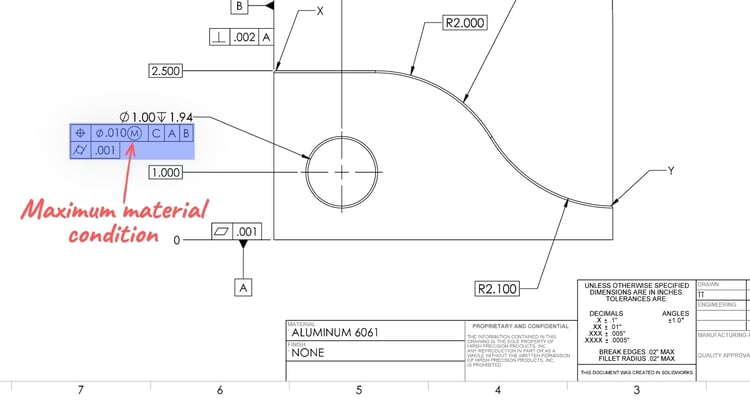
Material condition modifiers are a good example. MMC and LMC are often treated as advanced or optional features, when in reality they are powerful economic tools. By explicitly linking allowable geometric variation to feature size, they enable additional tolerance where it is functionally permissible, often unlocking substantial manufacturing yield improvements without sacrificing performance.
At the same time, restraint matters. Not every part requires GD&T on every feature. Over‑specification increases inspection burden, raises cost, and can obscure what actually matters. Under‑specification creates ambiguity and downstream rework. The skill lies in knowing where to draw that line.
This knowledge base is structured around that reality. The goal is not to turn engineers into walking copies of ASME Y14.5, but to give them the tools to reason from function to tolerance with confidence.
What GD&T Is Not
Despite its intent, GD&T is often perceived as a way to make drawings more restrictive. This perception usually comes from poor application rather than from GD&T itself.
One of the most common failure modes in GD&T is starting with features instead of function. Engineers look at a drawing, identify holes, faces, and slots, and then ask, “What tolerance should I put here?”
That question is already backwards.
The correct starting point is always functional behavior in assembly:
- How is the part located?
- Which surfaces establish repeatability?
- Which features interface with other components under load?
- Which misalignments cause binding, leakage, or wear?
Only after those questions are answered does it make sense to decide how geometry should be controlled. Your tolerancing should be framed around assembly context and mating conditions, rather than isolated features because geometry divorced from function leads to over-constraint and unnecessary cost.
This functional framing also explains why two parts with superficially similar geometry can require radically different GD&T schemes depending on how they are used. A hole that locates a bearing in a rotating assembly is fundamentally different from a clearance hole for a fastener, even if the diameters are identical.
Properly applied, GD&T often loosens tolerances. By separating form, orientation, and location requirements, it allows engineers to stop over‑constraining features that do not impact function. This selective control is one of the primary economic benefits of GD&T, particularly in complex assemblies where tolerance stack‑ups dominate performance.
Another persistent misconception is that learning GD&T is primarily about memorizing symbols. This approach produces engineers who can decode a feature control frame but cannot decide when to use one. GD&T Basics explicitly criticizes this rote‑learning model, noting that standards familiarity without application context rarely translates into effective tolerancing decisions.
Finally, GD&T is not a substitute for good design. It cannot fix poor part architecture, unrealistic process assumptions, or undefined functional requirements. GD&T clarifies intent; it does not invent it.
When GD&T “fails,” the root cause is almost always upstream in the design process.
This article is part of a series about GD&T. Other articles include How GD&T Reduces Cost, Feature Control Frame, and GD&T symbols.