
Fatigue resistance is a critical mechanical property that defines how a material performs under repeated or cyclic loading. Unlike static strength or elasticity, fatigue resistance determines a metal’s ability to withstand fluctuating stresses over time without initiating cracks or experiencing catastrophic failure.
In CNC machining and mechanical design, fatigue resistance is essential for components subjected to vibration, rotation, or load cycles—such as shafts, fasteners, springs, and structural supports in aerospace, automotive, and medical devices.
This blog explores what fatigue resistance is, how it’s measured, how it affects machining, and how engineers can strategically select fatigue-resistant metals to design durable, high-performance components.
What is Fatigue Resistance and Why it Matters
Fatigue resistance refers to a material’s ability to endure cyclic loading without developing cracks that lead to failure.
Even when the applied stress is below the material’s yield strength, repeated loading can cause microstructural damage to accumulate over time. This damage initiates microscopic cracks that grow with each cycle until the part ultimately fractures.
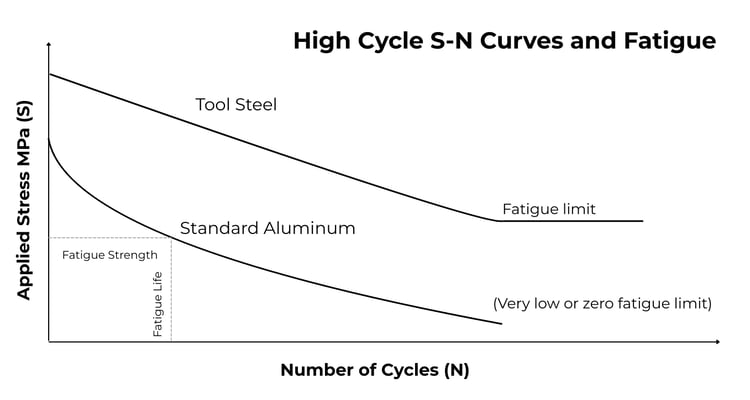
The number of cycles a material can withstand before failure is known as its fatigue life, and the maximum stress it can endure indefinitely without failure is called the fatigue limit.
In metals, fatigue resistance is vital for ensuring long-term reliability in dynamic environments. For example, in aerospace applications, components like wing spars and landing gear experience thousands of load cycles during their service life. A metal with high fatigue resistance will maintain its integrity under these conditions, reducing the risk of unexpected failure and extending the lifespan of the part.
Factors that Affect Fatigue Resistance
Several factors affect a metal’s fatigue resistance, including composition, heat treatment, grain size, and more.
Composition
The chemical makeup of a metal significantly influences its fatigue behavior. Alloying elements such as chromium, nickel, and molybdenum can enhance fatigue resistance by improving strength and reducing crack propagation.
For instance, stainless steels with high chromium content offer better fatigue performance due to their corrosion resistance, which helps prevent surface degradation that can initiate cracks.
Heat Treatment
Heat treatment processes such as quenching and tempering can significantly improve fatigue resistance by increasing hardness and refining the microstructure. These treatments reduce residual stresses and enhance the uniformity of the material, making it more resilient to cyclic loading.
However, improper heat treatment can introduce stress concentrations or reduce ductility, which may compromise fatigue life.
Grain Size
Fine-grained metals generally exhibit better fatigue resistance than coarse-grained counterparts. Smaller grains create more grain boundaries, which act as barriers to crack propagation. This microstructural refinement helps distribute stress more evenly and delays the onset of fatigue failure.
Engineers should consider grain size control during material selection and processing to optimize fatigue performance.
Work Hardening
Work hardening increases strength but may reduce ductility, affecting the material’s ability to absorb cyclic loads. Engineers should evaluate whether stress-relief treatments are necessary to optimize fatigue behavior.
Surface Condition
Surface finish plays a pivotal role in fatigue resistance. Rough surfaces with machining marks, burrs, or tool chatter can act as stress concentrators, accelerating crack initiation. Polishing, shot peening, and surface coatings can improve fatigue performance by reducing surface roughness and introducing beneficial compressive stresses.
Engineers should prioritize post-machining processes that enhance surface integrity, especially for parts in high-cycle applications.
Residual Stress
Residual stresses from machining or forming operations can either help or hinder fatigue resistance. Compressive residual stresses on the surface can delay crack initiation, while tensile residual stresses can promote it.
Modes of Fatigue-Related Failure in Metals
Fatigue failure often occurs without warning after thousands or millions of load cycles. It typically begins with crack initiation at a surface defect or stress concentrator, followed by crack propagation and eventual fracture.
Unlike elastic or plastic deformation, fatigue failure is not immediately visible and may occur even when the part has been operating within its design limits. This makes fatigue analysis and testing essential for components in critical applications.
Additionally, material imperfections like inclusions, grain structure anomalies, and poor design practices—such as sharp corners or notches that create stress concentrations—can significantly increase cyclic load failure.
Another fatigue-related concern is the behavior of brittle materials, which do not exhibit the same yield strength characteristics as ductile metals. In fatigue scenarios, brittle materials may fail under tensile or compressive stresses that are well below their ultimate strength due to their limited ability to deform plastically. This makes it essential to consider both the compressive and tensile properties of brittle metals when designing for fatigue resistance.
How Fatigue Resistance is Measured
Understanding how to measure fatigue resistance is essential for engineers because it directly informs the reliability and safety of machined components subjected to cyclic loading.
Without accurate measurement, it’s nearly impossible to predict how long a part will last under real-world conditions, especially in critical applications like aerospace, automotive, or medical devices where failure could have catastrophic consequences.
Rotating Bending Fatigue Test
One of the most common approaches is the rotating bending fatigue test, where a specimen is subjected to repeated bending while rotating at a constant speed. This test helps determine the number of cycles a material can endure before failure, known as its fatigue life.
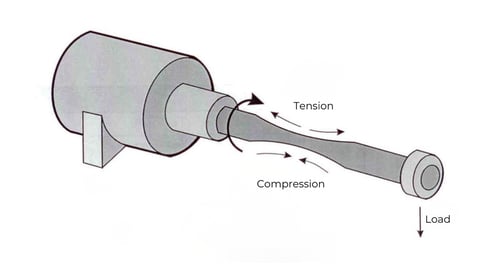
The results are plotted on an S-N curve (stress vs. number of cycles), which provides insight into the endurance limit—the stress level below which the material can theoretically withstand infinite cycles without failing.
Fracture Toughness Testing
Another method used to evaluate fatigue resistance is the fracture toughness test, which assesses a material’s ability to resist crack propagation under cyclic stress. This test is particularly important for components that operate in environments where surface defects or stress concentrations are present.
By measuring how a crack grows under repeated loading, engineers can predict the material’s performance and durability in real-world applications.
Tolerance Analysis Methods
In addition to physical testing, engineers often use tolerance analysis methods such as Monte Carlo simulations or Root Sum Squared (RSS) techniques to model fatigue behavior in complex assemblies.

These methods help account for variability in material properties, geometry, and loading conditions, providing a more comprehensive understanding of how fatigue resistance will manifest in a finished part. While these simulations don’t replace physical testing, they are valuable tools for early-stage design and risk assessment.
By using standardized testing methods—such as rotating bending tests or fracture toughness evaluations—engineers can quantify a material’s fatigue life and endurance limit, enabling them to make informed decisions about material selection, part geometry, and machining strategies.
This knowledge also supports the development of more robust designs, helps identify potential failure points early in the design process, and ensures that components meet performance and regulatory requirements throughout their service life.
Fatigue Resistance in Commonly Machined Metals
Fatigue resistance plays a pivotal role in the performance and longevity of machined components, especially in applications where parts are subjected to repeated or cyclic loading. In such environments, even small, consistent stresses can initiate microcracks that grow over time, leading to eventual failure. This makes fatigue resistance a key consideration in industries like aerospace, automotive, and medical devices, where reliability and safety are paramount.
Commonly machined metals vary widely in their fatigue resistance due to differences in composition, microstructure, and mechanical properties.
- Aluminum alloys are lightweight and easy to machine but have lower fatigue resistance than steels
- Stainless steels offer better fatigue performance, especially with proper heat treatment, though they are more difficult to machine
- Titanium alloys combine a high strength-to-weight ratio with excellent corrosion and fatigue resistance
Below is a table ranking commonly used machined metals from least to most fatigue resistant, along with key machining considerations for each.
|
Metal |
Fatigue Resistance |
Machining Considerations |
|
Low to moderate |
Excellent machinability; prone to chatter; requires attention to surface finish and stress relief. |
|
| Moderate |
Good machinability; ductile; thermal conductivity can affect tool life; surface finish is critical. |
|
|
Moderate to high |
Very machinable; low density; requires careful handling due to flammability and corrosion sensitivity. |
|
|
High |
Work hardening common; use sharp tools and proper cooling; surface finish impacts fatigue life. |
|
|
High |
Good fatigue resistance; relatively easy to machine; benefits from heat treatment and surface finishing. |
Several surface treatments can significantly improve fatigue resistance in machined metals by enhancing surface integrity, reducing stress concentrations, and introducing beneficial compressive stresses.
Shot Peening
Shot peening involves bombarding the surface of a metal part with small spherical media. This process induces compressive residual stresses on the surface, which help prevent crack initiation and slow down crack propagation—two key factors in improving fatigue life.
Anodizing
While anodizing is primarily known for improving corrosion resistance and aesthetics, it also contributes to fatigue resistance by creating a hard, protective oxide layer that shields the surface from environmental degradation. This layer can reduce the likelihood of surface defects that often serve as nucleation sites for fatigue cracks.
Media Blasting
Media blasting is also effective for enhancing fatigue performance. These treatments smooth out surface irregularities left by machining, such as tool marks or burrs, which can act as stress risers. By refining the surface finish, these processes help distribute stress more evenly across the part, reducing the risk of localized fatigue failure.
Selecting the right surface treatment depends on the material type, application requirements, and desired balance between fatigue resistance, corrosion protection, and aesthetics.
Understanding the fatigue behavior of different metal families helps engineers make informed decisions about material selection and machining processes.
How Fatigue Resistance Impacts Machining
Metals with high fatigue resistance are often used in applications where components are subjected to cyclic loading, such as in aerospace, automotive, and medical devices. However, the very characteristics that make these metals durable under repeated stress—such as high strength, toughness, and resistance to crack propagation—can also introduce challenges during machining.
Tool Wear
Fatigue-resistant metals, such as titanium alloys and hardened steels, are typically harder and more abrasive, which accelerates tool wear. These materials often require specialized tooling—such as carbide or ceramic inserts—and optimized cutting parameters to maintain tool life and ensure consistent performance. Tool geometry, coatings, and cutting strategies must be carefully selected to manage heat generation and reduce mechanical stress on both the tool and the workpiece.
Surface Finish
Surface condition is directly tied to fatigue performance. Rough or damaged surfaces can act as initiation sites for fatigue cracks. Therefore, machining operations must prioritize achieving a smooth, uniform surface finish. This may involve using fine finishing passes, high-quality tooling, and post-machining treatments like polishing or shot peening to reduce surface roughness and introduce beneficial compressive stresses that enhance fatigue life.
Machinability
While fatigue-resistant metals offer superior performance in demanding applications, they are generally more difficult to machine. Their toughness and low thermal conductivity can lead to heat buildup, work hardening, and increased cutting forces. This necessitates slower feed rates, reduced depths of cut, and the use of high-pressure coolant systems to maintain process stability and prevent thermal damage.
Tolerances
High fatigue resistance often correlates with increased material hardness and strength, which can make achieving tight tolerances more difficult. These materials may also exhibit elastic recovery or spring-back during machining, particularly in thin-walled or flexible geometries. Engineers must account for these behaviors in their toolpath strategies and fixturing approaches to ensure dimensional accuracy and repeatability.
Understanding how fatigue resistance interacts with tooling, surface finish, tolerances, and overall machinability is essential for engineers and machinists aiming to produce reliable, high-performance parts.
Choosing the Right Metal for Fatigue Resistant Applications
When fatigue resistance is the driving factor in material selection, engineers must begin by understanding the operational demands of the component. This includes the type, magnitude, and frequency of cyclic loads the part will experience, as well as environmental factors like temperature, corrosion exposure, and vibration. These conditions help define the required fatigue life and endurance limit, which are essential benchmarks for narrowing down suitable metal families.
Once the performance criteria are established, engineers should evaluate candidate metals based on their known fatigue behavior. High-strength steels, titanium alloys, and nickel-based superalloys are often favored for their ability to resist crack initiation and propagation under repeated stress.
However, fatigue resistance is not solely a function of base material properties—it’s also influenced by microstructure, surface condition, and residual stress. Therefore, engineers must consider how alloying elements, grain size, and heat treatment will affect fatigue performance in the final part.
Machinability is the next critical factor. Fatigue-resistant metals tend to be harder and tougher, which can complicate machining. Assess whether the material can be machined to the required tolerances and surface finish without excessive tool wear or thermal damage.
Post-machining treatments such as shot peening, polishing, or surface coatings may be necessary to enhance fatigue life by reducing surface roughness and introducing compressive stresses.
Ultimately, the chosen metal should strike a balance between fatigue performance, manufacturability, cost, and long-term reliability in its intended application.