
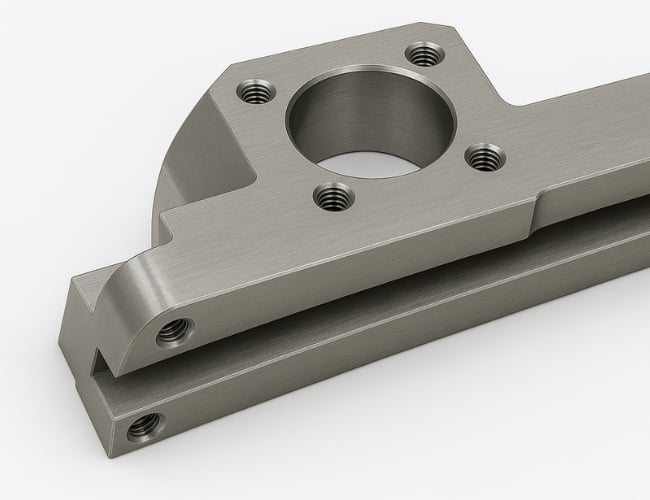
CNC Machining Titanium
This article reviews common titanium alloys for machined components and key factors like design, machinability, surface finish, and sourcing.
Titanium occupies a unique space in CNC machining. It is neither a “difficult aluminum” nor a “lightweight steel.” Its mechanical, thermal, and chemical behavior under cutting loads is fundamentally different from most structural metals, and designs that succeed in aluminum or stainless steel often fail—sometimes catastrophically—when translated directly to titanium.
From a design engineering standpoint, titanium should be treated as a performance‑driven material, selected only when its specific advantages materially impact part function. While titanium offers excellent strength‑to‑weight ratio, corrosion resistance, and temperature capability, these benefits come with narrow machining process windows, high sensitivity to geometry, and significant cost and lead‑time implications. Successful titanium parts are almost always the result of intentional geometry, conservative tolerance strategy, and early alignment between design and manufacturing realities.
Unlike aluminum, titanium does not dissipate heat efficiently during machining. Most cutting heat remains concentrated at the tool–chip interface rather than being carried away in the chip. This single characteristic drives many of the design rules engineers must follow when working with titanium: conservative cutting engagement, rigid geometry, generous radii, and avoidance of features that amplify heat, vibration, or tool dwell.
Common reasons engineers select titanium include:
- Exceptional strength‑to‑weight ratio compared to steel
- Outstanding corrosion resistance in aggressive environments
- High temperature capability with good strength retention
- Biocompatibility for medical and human‑contact applications
- Fatigue performance in properly designed geometries
Titanium is most successful when its use is functionally justified—aerospace structures where mass reduction matters, medical implants where corrosion and biocompatibility are mandatory, or industrial components exposed to heat, chlorides, or cyclic stress where other alloys fall short. Using titanium “just in case” almost always leads to unnecessary cost and manufacturing risk.
Typical CNC-machined titanium applications include: aerospace structural components and fittings, medical implants, surgical instruments, chemical processing hardware, defense and high-temperature industrial components.
Commonly Machined Grades of Titanium
While dozens of titanium alloys exist, the overwhelming majority of CNC‑machined titanium parts fall into four practical categories: commercially pure titanium (Grades 1 and 2), near‑alpha alloy Ti‑3Al‑2.5V (Grade 9), and alpha‑beta alloy Ti‑6Al‑4V (Grade 5). These materials differ meaningfully in strength, ductility, fatigue behavior, thermal response, and machining risk. Design assumptions that are valid for one grade are frequently incorrect—and occasionally dangerous—when applied to another.
From a DFM perspective, engineers should treat Grades 1, 2, 9, and 5 as fundamentally different materials, not incremental variants along a single spectrum. Geometry selection, wall thickness limits, tolerance strategy, surface finish requirements, and even inspection expectations should be deliberately adjusted based on the specific alloy chosen. Collapsing these grades into a single “titanium” category obscures real manufacturing risk and is a common root cause of cost overruns and late‑stage redesigns.
|
Alloy |
Ultimate Strength |
Yield Strength |
Fatigue Strength |
Shear Strength |
Shear Modulus |
Hardness |
Elongation |
| Grade 1 | 310-350 MPa | 220-240 MPa | 140-160 MPa | 170-190 MPa | 39-41 GPa | ~120 HB | 28-32% |
| Grade 2 | 420-470 MPa | 330-360 MPa | 200-2230 MPa | 240-260 MPa | 41-44 GPa | ~80-90 HRB | 23-25% |
| Grade 5 | 9200-1,000 MPa | 830-880 MPa | 500-560 MPa | 520-560 MPa | 43-44 GPa | ~330-350 HB | 9-14% |
| Grade 9 | 620-690 MPa | 480-550 MPa | 350-400 MPa | 36-400 MPa | 43-44 GPa | ~250-300 HB | 15-18% |
Production Considerations
Titanium production success depends less on nominal properties and more on how each grade’s machining behavior, design, and surface integrity work together. This guide treats Grades 1, 2, 9, 5, and 23 as distinct materials and organizes recommendations around design, machinability, and surface finish so engineers can align alloy choice with real production capability, reduce risk, and improve first‑pass yield—especially in regulated aerospace and medical applications.
Design
Designing titanium parts starts with machining stability, not maximum material efficiency. High strength can tempt aggressive wall thinning and tall, slender features, but titanium’s low modulus and poor thermal conductivity make those choices hard to machine. Parts that pass FEA can still act like springs at the spindle, causing chatter, heat buildup, and dimensional drift.
Prioritize stiff, thermally friendly geometry. Avoid long tool engagement, tiny cutters, and repeated spring passes—features like sharp internal corners, deep pockets, and narrow slots should be treated as thermal hotspots, not just shapes. Designs that allow larger tools, shorter engagement, and continuous toolpaths are far more robust.
Keep section thickness as consistent as possible. Abrupt transitions from thick to thin create stiffness and temperature gradients that drive chatter and distortion. Gradual transitions, blended radii, and uniform walls improve both machinability and fatigue life. When you need to reduce weight, use ribs and gussets instead of uniformly thinning large areas.
Lastly, be disciplined with tolerances. Elastic recovery, heat, and tool wear make tight tolerances on flexible or poorly supported features costly and risky. Apply tight tolerances only where function demands them, and ensure those features are well supported by surrounding geometry and stable datums.
DFM Best Practices for Titanium Components
Use ribs instead of tall, thin free‑standing walls, and design geometry that supports alternating‑side step‑down strategies
Heat concentrates at the tool edge, deep pockets and long tool engagement quickly burn up tools, so break deep features into steps, improve access, and avoid full‑slot cutting
Design continuous toolpaths and avoid small islands/slots that force decel/dwell. Titanium is prone to galling and edge notching when you leave the “comfort zone”
For blind holes or deep cts, design to support the correct tap type and coolant/chip evacuation strategy; avoid geometries that invite bottoming or chip packing
Geometry that forces long tool stick-out or weak fixturing will chatter and drift size, so build in flats, bosses, or datum pads that improve clamping stability without touching critical surfaces
- Grade 1
- Grade 2
- Grade 5
- Grade 9
-
Grade 1
Grade 1
Titanium Grade 1 is best suited when corrosion resistance, formability, and fracture toughness matter more than strength. Its very low interstitial content gives it excellent ductility and damage tolerance, making it a strong choice for thin‑wall parts, formed shapes, and chemically aggressive environments. It should not be used for load‑bearing or fatigue‑critical applications without substantial cross‑sectional margin.
-
Grade 2
Grade 2
Titanium Grade 2 is the workhorse commercially pure grade, balancing corrosion resistance, moderate strength, and weldability for applications like aerospace ducting, medical housings, and marine hardware. Engineers should note its lower fatigue strength compared to alpha‑beta alloys in cyclic service.
-
Grade 5
Grade 5
Titanium Grade 5 is the primary high‑strength, weight‑critical alloy for aerospace structures and load‑bearing medical devices. It offers excellent fatigue performance but is notch‑sensitive, so stress concentrations must be carefully controlled.
-
Grade 9
Grade 9
Titanium Grade 9 bridges the gap between CP titanium and Ti‑6Al‑4V, offering higher strength than Grades 1–2 with better formability and toughness than Grade 5. It is ideal for aerospace tubing, hydraulic lines, and thin‑wall pressure components, but is not a drop‑in replacement for Ti‑6Al‑4V in highly loaded primary structures.
Machinability
Titanium is often described as “hard to machine,” but hardness is not the primary challenge. The true difficulty lies in thermal behavior, chemical reactivity, and elastic response under load. Titanium’s low thermal conductivity means heat stays at the cutting edge, while its chemical affinity for cutting tools promotes adhesion and galling.
Key machining characteristics engineers should account for:
- Heat concentrates at the tool–chip interface
- Tool wear accelerates rapidly with improper engagement
- Cutting forces remain high even at low speeds
- Elastic recovery can affect dimensional accuracy
- Chip evacuation is critical to prevent recutting and heat buildup
Machining success depends on maintaining a sharp, continuously cutting tool, minimizing dwell, and preventing heat accumulation. From a design standpoint, this means eliminating features that force small tools, long reach, or repeated spring passes.
- Grade 1
- Grade 2
- Grade 5
- Grade 9
-
Grade 1
Grade 1
Machinability is poor despite the low strength, driven by titanium’s low thermal conductivity and strong tendency to gall. Cutting forces are moderate, but heat concentrates at the tool edge, accelerating wear. Conservative surface speeds, sharp tooling, and continuous chip evacuation are required to maintain process stability.
-
Grade 2
Grade 2
Machining behavior is similar to Grade 1 but with slightly higher cutting forces. Heat management remains the primary challenge; tool wear is driven more by thermal effects than mechanical load. Stable machining requires rigid setups, flood coolant, and conservative engagement strategies.
-
Grade 5
Grade 5
Machinability is challenging due to high strength, low thermal conductivity, and strong chemical affinity with cutting tools. Cutting forces are high, tool life is limited, and process windows are narrow. Successful machining requires sharp, wear‑resistant tooling, high‑pressure coolant, and disciplined parameter control.
-
Grade 9
Grade 9
Grade 9 machines more easily than Ti‑6Al‑4V because of its lower strength and cutting forces, but heat at the tool edge still limits the process and demands sharp tools, moderate speeds, and strong coolant. Compared to Grade 5, it generally offers longer tool life and wider process windows, making it well suited to high‑mix, low‑volume work.
Surface Finish
Finishing Options: media blasting, vibratory tumbling, passivation, powder coating, electroplating, and anodizing
Tool wear, heat, and vibration directly influence finish quality on titanium components, and cosmetic requirements often drive disproportionate cost.
Important surface finish considerations:
- Tight tolerances amplify tool wear and inspection burden
- Thin features are prone to spring‑back after machining
- Surface finish degrades rapidly with worn tooling
- Secondary processes can alter critical dimensions
- Datum strategy strongly influences achievable repeatability
- Grade 1
- Grade 2
- Grade 5
- Grade 9
-
Grade 1
Grade 1
Good surface finishes are achievable directly from machining due to the alloy’s softness, but surface smearing and galling must be controlled. Grade 1 responds well to polishing and chemical passivation. Surface integrity is generally robust, making it suitable for applications where cleanability and corrosion resistance dominate over fatigue performance.
-
Grade 2
Grade 2
Grade 2 supports consistent as‑machined finishes and responds well to bead blasting, polishing, and anodizing. Care must be taken to avoid surface tearing during aggressive finishing passes. Surface finish quality is generally sufficient for pressure‑containing and hygienic applications without secondary grinding.
-
Grade 5
Grade 5
Surface finish has a direct impact on fatigue life. As‑machined surfaces often require polishing or controlled finishing to remove tool marks and residual tensile stresses. Shot peening or similar surface treatments are frequently used to improve fatigue performance, but must be tightly controlled and validated.
-
Grade 9
Grade 9
Grade 9 delivers consistent as‑machined finishes with less risk of tearing than higher‑strength titanium, which is valuable in pressure‑ and fatigue‑sensitive parts. It responds well to polishing, light bead blasting, and passivation, and its surface integrity is easier to control than Ti‑6Al‑4V as long as machining avoids thermal damage.
Sourcing
Cost is driven more by machining and risk than by raw material price, with long cycles, fast tool wear, conservative cuts, and extra inspection adding most of the expense—especially when designs require small tools, long reach, or frequent re‑clamping.
Because titanium can’t be machined aggressively, every extra feature, setup, or tight tolerance sharply increases cycle time, scrap risk, and cost. Lead time also grows with longer procurement for certified grades and extended machine runtime.
Primary cost drivers include:
- Alloy grade and certification requirements
- Feature complexity and tool engagement time
- Tool wear driven by small tools and long reach
- Number of setups and datum changes
- Tolerance tightness and inspection burden
The best way to control cost and lead time is disciplined design upfront: reduce unnecessary tight tolerances, extreme or hard‑to‑reach geometry, setups, and choose the lowest‑performance titanium grade that still meets functional requirements.