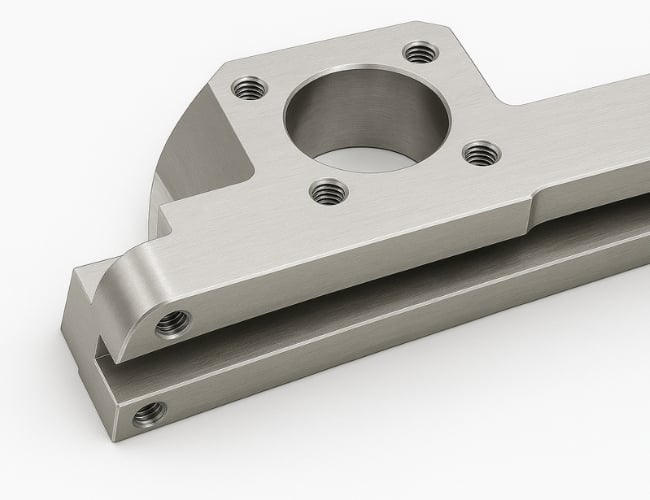
CNC Machining Stainless Steel
This article reviews the stainless steel alloys most frequently used for machined components and outlines key factors at every stage of production, including design, machinability, surface finish, and sourcing.
Stainless steel is widely used in CNC machining because it supports structural, cosmetic, pressure‑containing, and corrosion‑exposed applications. Machined stainless parts are often critical interfaces that must align, seal, slide, or transmit load while resisting wear and corrosion.
Engineers choose stainless when they need a practical balance of corrosion resistance, mechanical strength, durability, and manufacturability at scale. It sits between aluminum, which is typically strength‑to‑weight driven, and nickel alloys, which are reserved for extreme environments.
However, stainless is not a single behavior. Austenitic, precipitation‑hardened, and martensitic grades machine very differently, and those differences affect tolerances and tool life. Treating all grades as interchangeable leads to designs that look acceptable on paper but create instability, excess wear, and tolerance risk in production.
Many stainless parts also go through post‑machining steps like passivation or heat treatment that change final dimensions. Engineers should state whether tolerances apply before or after these processes and avoid ultra‑tight requirements on features that are likely to move. Clear rules prevent false rejects, rework, and yield loss.
Engineers commonly select stainless steel for:
- Corrosion resistance in atmospheric, aqueous, or chemical environments
- Good mechanical strength without exotic processing
- Compatibility with welding, forming, and secondary operations
- Long service life with minimal maintenance
- Regulatory or industry familiarity (medical, food, aerospace, industrial)
Typical CNC‑machined stainless steel applications include medical and life-science components, brackets, fittings, and housings for the aerospace industry, valves, manifolds, and fluid-handling components, industrial enclosures, mounts, tooling, shafts, and fasteners.
Commonly Machined Grades of Stainless Steel
Stainless steels fall into several metallurgical families—austenitic, martensitic, ferritic, and precipitation‑hardened—and machinability is driven more by family behavior than corrosion rating. Work hardening, chip formation, heat response, and achievable surface finish vary dramatically across grades.
Engineers should not assume that “higher corrosion resistance” implies “harder to machine,” or that “free‑machining” grades are universally better. Each alloy presents tradeoffs between corrosion resistance, strength, machinability, and post‑machining behavior.
|
Alloy |
Ultimate Strength |
Yield Strength |
Fatigue Strength |
Shear Strength |
Shear Modulus |
Hardness |
Elongation |
| SS 15-5 | 890 - 1200 MPa | 590 - 890 MPa | ~450 MPa | 550 - 720 MPa | ~77 GPa | 28 - 40 HRC | 7 - 16% |
| SS 17-4 | 1340 MPA | 1170 MPa | ~480 MPa | 780 MPa | ~77 GPa | 38 - 44 HRC | 13% |
| SS 303 | 580 - 700 MPa | 205 - 350 MPa | ~230 MPa | 335 - 415 MPa | ~77 GPa | 234 HB | 40 - 50% |
| SS 304 | 520 - 600 MPA | 210 - 250 MPa | ~240 MPa | 300 360 MPa | ~77 GPa | 215 HB | 45% |
| SS 316 | 480 - 600 MPa | 170 - 230 MPa | ~230 MPa | 280 - 360 MPa | ~74 GPa | 215 HB | 38 - 55% |
| SS 410 | ~700 MPa | ~450 MPa | ~300 MPa | ~420 MPa | ~77 GPa | 35 - 45 HRC | 15% |
| SS 416 | 440 - 580 MPa | 275 - 345 MPa | ~250 MPa | 260 - 360 MPa | ~77 GPa | 30 HRC | 7 - 25% |
| SS 420 | 485 - 750 MPa | 275 - 380 MPa | ~310 MPa | 290 - 460 MPa | ~77 GPa | 48 - 52 HRC | 15 - 20% |
| SS 440C | 560 - 800 MPa | 340 - 430 MPa | ~350 MPa | 325 - 500 MPa | ~78 GPa | 58 - 60 HRC | 14 - 18% |
Production Considerations
Stainless steel presents a unique set of challenges and tradeoffs once a design leaves the CAD environment and enters production. While its corrosion resistance and mechanical properties make it indispensable across medical, industrial, and aerospace applications, those same characteristics—work hardening, toughness, and low thermal conductivity—demand careful consideration throughout the machining lifecycle.
Production success with stainless steel is rarely the result of a single decision; it is driven by how design intent, material behavior, surface requirements, and supply‑chain realities interact on the shop floor.
Design
Designing stainless steel parts for CNC machining is largely about avoiding unstable cutting conditions. Many “material problems” are actually geometry issues that force long tools, small diameters, repeated re‑entry, and light finishing passes. These amplify stainless sensitivities: work hardening (especially austenitics), tool wear variation, and heat buildup. Effective DFM starts with one rule: design features so they can be machined with short, rigid tools and continuous engagement wherever possible.
Because your grade list spans austenitic, PH, and martensitic families, process sequencing matters. PH grades such as 15‑5 and 17‑4 are usually best machined in the solution‑annealed condition, then aged. Martensitic grades are typically machined annealed, then hardened, with grinding saved for critical fits at high hardness. Drawings that force significant machining after heat treat (e.g., threads after aging, tight bores after hardening) drive up cost and scrap. Strong DFM isolates “after heat treat” requirements to only the surfaces that truly must be finished in the final condition.
Stainless machining success depends on keeping the tool cutting rather than rubbing. Low chip load and dwell raise heat and strain, creating a harder “skin” the next pass must remove. Features that demand spring passes, long stick‑out, or frequent re‑entries (multi‑level pockets, tight re‑entrant corners, thin walls) are the ones most likely to drift out of tolerance late in the run, when tools are hot and edges are worn. Stainless can absolutely hold tight tolerances, but the real limit is how cutting forces, heat, and part compliance interact with your geometry. On thin walls, long overhangs, and deep pockets, these effects show up as tapered walls, bore bell‑mouthing, shifted true position, and variation that follows machining order more than print intent.
Finally, stainless design needs to align with your GD&T, not just the feature shapes. If your tolerance scheme puts primary datums on compliant surfaces (thin flanges, flexible walls), you add measurement instability to machining instability. Using stiffer datums—thicker pads, larger planes, robust bores—reduces both machining variation and metrology ambiguity, especially under ASME Y14.5 or ISO‑GPS, where datum simulation and part restraint significantly affect reported results.
DFM Best Practices for Stainless Steel Components
- Austenitic/duplex steels generate notch wear and BUE/smearing; avoid designs that require ultra-light “kiss cuts” across broad areas—design for meaningful finishing stock to cut under the hardened layer
- Inside corners amplify engagement and instability. Increase radii and/or provide reliefs so finishing cutters are not forced into overload
- Thermal cycling in milling contributes to cracking; many strategies run dry in roughing and introduce coolant/mist for finishing when surface requirements demand it—design surfaces to separate rough/finish zones
- Stainless burrs are persistent. For flow paths and sealing interfaces, design explicit chamfers/edge breaks and give deburr tool access (especially at cross-holes)
- Geometry that forces full-width slotting or abrupt entries spikes heat and load; use open pockets, ramp entries, and reliefs to keep engagement controlled
- SS 15-5
- SS 17-4
- SS 303
- SS 304
- SS 316
- SS 410
- SS 416
- SS 420
- SS 440C
-
SS 15-5
SS 15-5
15‑5 PH is a precipitation‑hardening martensitic stainless steel developed to provide higher toughness and more uniform mechanical properties than 17‑4 PH, particularly in large cross‑sections. Its refined chemistry and controlled delta‑ferrite content reduce segregation and improve transverse ductility, making it well suited for aerospace, nuclear, and pressure‑bearing components.
As with all PH alloys, the design must explicitly specify heat treatment condition (e.g., H1025, H1075), as strength, fracture toughness, and stress corrosion performance vary significantly with aging temperature.
-
SS 17-4
SS 17-4
17‑4 PH is a precipitation‑hardening stainless steel offering high strength, good fracture toughness, and moderate corrosion resistance. It is frequently selected for aerospace, defense, and high‑load industrial components where mechanical performance is the primary driver.
Engineers should specify the intended heat treatment condition (e.g., H900, H1025) explicitly, as mechanical properties vary significantly with aging temperature.
-
SS 303
SS 303
Stainless 303 is a sulfur‑modified austenitic alloy optimized for machinability and high‑throughput, tight‑tolerance parts.
It should not be used in corrosive, chloride‑rich, cyclic‑fatigue, pressure‑retaining, or welded applications, where its sulfur inclusions reduce corrosion resistance and structural integrity compared to 304.
-
SS 304
SS 304
304 is the standard austenitic stainless for corrosion‑resistant structural parts, offering a strong blend of strength, toughness, and environmental resistance for food, medical, and industrial use.
304 is preferred for welded assemblies to limit intergranular corrosion, and engineers should consider its work‑hardening when designing thin walls or deep machined features.
-
SS 316
SS 316
316 stainless adds molybdenum for strong resistance to pitting and chemical attack, especially in chlorides, making it a go‑to for marine, chemical, and implant‑adjacent parts.
It welds well without sensitization, but its lower yield strength than PH grades should be considered where stiffness or high load capacity is critical.
-
SS 410
SS 410
410 is a martensitic stainless that provides higher strength, hardness, wear resistance, and magnetism than austenitic grades, making it suitable for controlled environments where heat treatability matters.
Engineers must account for its lower toughness and reduced corrosion resistance vs. 300‑series, especially in chloride‑rich or cyclic loading applications.
-
SS 416
SS 416
416 is a free‑machining martensitic stainless steel designed for parts that need moderate corrosion resistance, magnetic behavior, and the option to heat treat for higher hardness. It is a good fit for controlled industrial environments, but not for highly corrosive service.
Engineers should account for its notch sensitivity and lower toughness compared to austenitic grades.
-
SS 420
SS 420
420 is a higher‑carbon martensitic stainless used when hardness, edge retention, and wear resistance are critical. With heat treatment it reaches much higher hardness than 410, making it suitable for tooling, surgical instruments, and wear surfaces, but at the cost of lower ductility and corrosion resistance than austenitic or PH grades.
-
SS 440C
SS 440C
440C is a high‑carbon, high‑chromium martensitic stainless that delivers very high hardness and wear resistance, making it ideal for bearings, valve seats, and precision wear parts. Its corrosion resistance is better than lower‑chromium martensitics but below austenitic grades, and at maximum hardness it can be relatively brittle under impact.
Machinability
Stainless steel is a machining category, not a single behavior.
Austenitic grades (18‑8/304/316) are typically tough, ductile, and prone to aggressive work hardening, while precipitation‑hardening grades (15‑5, 17‑4) introduce condition‑dependent machinability that can swing dramatically based on whether the material is in solution‑annealed Condition A or aged states.
Martensitic grades (410/416/420/440C) bring their own machining reality: they can cut “cleaner” in annealed form but become wear‑intensive and sometimes grind‑preferred when hardened, especially when high carbon content drives hardness and abrasiveness upward.
Key machining characteristics engineers should account for:
- Work‑hardening sensitivity (especially austenitics)
- Condition‑dependent machinability in PH stainless
- Higher cutting forces and heat vs aluminum
- Strong dependence on tool rigidity/chip evacuation driven by geometry
Stainless rewards stable, well‑supported machining more than aggressive cutting. Rigid setups, good chip evacuation, and easy finishing access reduce issues like built‑up edge, variable tool wear, and heat, which otherwise slow production and add cost. Complex geometries often make stainless parts expensive by creating unstable cutting conditions, not because the alloy is inherently unmachinable.
- SS 15-5
- SS 17-4
- SS 303
- SS 304
- SS 316
- SS 410
- SS 416
- SS 420
- SS 440C
-
SS 15-5
SS 15-5
Machining is typically performed in the solution‑annealed (Condition A) state, where machinability is comparable to 17‑4 PH and moderately more demanding than 304. Cutting forces are elevated, but chip control is predictable with sharp tooling and positive rake geometries.
Once aged, machinability decreases rapidly with hardness, and post‑heat‑treat machining should be minimized or restricted to light finishing passes. Rigid fixturing and conservative engagement are essential for dimensional stability.
-
SS 17-4
SS 17-4
For best results, 17‑4 should be machined in the solution‑annealed Condition A before aging. In this state, it machines similarly to 304, though cutting forces are higher. After heat treatment, machinability drops quickly as hardness increases, so tooling must shift to very rigid setups, lighter engagement, and wear‑resistant carbide.
-
SS 303
SS 303
303 is one of the easiest austenitic stainless steels to machine. Its added sulfur breaks chips cleanly, limits built‑up edge, and allows higher cutting speeds with more predictable tool life.
Turning, drilling, tapping, and multi‑axis milling are typically more stable than in 304 or 316, which is why 303 is often chosen for Swiss‑type work and high‑volume automation. Engineers should still allow for lower toughness at the cut and avoid very aggressive interrupted cuts on slender features.
-
SS 304
SS 304
Machining 304 demands tight process control. The material work‑hardens quickly, so low feeds or chip loads drive up cutting forces and tool wear. It runs best with sharp tools, positive rake geometry, and steady, continuous engagement. Interrupted cuts, dwell, and very low surface speeds should be minimized.
Compared to 303, expect longer cycle times and higher tooling costs, but with rigid setups and optimized parameters, 304 can still be machined very reliably.
-
SS 316
SS 316
316 is harder to machine than 304 because it is more ductile, generates higher cutting forces, and work‑hardens quickly. Tool wear is especially high in drilling and threading. It runs best with conservative cutting speeds, strong feed rates, and reliable chip evacuation. In practice, machining plans should focus on temperature control and predictable tool life rather than pushing for the fastest possible cycle time.
-
SS 410
SS 410
In the annealed condition, 410 machines reliably, with cutting forces lower than duplex or PH stainless but higher than free‑machining grades. Chip control is straightforward and tool life is predictable with standard carbide tools. After heat treat, hardness and tool wear increase sharply, so tight‑tolerance features are best machined before hardening.
-
SS 416
SS 416
Among stainless steels, 416 is very easy to machine. Its added sulfur gives excellent chip breakage, low cutting forces, and consistent tool life. It performs especially well on high‑precision turned parts and deep‑drilled features. Even in heat‑treated conditions, it remains machinable with the right tooling.
-
SS 420
SS 420
In the annealed state, 420 machines reasonably well, but machinability drops quickly as hardness goes up.
The best approach is to rough‑machine before heat treat, then reserve post‑hardening work for grinding or light finishing cuts. Tooling should prioritize wear resistance, and interrupted cuts on hardened material should be minimized to protect cutting edges.
-
SS 440C
SS 440C
Machinability for 440C is difficult. In the annealed state, it can be cut with high but controllable forces if you use rigid setups and conservative parameters.
Once hardened, it is rarely machined by conventional cutting; finishing is typically done by grinding, honing, or lapping. All critical dimensions and features should be machined before heat treatment.
Surface Finish
Finishing Options: black oxide, electropolishing, ENP, media blasting, nickel plating, passivation, powder coating, tumbling, and zinc plating
Surface finish in stainless should be specified as functionally as possible, because “good finish” can mean different things depending on the service environment. A low Ra number doesn’t automatically imply good surface integrity: a surface can measure acceptably while still exhibiting tearing, smearing, or localized work‑hardening from worn tools or rubbing passes. This matters in fatigue‑loaded parts, sealing interfaces, and sliding contact surfaces where micro‑damage becomes performance‑relevant.
Engineers get better outcomes by calling out finish on the surfaces that truly need it (seal lands, bearing fits, optical/cosmetic zones) and leaving the rest as standard machined, rather than forcing uniform finishing everywhere.
Important surface finish considerations:
- Specify finish where it affects sealing, wear, fatigue, or cleanliness
- Define pre‑ vs post‑process inspection requirements when passivation/heat treat/finishing is involved
- SS 15-5
- SS 17-4
- SS 303
- SS 304
- SS 316
- SS 410
- SS 416
- SS 420
- SS 440C
-
SS 15-5
SS 15-5
15‑5 PH produces stable, uniform surface finishes in the annealed condition, suitable for subsequent aging without significant distortion. Surface integrity is generally preserved through heat treatment, provided machining‑induced residual stresses are controlled.
Passivation is commonly applied; however, electropolishing effectiveness depends on final hardness and prior surface condition. Surface finish requirements for fatigue‑critical components should be validated post‑aging.
-
SS 17-4
SS 17-4
17‑4 typically delivers good surface finishes and can be heat treated afterward with minimal distortion. After aging, the surface remains stable, but finishing options are more limited. Passivation is common, while electropolishing performance depends on the final hardness and the pre‑aging surface condition.
-
SS 303
SS 303
303 can produce very good as‑machined surface finishes thanks to stable chip formation and less smearing. However, its sulfur inclusions can interrupt the surface at a micro level, which can limit electropolish results and ultra‑cosmetic finishes. Passivation helps but cannot fully overcome the alloy’s lower corrosion resistance. For regulated applications with Ra < 0.8 µm, surface performance should be validated with process‑specific trials rather than assumed from machinability alone.
-
SS 304
SS 304
304 accepts a wide range of surface finishes, including bead blasting, passivation, electropolishing, and mechanical polishing. Electropolished 304 is often used in hygienic or contamination‑sensitive environments because it improves corrosion resistance and lowers surface roughness. Overall surface integrity is excellent when machining is controlled to avoid excessive work‑hardening and tearing.
-
SS 316
SS 316
Even though 316 is harder to machine, it can deliver excellent surface finishes when cutting parameters are well controlled. It works very well with electropolishing, passivation, and high‑polish cosmetic finishes. In regulated industries, 316 is often chosen for surface‑critical components because it maintains superior long‑term corrosion performance after finishing and cleaning.
-
SS 410
SS 410
410 can deliver good as‑machined surface finishes, especially in the annealed state. After hardening, finishing becomes more limited and polishing takes more effort. Passivation offers only a modest boost in corrosion resistance and should not be relied on instead of choosing a more corrosion‑resistant alloy for aggressive environments.
-
SS 416
SS 416
As‑machined surfaces in 416 are usually smooth and consistent. However, sulfur inclusions can limit results in high‑polish or electropolished applications. Passivation offers only modest corrosion improvement compared to austenitic grades and should not be relied on for aggressive environments.
-
SS 420
SS 420
420 can deliver very fine surface finishes, especially after heat treatment and mechanical polishing, which is why it is often used for cutting edges and contact surfaces. Electropolishing is less effective than with austenitic stainless, but mechanical polishing can still produce excellent cosmetic and functional results. Consistent finish quality depends heavily on uniform hardness across the part.
-
SS 440C
SS 440C
440C is an excellent choice when you need extremely smooth, highly wear‑resistant surfaces. After hardening, grinding and superfinishing can achieve very low roughness levels ideal for bearing and sealing components. Electropolishing contributes little; final surface quality depends far more on precise heat treatment and disciplined finishing processes.
Sourcing
Cost is driven more by how it’s machined than by material price, and climbs quickly when difficult grades are combined with geometry that forces small tools, long reaches, thin walls, or large cosmetic surfaces.
Lead time follows the same pattern: process steps, queue time, and extra inspection dominate, and unclear dimensions can slow delivery down.
Primary cost drivers include:
- Grade family (austenitic vs PH vs martensitic)
- Small/long‑reach tooling driven by geometry
- Tight tolerances on thin sections
- Heat treatment/aging steps and finishing requirements
- Additional inspection stages caused by ambiguous dimensioning