
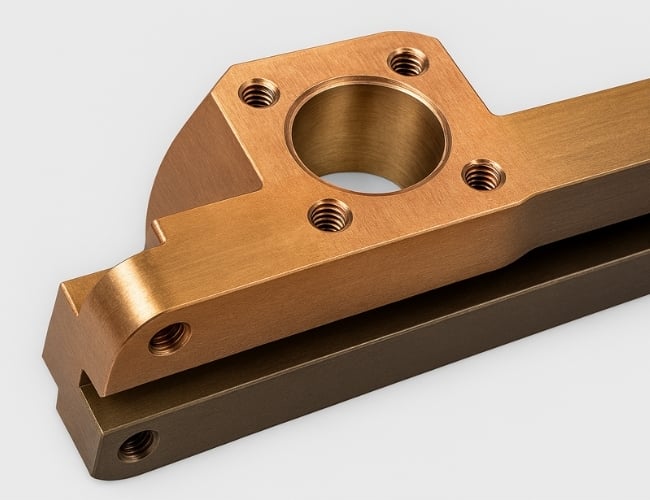
What to know about CNC machining copper?
Copper is a highly workable CNC machining material that's prized for its conductivity, but is harder to machine than similar materials (like brass or aluminum) because of its soft, ductile nature.
Updated: 8/17/26
What is copper CNC machining?
Copper CNC machining is a computer-controlled, subtractive machining process that's widely used to make conductive, corrosion-resistant parts such as busbars, heat sinks, cold plates, electrical terminals, and RF components.
The single most important point is that copper’s function and its machinability are in tension: the purer the copper for electrical or thermal performance, the more its softness and ductility make machining less forgiving.
Successful production depends on controlling chip formation, friction, and tool adhesion—not simply applying aluminum-like toolpaths.
What are the advantages of CNC machining copper?
CNC machining copper combines copper’s exceptional electrical and thermal performance with CNC’s precision and repeatability. It is especially valuable when a part must conduct current or remove heat while also meeting tight dimensional requirements.
The main advantages include:
- Excellent electrical conductivity
- Good heat transfer
- Complex geometry without dedicated tooling
- Good corrosion resistance
- Ductility and finishing flexibility
What are the challenges of CNC machining copper?
Copper is difficult to machine not because it is hard, but because it is soft, ductile, thermally conductive, and prone to sticking to the cutter.
The main challenges include:
- Built-up edge (BUE)
- Long, gummy chips
- Surface smearing and rough finish
- Work hardening
- Dimensional variation or distortion
- Rapid tool wear
What are the most common copper grades?
The most common grades for CNC machining are C101 and C110 when conductivity is the priority. C145 and C147 are often selected when better machinability is needed.
Not all copper grades machine the same way. Temper, metal purity, and material composition all impact cutting behavior, chip formation, surface temperature, dimensional stability, and what type of cutting parameters you can deploy.
| Grade | Tensile (KSI) | Yield (KSI) | Hardness | Machinability | Weldability | Corrosion Resistance |
| C101 | 43.5 | 36.3 | 40 HRB | Poor | Excellent | Excellent |
| C110 | 42.1 | 36.3 | 40 HRB | Poor | Good | Excellent |
| C145 | 47.9 | 44.2 | HRB 48 | Excellent | Good | Excellent |
| C147 | 42 | 39 | 43 HRB | Excellent | Moderate | Excellent |
| C182 | 75 | 65 | 145 HB | Moderate | Good | Good |
| C172 | 200 | 160 | 40 HRC | Moderate | Moderate | Good |
*Please note that these are all estimates and should only be used to inform research
How to pick the right copper grade?
The best all-around copper grade to machine is C145 (tellurium copper). It breaks chips more readily and machines more predictably than high-purity copper grades like C101 and C110, but still exhibits strong electrical and thermal conductivity.
Define the primary demand or limiting factor and select your copper grade appropriately.
- Maximum conductivity or purity? C101
- General electrical or thermal parts? C110
- Complex geometry or tight tolerances? C145
- Need strength and/or heat resistance? C182
What are the best surface finish options for copper?
The best surface finish for copper depends on whether you need conductivity, corrosion resistance, wear resistance, flatness, or appearance. For most electrical components, tin or nickel is the best surface finish option. For parts that need a good cosmetic finish, polishing or electropolishing is best.
Copper parts can use an as-machined finish or be finished with media blasting, electrolytic nickel plating, electroless nickel plating, tin plating, silver plating, chrome plating, grinding, lapping, or polishing.
Additionally, surface finish is heavily influenced by tool sharpness and toolpath direction. Copper reveals even subtle tool wear, and the difference between a polished, functional surface and a smeared, grain‑torn surface can be as simple as one pass too many with a tool that has begun to dull.
Important surface finish conditions:
- Surface roughness
- Smearing and tearing
- Built-up edge (BUE)
- Burrs
- Flatness and waviness
- Tool-mark direction
- Oxidation and contamination
- Coating compatibility
- Functional surface requirements
What are best practices for designing copper parts?
Designing copper parts for CNC machining means managing flexibility, chip flow, and heat—not just meeting functional geometry. Treating copper like aluminum often drives cost and tolerance problems because its softness makes long, slender, or unsupported features act like springs, leading to chatter and deflection.
Good DFM practices take toolpath strategy into account and favor rounded, accessible, and consistent geometry.
- Copper burrs can fold and stay attached at ports and intersections, so add back-chamfers or access windows to allow for burr removal
- Use larger radii and stepped depths to keep tools rigid and avoid smearing and deflection
- Clearly specify edge-break and deburr limits so contact geometry, current, and heat distribution stay controlled
- Design parts for continuous toolpaths to avoid forced low speeds and slow feeds
Frequently asked questions
Why is copper difficult to CNC machine?
Copper can be easy to cut but difficult to machine cleanly because pure grades are soft, ductile, and prone to smearing and built-up edge. Use sharp, polished, positive-rake tools, maintain adequate chip load, and provide effective lubrication or coolant.
Is pure copper harder to machine than brass?
Yes. C101 and C110 are harder to machine than brass because they are highly ductile, produce long chips, and form built-up edge. Free-machining brass and copper alloys such as C145 and C147 break chips more cleanly and are easier to machine; C101 and C110 are typically around 20% machinability.
Which copper grade is best for CNC machining?
Copper grade selection depends on function: C110 provides high electrical and thermal conductivity, C101 is used when oxygen-free copper is required, and free-machining grades such as C145 and C147 improve chip control and cycle time when some conductivity trade-off is acceptable.
What tools work best for CNC machining copper?
Sharp, polished, positive-rake carbide tools are a strong starting point for copper; two- or three-flute cutters provide chip space in milling. PCD can improve adhesion resistance and tool life in high-volume work. Choose tooling based on the operation, feature size, machine rigidity, coolant, and copper grade.
Should I use coated or uncoated carbide for copper?
For pure copper, polished uncoated carbide or diamond tooling is preferred because sharp edges and low adhesion matter most. Specialized DLC or diamond coatings may help, but standard coatings designed for steel are not automatically suitable; the coating, surface finish, and edge preparation must match copper.
What speeds and feeds should I use for copper?
Use sharp, polished uncoated carbide or diamond-based tools for pure copper because edge sharpness and low adhesion matter most. Specialized DLC or diamond coatings may help, but standard coatings designed for steel are not automatically suitable.
Why does copper produce so many burrs?
Copper’s ductility can cause burrs when material is dragged instead of sheared, especially with dull tools, unsupported exit edges, or rubbing cuts. Provide deburring access, specify only the functional edge break required, and machine delicate finished edges late in the process.
How can I reduce burrs on copper parts?
Use sharp tooling and clean shearing to reduce copper burrs. Avoid worn tools, built-up edge, and unsupported exits; use controlled deburring or edge breaks when allowed. For burr-free electrical contacts, define the allowable edge condition on the drawing.
Can copper hold tight tolerances?
CNC-machined copper can hold tight tolerances, but its softness makes it prone to clamping and measurement damage. Thin walls, unsupported surfaces, and delicate features require careful workholding, low clamping force, controlled machining, and non-distorting inspection.
How should I fixture copper parts?
Use minimal clamping force, broad support, and non-marring fixtures to hold copper without distortion or surface damage. Soft jaws, nests, sacrificial supports, and vacuum or adhesive fixtures work well for thin plates; keep clamps and datums away from functional contact surfaces.
What surface finish can CNC machining achieve in copper?
Use minimal clamping force, broad support, and non-marring fixtures to prevent copper distortion and surface damage. Soft jaws, nests, sacrificial supports, and vacuum or adhesive fixtures are useful for thin plates; keep clamps and datums away from functional surfaces.
Is C101 or C110 better for machined electrical parts?
Use minimal clamping force and broad, non-marring support to prevent copper distortion and surface damage. Soft jaws, nests, sacrificial supports, and vacuum or adhesive fixtures are useful for thin plates; keep clamps and datums away from functional surfaces.
When should I choose a free-machining copper alloy?
Choose free-machining copper alloys when production efficiency, chip control, and reduced deburring matter more than maximum conductivity. Confirm the grade still meets electrical, corrosion, joining, regulatory, and mechanical requirements; it is a trade-off, not a universal substitute for C101 or C110.