
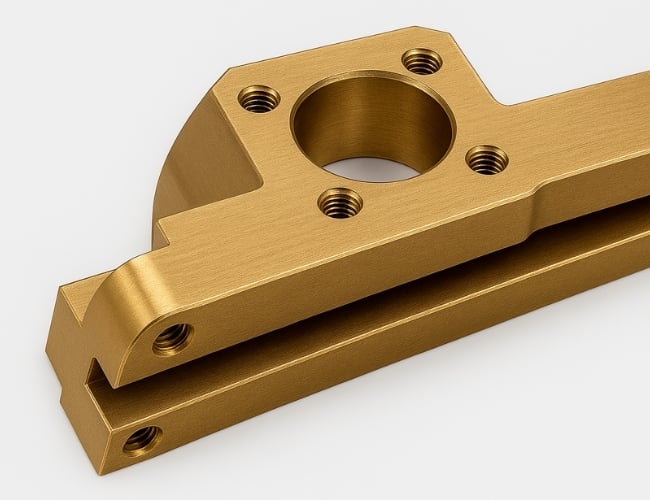
CNC Machining Bronze
This article reviews common bronze alloys for machined components and key factors like design, machinability, surface finish, and sourcing.
Bronze serves a very different purpose than aluminum or brass. Aluminum is typically chosen for low weight and general machinability, and brass for precision and clean cutting. Bronze, however, is usually specified for its tribological performance—its ability to resist wear, carry load, and deliver consistent friction behavior under boundary or marginal lubrication.
Bronze is usually selected for components that must withstand sliding contact, oscillating motion, or continuous loads where aluminum, brass, or even some steels would gall, seize, or wear out. Many bronze parts are intentionally sacrificial, protecting harder mating components while providing consistent, predictable wear over time.
Common reasons engineers select bronze include
- Excellent bearing and wear properties
- Predictable friction behavior under load
- Resistance to galling and seizure
- Ability to embed contaminants
- Good corrosion resistance in many environments
In CNC machining, bronze frequently appears in applications where consistent clearance, surface finish, and alignment directly affect system life. These are parts where dimensional stability and surface integrity matter more than raw strength.
Typical CNC-machined bronze applications include: bearings, bushings, wear plates, washers, worm gears, gear blanks, slide pads, pump components, and valve components.
Commonly Machined Grades of Bronze
The term “bronze” encompasses a wide family of copper‑based alloys, typically alloyed with tin, lead, aluminum, or silicon. In CNC machining, however, C932 (SAE 660 bearing bronze) dominates due to its balanced combination of machinability, load capacity, and wear performance.
C932 is a leaded tin bronze commonly referred to as SAE 660 bearing bronze. Its nominal composition includes copper alloyed with tin and lead, with lead content providing internal lubrication and embeddability. This alloy is predominantly used for bearing and wear applications because it offers a reliable balance between load capacity, conformability, and machinability.
|
Alloy |
Ultimate Strength |
Yield Strength |
Fatigue Strength |
Shear Strength |
Shear Modulus |
Hardness |
Elongation |
| C932 | 240-280 MPa | 125-150 MPa | 70-95 MPa | 165-185 MPa | 41-44 GPa | 65-85 HB | 8-15% |
Unlike brass, where free‑machining grades are optimized for cutting efficiency, most bronzes are optimized for tribological behavior. This means machinability varies widely, and design decisions must account for cutting forces, abrasiveness, and thermal behavior that differ significantly from aluminum or brass.
Production Considerations
Bronze is capable of holding tight tolerances, but not effortlessly. Dimensional stability depends heavily on geometry stiffness, fixturing strategy, and thermal control. Engineers should assume that bronze behaves closer to cast iron than aluminum in terms of rigidity and closer to steel in terms of cutting force.
Design
Designing parts in C932 means recognizing that this alloy is intended to wear in service, not stay visually perfect. Focus the design on functional geometry—adequate bearing area, effective lubrication grooves, and proper wall thickness—rather than on cosmetic appearance.
Most geometry failures in C932 are related to deflection and heat, not tool breakage. Thin‑walled bushings, long sleeves, or parts with interrupted cuts can distort during machining, leading to out‑of‑round conditions or taper that only appears after unclamping.
Another common trap is treating C932 like free‑machining brass and specifying fine details or cosmetic finishes that add cost without improving performance. Bronze bearing components rarely benefit from decorative features, and such requirements often conflict with machining stability.
Common C932 geometry traps to avoid:
- Thin walls on long bearing sleeves
- Deep internal grooves without adequate support
- Sharp internal corners at load‑bearing transitions
- Overly fine threads in wear‑critical regions
- Cosmetic requirements on functional wear surfaces
DFM Best Practices for Bronze Components
Because many bronzes are tougher on tools than brass, design to limit nonfunctional finishing passes and avoid long, constant‑contact contouring on large surfaces
For tight positional control, place critical datums on stiff sections and keep them away from heavy stock removal so stress does not shift your stack‑up
For critical bores, provide lead‑in and straight length so they can be reamed or honed, and avoid hiding them at the bottom of deep pockets
Avoid wide areas that require ultra‑light finishing passes; design for consistent stock so final cuts have a meaningful chip load and good surface integrity
Because bronze parts often slide or rotate, call out edge breaks with max/min chamfer or radius so deburring does not change function
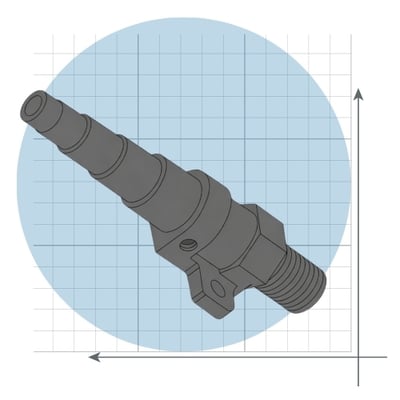
Machinability
Bronze machinability varies more widely than aluminum or brass. Even within bearing bronzes, cutting behavior depends on lead content, tin percentage, and casting quality. In general, bronzes exhibit higher cutting forces, greater tool wear, and more heat generation than brass, but far less built‑up edge than aluminum.
C932 is one of the easiest bronzes to machine. Its lead content helps break chips and lowers tool friction, making it significantly more machinable than aluminum bronzes or high‑tin bronzes. That said, it still behaves very differently from brass: cutting forces are higher, tools experience more abrasion, and achieving a good surface finish depends heavily on setup rigidity and sharp tooling.
Key machining characteristics engineers should account for:
- Higher cutting forces than brass or aluminum
- Moderate to high tool wear
- Chip behavior varies by alloy
- Heat management affects dimensional stability
- Thin features are especially sensitive to deflection
Surface Finish
Finishing Options: machined finish, media blasting, hand polish, electroplating, powder coating, bead blasting, electropolishing, and various chemical treatments
Surface finish requirements should be driven by functional performance, particularly in wear applications. Over‑specifying surface finish can degrade performance rather than improve it.
C932 is typically used in the as‑machined condition, where surface finish directly influences wear behavior and lubricant retention. Unlike aluminum, secondary coatings are uncommon and often unnecessary. Surface texture should be specified with function in mind—too smooth can be as problematic as too rough in bearing applications.
Polishing is sometimes used for specific tribological requirements, but aggressive finishing can smear lead phases and alter surface behavior. Engineers should be cautious about applying generic finishing specifications without understanding how they affect wear performance.
Important surface finish considerations:
- Tight tolerances increase cost significantly
- Thin or long parts are prone to distortion
- Surface finish affects wear and lubrication
- As‑machined finishes are often preferred
- Inspection strategy should match functional risk
Tolerance schemes should reflect the fact that many bronze components are part of clearance‑critical systems, not interference‑fit assemblies. Designing for predictable clearance under operating conditions matters more than achieving nominal dimensions on the bench
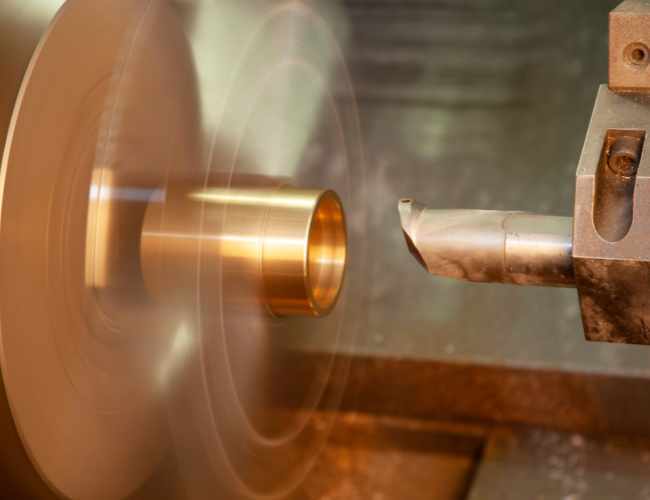
Sourcing
Bronze costs more and machines slower than aluminum and most brasses, but its durability often lowers maintenance and extends service life enough to justify the higher price.
Bronze lead time depends on stock form and size: common C932 bar and tube are readily available, while large or specialty sizes take longer. Designing around standard sizes and limiting machining helps cut cost and lead time.
Primary cost drivers include:
- Bronze alloy selection and copper market volatility
- Machining complexity and tolerances
- Scrap risk and material yield
- Order volume and setup economics
- Secondary operations and compliance requirements