
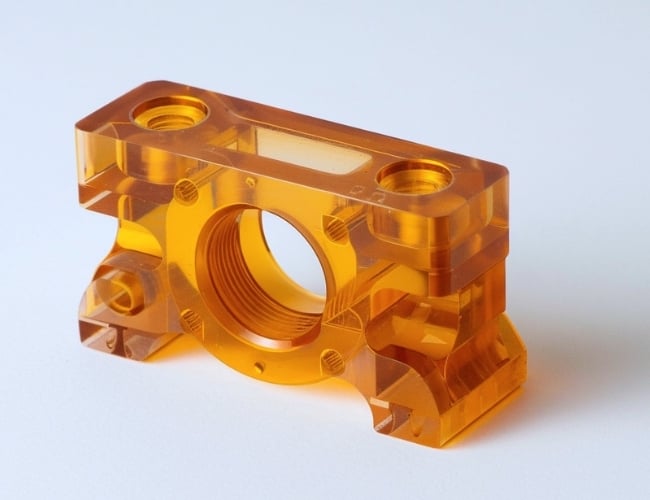
What is Ultem?
Ultem (PEI) is a high-performance thermoplastic with excellent heat resistance, strength, dimensional stability, and flame retardancy. It is machined for aerospace, medical, semiconductor, electrical, and industrial components that require tight tolerances and reliable performance in demanding environments.
Ultem is a lightweight metal alternative that provides high stiffness, electrical insulation, and strong thermal performance.
Updated: 9/4/26
What are the key properties of Ultem?
Ultem is valued in CNC machining applications for its combination of mechanical strength, thermal resistance, and dimensional stability. Key characteristics include:
- Excellent heat resistance
- High strength and stiffness
- Outstanding dimensional stability
- Good machinability
- Excellent electrical insulation
- Inherent flame resistance
- Good chemical resistance
- Low smoke generation
- High creep resistance
- Lightweight compared to metals
Because Ultem is an amorphous thermoplastic, it exhibits predictable dimensional behavior and tight tolerance capability during machining.
Chemical Properties and Composition of Ultem
Ultem is a polyetherimide polymer consisting primarily of:
- Aromatic imide groups that provide thermal stability
- Ether linkages that improve processability and toughness
- High-performance engineering polymer chains that contribute to strength and chemical resistance
The molecular structure allows Ultem to maintain mechanical properties at temperatures where many engineering plastics begin to soften or deform.
Chemical Composition of Ultem
| Component | Chemical Structure |
| Aromatic Phenylene Group |
C₆H₄
|
| Ether Linkage |
–O–
|
| Imide Group |
–CO–N–CO–
|
| Polyetherimide Repeat Unit |
[(C₆H₄)–O–(C₆H₄)–N(CO)₂–]ₙ
|
What are the advantages of Ultem?
Excellent Heat Resistance
Ultem maintains strength and dimensional stability at temperatures significantly higher than ABS, acetal, or nylon. It is well suited for applications exposed to continuous thermal cycling.
High Strength and Stiffness
The material provides excellent mechanical performance while remaining substantially lighter than metal alternatives.
Outstanding Dimensional Stability
Ultem exhibits low thermal expansion and low moisture absorption, helping maintain tight tolerances in precision components.
Inherent Flame Resistance
Unlike many plastics that require additives, Ultem naturally exhibits flame-retardant characteristics and low smoke generation.
Excellent Electrical Performance
Ultem offers high dielectric strength and reliable electrical insulation across a wide temperature range, making it popular for electrical and electronic applications.
Broad Chemical Resistance
The material resists many automotive fluids, cleaning agents, fuels, and industrial chemicals.
Sterilization Compatibility
Many grades withstand repeated steam, radiation, and chemical sterilization processes, making them suitable for medical and laboratory equipment.
What are the disadvantages of Ultem?
Higher Material Cost
Ultem is significantly more expensive than commodity engineering plastics such as ABS, HDPE, or polycarbonate.
More Demanding to Machine
Its hardness and elevated-temperature performance require careful tool selection and machining parameters to maintain surface quality.
Lower Impact Resistance Than Some Alternatives
While strong and stiff, Ultem may not match the impact toughness of polycarbonate in highly abusive environments.
Susceptibility to Stress Cracking
Improper machining practices, excessive clamping forces, or incompatible chemicals can contribute to stress cracking.
Limited Wear Performance
For high-friction wear applications, materials such as PEEK or filled bearing-grade plastics may provide superior performance.
What are the types of Ultem?
Several grades are available to address specific performance requirements.
- Ultem 1000: Unfilled general-purpose PEI offering a balance of strength, thermal resistance, and machinability.
- Ultem 2100: 10% glass-filled grade providing increased stiffness and dimensional stability.
- Ultem 2200: 20% glass-filled grade for improved strength and rigidity.
- Ultem 2300: 30% glass-filled grade for maximum stiffness and reduced thermal expansion.
- Medical Grades: Designed for sterilization and healthcare applications.
- ESD Grades: Formulated for semiconductor and electronics manufacturing environments.
- Flame-Retardant Grades: Used in aerospace, transportation, and electrical systems requiring fire-performance compliance.
What to know about CNC machining Ultem?
Tooling
Use sharp, rigid tooling designed for engineering plastics:
- Use polished carbide end mills with positive rake geometry
- Use sharp drills designed for plastics
- Minimize tool wear by maintaining proper chip load
- Use rigid fixturing to prevent vibration
- Avoid dull cutting edges that generate excessive heat
The objective is to shear material efficiently while minimizing thermal buildup and residual stress.
Feeds, Speeds, and Chips
There is no single correct machining parameter because results depend on tooling, machine rigidity, geometry, and finish requirements. Monitor chip formation closely:
- Produce consistent chips rather than dust
- Avoid excessive spindle speeds that generate heat
- Maintain adequate feed rates
- Prevent chip recutting
- Use conservative finishing passes for high-precision component
Cooling and Chip Evacuation
- Use compressed air for chip removal and cooling
- Verify coolant compatibility before use
- Minimize heat buildup during prolonged machining cycles
- Maintain clean cutting zones to avoid recutting chips
Workholding
Ultem can develop stress if clamped improperly:
- Use evenly distributed clamping pressure
- Avoid overtightening workholding devices
- Support thin sections during machining
- Leave finishing stock when tolerance requirements are critical
- Allow components to stabilize before final finishing operations
What are design considerations for Ultem?
When designing machined Ultem components, consider both performance and manufacturability.
Avoid Extremely Thin Walls
Thin features may become difficult to machine accurately and can increase machining costs.
Maintain Generous Internal Radii
Larger radii improve cutter access, reduce stress concentration, and increase component durability.
Account for Thermal Expansion
Although more stable than many plastics, thermal expansion should still be evaluated in precision assemblies.
Consider Thread Strength
For high-load or repeatedly assembled joints, threaded inserts often provide greater reliability than machined plastic threads.
Design for Heat Exposure
Ultem excels in elevated-temperature environments, but operating temperatures should still be evaluated against material specifications.
Evaluate Environmental Requirements
Consider:
- Operating temperature
- Chemical exposure
- Mechanical loads
- Electrical requirements
- Flame-resistance requirements
- Dimensional stability requirements
For applications requiring extreme wear resistance or the highest thermal performance, materials such as PEEK, Torlon®, or specialty composites may also be considered
How can Ultem be modified?
Ultem is frequently modified to enhance performance for specialized applications. Common modifications include:
- Glass fiber reinforcement for increased stiffness
- Carbon fiber reinforcement for improved strength-to-weight ratio
- ESD-safe fillers for electronics manufacturing
- Conductive additives
- Custom pigmentation
- Wear-resistant compounds
- Aerospace-qualified formulations
Material modifications often improve specific properties while potentially affecting machinability, toughness, dimensional stability, or cost.
Frequently asked questions about Ultem
What are the most common applications for Ultem machined components?
Machined Ultem components are typically chosen where a part must retain dimensional stability and strength at elevated temperature while also providing flame resistance, electrical insulation, chemical resistance, or repeated-sterilization capability. This includes brackets, housings, insulators, electrical connector components, sensor housings, circuit-board supports, surgical trays, diagnostic-equipment housings, lab fixtures, fluidic manifolds, sterilization hardware, pumps, valve parts, manifolds, bearings, and sliders.
How does glass-filled Ultem 2300 differ from unfilled Ultem 1000 in machining?
Unfilled Ultem® 1000 is easier to machine and finish, while glass-filled Ultem® 2300 behaves more like an abrasive composite. Ultem 2300 offers greater rigidity and thermal dimensional stability, but it wears tools faster and is more prone to edge chipping. Ultem 2300 is a 30% glass-fiber-reinforced PEI grade.
How does Ultem compare to PEEK in high-temperature component applications?
For the highest-temperature applications, PEEK typically offers better performance, retaining mechanical strength at higher continuous temperatures and providing broader chemical resistance. Ultem®/PEI is often a more economical and easier-to-machine option for high-heat electrical, aerospace, medical, and industrial parts that operate within its long-term temperature limit.
What type of surface finishes and post-machining operations can Ultem components take?
For the highest-temperature applications, PEEK typically offers better performance, retaining mechanical strength at higher continuous temperatures and providing broader chemical resistance. Ultem®/PEI is often a more economical and easier-to-machine option for high-heat electrical, aerospace, medical, and industrial parts that operate within its long-term temperature limit.
How does annealing prevent stress cracking in machined Ultem parts?
Annealing reduces the risk of stress cracking in machined Ultem®/PEI by relieving residual tensile stress before it combines with service loads, press fits, solvents, cleaners, or heat. It will not repair existing cracks or make PEI chemically resistant, but it removes a major factor that can make the part vulnerable.
What types of coolants and cutting fluids are safe for Ultem machining?
For Ultem®/PEI, dry machining with clean compressed air is usually the safest option. If liquid cooling is needed for deep drilling, boring, tapping, or high-heat milling, use only a verified PEI-compatible, water-soluble, non-aromatic coolant. Avoid petroleum-rich, aromatic, chlorinated, or unknown fluids, which can cause delayed crazing or environmental stress cracking.