
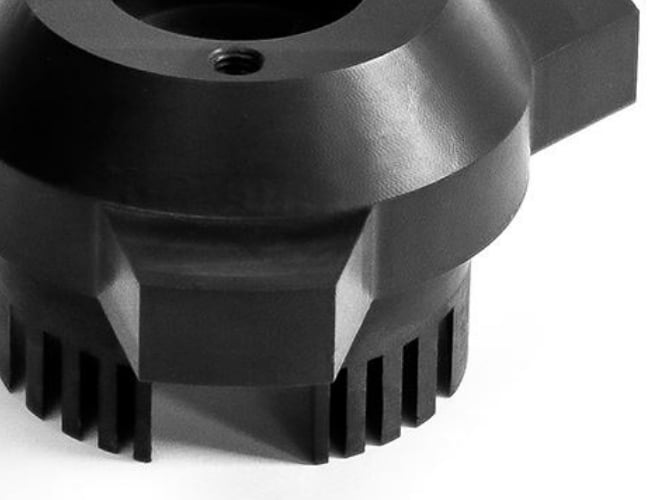
What is UHMW?
UHMW is a durable engineering thermoplastic with excellent abrasion and impact resistance, low friction, and chemical resistance. It is commonly machined into wear strips, guides, liners, bushings, and conveyor components.
UHMW machines easily with standard CNC equipment and provides durable, wear-resistant performance without metal’s weight or corrosion.
Updated: 8/31/26
What are the key properties of UHMW?
UHMW is widely used in CNC machining applications because of its outstanding wear characteristics and toughness. Key characteristics include:
- Exceptional abrasion resistance
- Extremely low coefficient of friction
- High impact resistance
- Excellent chemical resistance
- Lightweight
- Good electrical insulation
- Low moisture absorption
- Self-lubricating surface
- FDA-compliant grades available
- Excellent noise and vibration dampening
Because UHMW is a semi-crystalline thermoplastic with an extremely high molecular weight, it exhibits excellent toughness and wear performance. However, it is more flexible and less dimensionally stable than many engineering plastics.
Chemical Properties and Composition of UHMW
UHMW is a polyethylene material consisting of very long molecular chains that provide superior impact strength and wear resistance compared to standard HDPE. Its extremely high molecular weight allows the polymer chains to effectively transfer loads and resist surface wear, making it one of the most durable thermoplastics available.
Chemical Composition of UHMW
| Component | Chemical Structure |
| Ethylene Monomer |
CH₂=CH₂
|
| Polyethylene Repeat Unit |
(C₂H₄)n
|
What are the advantages of UHMW?
Exceptional Wear Resistance
UHMW offers some of the highest abrasion resistance available among engineering plastics. It significantly outperforms many metals and plastics in sliding and wear applications.
Extremely Low Friction
The naturally lubricious surface minimizes friction between moving components and helps reduce energy consumption and wear.
Outstanding Impact Strength
UHMW maintains excellent toughness even at low temperatures and can withstand repeated impacts without cracking or fracture.
Excellent Chemical Resistance
The material is resistant to a broad range of acids, alkalis, cleaning chemicals, and industrial fluids.
Lightweight Alternative to Metal
UHMW weighs substantially less than steel, aluminum, or bronze while providing excellent wear performance.
Self-Lubricating Performance
Many applications require no external lubrication, reducing maintenance requirements and contamination concerns.
What are the disadvantages of UHMW?
Lower Stiffness
UHMW is significantly less rigid than acetal, nylon, polycarbonate, or metal materials.
Thermal Expansion
The material exhibits relatively high thermal expansion and contraction, which can affect tight-tolerance assemblies.
Limited Temperature Resistance
UHMW is generally not recommended for continuous service above approximately 180°F (82°C).
Difficult Bonding
The low surface energy of UHMW makes adhesives, coatings, and painting challenging without specialized surface treatment.
Dimensional Stability Challenges
Internal stress relief, thermal movement, and material flexibility can affect precision tolerances, especially on large components.
What are the types of UHMW?
Several UHMW grades are available to meet specific performance requirements.
- Virgin UHMW: Standard wear-resistant material for industrial applications
- Reprocessed UHMW: Economical option containing recycled material
- FDA-Compliant UHMW: Suitable for food processing and handling equipment
- Static-Dissipative UHMW: Controls electrostatic discharge in sensitive environments
- Conductive UHMW: Enhanced electrical conductivity for specialized applications
- Glass-Filled UHMW: Improved dimensional stability and stiffness
- Oil-Filled UHMW: Reduced friction and improved wear characteristics
- Antimicrobial UHMW: Used in medical and sanitary environments
- UV-Stabilized UHMW: Designed for outdoor exposure
What to know about CNC machining UHMW?
Tooling
Use sharp tooling specifically suited for plastics:
- Use polished carbide cutters with generous rake angles
- Select O-flute or high-helix end mills for improved chip evacuation
- Use sharp drills to prevent material smearing
- Maintain sharp cutting edges to reduce heat generation
- Use rigid tooling setups to minimize part movement
The objective is to shear the material cleanly rather than deform it. Sharp tools are critical because UHMW tends to deflect and push away from dull cutting edges.
Feeds, Speeds, and Chips
There is no universal RPM or feed rate for UHMW because results vary by machine rigidity, tool geometry, stock dimensions, and finish requirements. Monitor chip formation as the primary indicator:
- Maintain adequate chip load
- Use moderate spindle speeds to limit heat buildup
- Avoid rubbing instead of cutting
- Ensure efficient chip evacuation
- Use consistent finishing passes
Because UHMW is soft and ductile, excessive heat can cause localized melting or dimensional variation.
Cooling and Chip Evacuation
Compressed air is commonly used for cooling and chip removal.
- Remove chips continuously from pockets and slots
- Minimize heat accumulation
- Verify coolant compatibility before use
- Avoid excessive heat during long tool engagements
Workholding
UHMW can deform easily during machining:
- Use broad support surfaces
- Avoid excessive clamping pressure
- Support thin walls and large flat sections
- Consider vacuum workholding where appropriate
- Allow parts to relax before final finishing operations
Large parts may require rough machining followed by stabilization before final machining.
What are design considerations for UHMW?
When designing machined UHMW components, both material behavior and manufacturing requirements should be considered.
Avoid Tight Tolerances
UHMW's high thermal expansion and flexibility can make extremely tight tolerances difficult to maintain.
Maintain Adequate Wall Thickness
Thin sections may flex during machining and operation.
Account for Thermal Expansion
Temperature changes can produce noticeable dimensional changes in larger components.
Consider Wear Benefits
UHMW performs exceptionally well in sliding and abrasion applications where wear life is more important than structural rigidity.
Limit High Structural Loads
The material excels in wear applications but is not ideal for highly loaded structural components due to its relatively low stiffness.
Evaluate Operating Environment
Consider:
- Continuous operating temperature
- Exposure to chemicals
- UV exposure
- Abrasion requirements
- Load conditions
- Tolerance requirements
For applications requiring greater stiffness, improved temperature capability, or tighter dimensional stability, materials such as acetal (POM), nylon, PET, polycarbonate, or PEEK may be more suitable.
How can UHMW be modified?
UHMW is frequently modified to enhance specific performance characteristics. Common modifications include:
- Glass fiber reinforcement for increased stiffness
- Oil-filled additives for reduced friction
- UV stabilizers for outdoor applications
- Conductive fillers for ESD protection
- Antimicrobial additives
- Color compounds for identification and branding
- Mineral fillers for improved dimensional stability
Material modifications often improve wear resistance, conductivity, or stiffness while potentially affecting machinability, impact strength, or cost.
Frequently asked questions about UHMW
How does UHMW(PE) compare to HPDE?
UHMWPE and HDPE share low density, chemical resistance, and minimal moisture absorption. UHMWPE’s longer molecular chains provide greater toughness, wear resistance, and lower friction. HDPE is stiffer, less costly, easier to fabricate, and better suited to general structural and chemical-containment applications.
Why is UHMW self-lubricating?
UHM is considered self-lubricating because its naturally low-friction, wax-like surface slides easily and resists sticking to other materials. It does not produce oil or grease, but many parts can operate without added lubricant.
What are the limitations of UHMW in engineering?
UHMW has limited stiffness and temperature capability, can creep under load, expand significantly with heat, and is difficult to bond. It works well for abrasion-resistant, impact-resistant, low-friction liners and guides, but is less suitable for precision, heavily loaded, hot, or rigid machine components.
How does UHMW creep rate change at elevated temperatures?
UHMW creeps faster as temperature rises, even under the same load. As temperatures approach 60–80 °C, a load that is safe at room temperature may cause permanent deformation.