
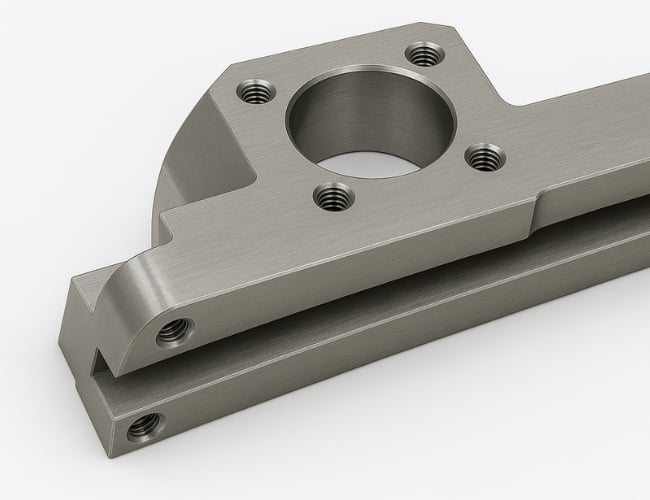
What to know about CNC machining titanium?
Titanium is widely used in CNC machining for applications that demand an exceptional strength-to-weight ratio, corrosion resistance, heat resistance, and long-term durability.
Updated: 9/10/26
What is titanium CNC machining?
Titanium CNC machining is the computer-controlled removal of material from a titanium workpiece to make a precise finished part.
It is often used for complex, high-performance parts when titanium’s strength-to-weight ratio, corrosion resistance, and durability justify its higher material and machining costs—especially in aerospace, medical, and other demanding industries.
Titanium machining requires careful control of heat, tool wear, vibration, coolant, and chip removal. Because titanium conducts heat poorly, much of the heat generated during cutting stays near the cutting tool instead of moving through the workpiece. This can shorten tool life and affect the part’s surface finish and dimensional accuracy.
What are the advantages of CNC machining titanium?
CNC machining titanium combines the material’s high-performance properties with the precision and geometric freedom of computer-controlled manufacturing. It is especially valuable when a part must be light, strong, corrosion-resistant, and made to tight tolerances.
The main advantages include:
- High strength at low weight
- Corrosion resistance
- High-temperature capability
- Biocompatibility, ideal for medical
- Durability and fatigue performance
What are the challenges of CNC machining titanium?
Titanium is challenging to machine because it holds heat near the cutting edge, can react with cutting tools, and must be processed within a narrow range of carefully controlled conditions. Compared with easier-to-machine metals such as aluminum, this can slow production, shorten tool life, and increase the risk of surface defects, dimensional variation, and other quality issues.
The main challenges include:
- Rapid tool wear and galling from heat buildup
- Work hardening
- Vibration and chatter
- Difficult chip control
What are the most common titanium grades?
The most widely used titanium alloy for CNC machined parts is Grade 2 and Grade 5. Any of the commercially pure 1-4 grades are commonly selected, as are several alloys --- especially Grade 5 (Ti-6Al-4V).
Each alloy varies in strength, ductility, fatigue behavior, thermal response, and machinability. Geometry selection, wall thickness limits, tolerance strategy, surface finish requirements, and inspection requirements should be selected based on the specific alloy chosen.
| Grade | Tensile (KSI) | Yield (KSI) | Hardness | Machinability | Weldability | Corrosion Resistance |
| Grade 1 | 48 | 40 | 120 HB | Excellent | Excellent | Excellent |
| Grade 2 | 63 | 50 | 160 HB | Good | Excellent | Excellent |
| Grade 3 | 79 | 65 | 200 HB | Good | Good | Excellent |
| Grade 4 | 95 | 80 | 265 HB | Moderate | Good | Excellent |
| Grade 5 | 138 | 128 | 34 HRC | Moderate | Moderate | Good |
| Grade 9 | 95 | 80 | 30 HRC | Good | Good | Good |
| Grade 12 | 80 | 60 | 220 HB | Good | Excellent | Excellent |
| Grade 23 | 125 | 115 | 32 HRC | Moderate | Moderate | Excellent |
*Please note that these are estimates and intended to be used as a reference
How to pick the right titanium grade?
Grade 2 is the default option for titanium components, followed quickly by Grade 5. Like any alloy selection, the right titanium grade will depend on the component's end-use application and environment.
Quick selection guide:
- Need corrosion resistance or weldability? Grade 2
- Need good strength-to-weight ratio? Grade 5
- Need biocompatibility? Grade 23
What are the best surface finish options for titanium?
For most general titanium CNC parts, a fine machined or bead-blasted finish is the best surface finish option since titanium naturally develops a protective oxide film. There is no single best finish for titanium. The best surface finish option will depend on whether ear resistance, low roughness, medical performance, or cosmetics is the priority.
Titanium parts can be finished with media blasting, vibratory tumbling, passivation, powder coating, electroplating, or anodizing. For parts with sliding or fretting surfaces, Type II anodizing is the best functional post-process.
Important surface finish considerations:
- Tight tolerances amplify tool wear and inspection burden
- Thin features are prone to spring‑back after machining
- Surface finish degrades rapidly with worn tooling
- Secondary processes can alter critical dimensions
- Datum strategy strongly influences achievable repeatability
What are the best practices for designing titanium parts?
Designing titanium parts starts with machining stability. Titanium's high strength can tempt aggressive wall thinning and tall, narrow features, but its low modulus and poor thermal conductivity make those design features hard to machine.
DFM best practices for designing titanium components include:
- Prioritize stiff, thermally friendly geometry
- Avoid features that require long tool engagement, tiny cutters, and repeated spring passes
- Keep section thickness as consistent as possible
- Employ ribs instead of tall, thin free-standing walls
- Design for continuous toolpaths and avoid small islands/slots
Frequently asked questions
Why is titanium difficult to CNC machine?
CNC-machined copper can hold tight tolerances, but its softness makes it prone to clamping and inspection damage. Thin walls, unsupported surfaces, and delicate features require careful workholding, low clamping force, staged machining, and non-distorting inspection.
Is titanium harder to machine than stainless steel?
Titanium is harder to machine than common stainless steel because it concentrates heat at the cutting edge, wears tools quickly, and can gall or work-harden. Actual difficulty depends on the grade, condition, operation, equipment, and geometry, so machining requires tight control of heat, engagement, and coolant.
Which titanium grades are most common in CNC machining?
Titanium machining commonly uses Grade 2 and Grade 5 (Ti-6Al-4V). Grade 2 offers corrosion resistance, ductility, biocompatibility, and moderate strength. Grade 5 provides much higher strength for demanding structural applications but requires more conservative machining.
What is the difference between Grade 2 and Grade 5 titanium?
Grade 2 is commercially pure titanium suited to corrosion resistance, ductility, biocompatibility, and formed parts. Grade 5 is an aluminum-vanadium alloy with much higher strength for load-bearing parts, but it requires more controlled heat management and costs more to machine.
What cutting tools work best for titanium?
Use fine-grain carbide tools with sharp edges and positive rake to reduce heat, rubbing, and work hardening in titanium. TiAlN or AlTiN coatings may help at high temperatures, but tool rigidity and coolant strategy must also match the operation; short, secure setups reduce vibration and edge chipping.
What speeds and feeds should I use for titanium?
For carbide machining of Ti-6Al-4V, use conservative, validated parameters tailored to the alloy, operation, tooling, engagement, coolant, rigidity, and workholding. Keep chip load high enough to cut rather than rub, start at the lower end of the validated range, and adjust based on tool wear, load, vibration, chips, and dimensional results.
Why are my tools wearing out quickly in titanium?
Titanium tool wear is driven by excessive heat, rubbing, poor chip evacuation, and unstable setups. Use lower RPM, sufficient chip load, continuous cutting, high-pressure coolant, and rigid tooling and workholding to reduce thermal and vibration damage.
Does titanium work-harden during machining?
Titanium can work-harden when rubbing, dwell, excessive heat, or repeated shallow passes create a hardened surface. Keep the cutter engaged with sufficient chip load, avoid pausing, and replace worn tools before they burnish the part.
Why does titanium chatter during milling or turning?
Titanium chatter usually comes from insufficient system rigidity combined with high cutting forces. Reduce overhang and stickout, use large rigid tooling and strong support, select a stable spindle speed, and avoid abrupt engagement changes. High-efficiency or trochoidal milling can also reduce peak forces.
Is high-pressure coolant required for titanium?
High-pressure or through-tool coolant is preferred for titanium cuts that confine heat and chips, including deep drilling, slotting, rough milling, boring, and grooving. It cools the tool, flushes chips, and reduces recutting; required pressure depends on the tool, feature, coolant system, and process.
How can I prevent galling in titanium?
Prevent titanium galling by reducing friction and adhesion: use sharp positive-rake tools, adequate feed, and effective lubrication or high-pressure coolant. For threads, use titanium-specific tools and compounds, avoid chip recutting, and consider thread milling. Mating titanium parts may also need compatible coatings, lubricants, or dissimilar materials.
Can titanium parts hold tight tolerances?
Titanium chatter is mainly a rigidity problem amplified by high cutting forces. Reduce overhang, stickout, and unsupported spans; use rigid tooling, strong support, stable spindle speed, and smooth engagement. High-efficiency or trochoidal milling can reduce peak forces.
What surface finish can CNC machining achieve in titanium?
Titanium can be machined to tight tolerances, but the process must control deflection, heat, residual stress, thin-wall distortion, springback, and tool wear. Complex or flexible features may require staged roughing, semi-finishing, controlled finishing, and dedicated inspection. ±0.001 in. may be achievable in suitable Grade 5 geometries, but capability depends on the part.
Why is CNC-machined titanium expensive?
Titanium requires high-pressure or through-tool coolant for many heat- and chip-intensive operations, such as deep drilling, slotting, rough milling, boring, and grooving. It cools the cutting zone, flushes chips, and reduces recutting; the required pressure depends on the tool, feature, coolant system, and process.