
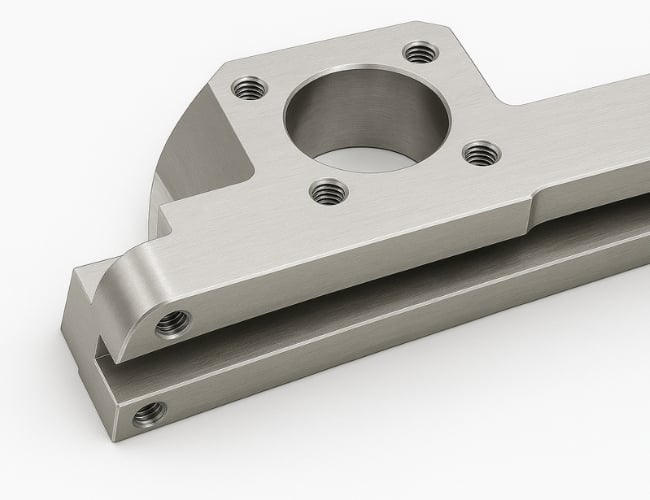
What to know about CNC machining stainless steel?
Stainless steel is a popular choice for CNC machined components because it balances corrosion resistance, mechanical strength, durability, and manufacturability at scale.
Updated: 8/17/26
What is stainless steel CNC machining?
Stainless steel CNC machining is the computer-controlled cutting, drilling, milling, turning, and finishing of stainless-steel stock into precise custom parts.
Stainless steel is a strong choice for parts that need corrosion resistance, durability, heat resistance, or a clean, hygienic surface. Its chromium content—typically at least 10%—forms a protective layer that helps prevent corrosion.
Common applications include medical instruments, marine fittings, chemical-processing components, industrial machinery, aerospace hardware, valves, and precision fasteners.
What are the advantages of CNC machining stainless steel?
There are several advantages to working with stainless steel for machined components. Namely, this family of alloys exhibits great durability and corrosion-resistant properties. Stainless steels are highly repeatable, even for components with complex geometries and tightly toleranced features.
The main advantages include:
- High strength and durability
- Corrosion resistance
- Repeatable quality
- Complex geometry
- Can achieve great surface finish
Successful machining with stainless steel requires sharp carbide tooling, rigid workholdings, generous use of coolant, chip-breaking tool geometry, and efficient speeds and feeds.
What are the challenges of CNC machining stainless steel?
Stainless steel is generally more difficult to machine than softer metals because it is tough, generates heat, and can work-harden—becoming harder if cutting conditions cause rubbing rather than clean chip removal.
The main challenges include:
- Work hardening
- Rapid tool wear
- Heat buildup near the tool edge and workpiece
- Stringy chip formation
- Longer cycle times
Engineers can mitigate many of these challenges with machining-friendly part geometry. Thin walls, deep pockets, unnecessarily tight tolerances, and features that require long-reach tools inadvertently increase both machining cost and chances for scrap.
What are the most common stainless steel grades?
The most commonly used stainless steel grades for machined components are 304 and 316, both from the austenitic family. Other frequently used grades include 303, 430, 410, 420, 17-4 PH, and 15-5 PH.
Stainless steel contains at least 10.5% chromium, which gives it corrosion resistance. Its grades fall into four main families: austenitic (such as 303, 304, and 316), martensitic (410, 416, 420, and 440C), precipitation-hardening (17-4 PH and 15-5 PH), and duplex (2205). Each family offers a different balance of strength, machinability, and corrosion resistance, so the best choice depends on your part’s environment and load.
| Grade | Type | Tensile (KSI) | Yield (KSI) | Hardness | Magnetic | Corrosion Resistance |
| 303 | Austenitic | 90 | 35 | 96 HRB | ❌ |
Moderate |
| 304 | Austenitic | 75 | 30 | 92 HRB | ❌ | Excellent |
| 304L | Austenitic | 70 | 25 | 88 HRB | ❌ | Excellent |
| 316 | Austenitic | 80 | 30 | 95 HRB | ❌ | Good |
| 316L | Austenitic | 75 | 25 | 90 HRB | ❌ | Good |
| 321 | Austenitic | 75 | 30 | 88 HRB | ❌ | Excellent |
| 347 | Austenitic | 75 | 30 | 88 HRB | ❌ | Excellent |
| 410 | Martensitic | 65 | 30 | 82 HRB | ✅ | Moderate |
| 416 | Martensitic | 75 | 40 | 96 HRB | ✅ | Moderate |
| 420 | Martensitic | 95 | 50 | 50 HRC | ✅ | Moderate |
| 440C | Martensitic | 110 | 65 | 58 HRC | ✅ | Moderate |
| 17-4 PH | Precipitation Hardening | 190 | 170 | 44 HRC | ✅ | Excellent |
| 15-5 PH | Precipitation Hardening | 190 | 170 | 44 HRC | ✅ | Excellent |
*Please note that this chart is meant to be used only as a reference
How to pick the right stainless steel grade?
The "right" grade for a machined component depends on end-use application, primary requirement, budget, and part complexity. This is especially true with stainless steels, given the large number of and variation between the different grades.
Quick decision guide:
- Need general corrosion resistance? 304
- Need chemical resistance? 316 or 316L
- Need machinability? 303
- Need affordable but no corrosion resistance? 430
- Need increased hardness or strength? 410, 420, or 17-4 PH
What are the best surface finish options for stainless steel?
For most stainless steel parts, the best surface finish is deburring plus passivation to remove sharp edges and improve corrosion resistance. That being said, there is no single "best" finish for every stainless steel machined component.
Stainless steel parts can take black oxide, electropolishing, ENP, media blasting, passivation, powder coating, tumbling, nickel plating, and zinc plating as surface finish options. Add polishing operations when you need a smoother, cosmetic, or easy-to-clean surface. Apply coats or plating if you need to improve wear resistance.
Important surface finish considerations include:
- Specify finish where it affects sealing, wear, fatigue, or cleanliness
- Define pre‑ vs post‑process inspection requirements when passivation/heat treat/finishing is involved
What are best practices for designing stainless steel parts?
Designing stainless steel parts for CNC machining is largely about avoiding unstable cutting conditions. Many “material problems” are actually geometry issues that force long tools, small diameters, repeated re‑entry, and light finishing passes. These amplify stainless sensitivities: work hardening (especially austenitics), tool wear variation, and heat buildup.
Effective DFM starts with one rule: design features so they can be machined with short, rigid tools and continuous engagement wherever possible.
Best practices for designing stainless steel parts include:
- Leave enough finishing stock to cut below the hardened layer and reduce tool wear and smearing
- Increase radii and/or provide reliefs so finishing cutters are not forced into overload
- Design surfaces to separate rough/finish zones
- For flow paths and sealing interfaces, design explicit chamfers/edge breaks and give deburr tool access (especially at cross-holes)
- Use open pockets, ramp entries, and reliefs to minimize heat spikes and load