
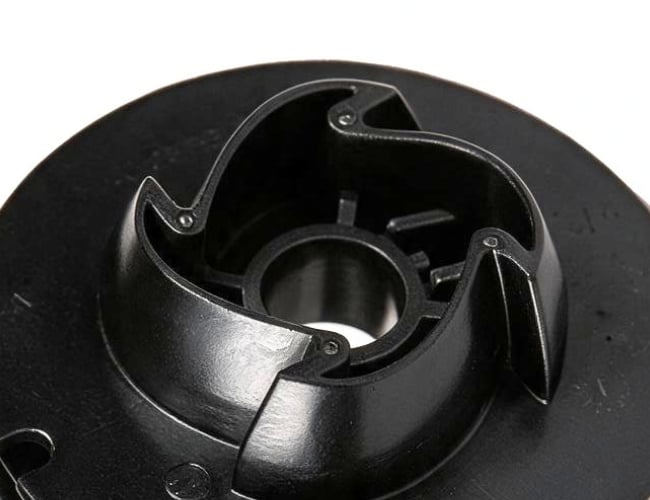
What is PVDF?
PVDF is a high-purity engineering thermoplastic that offers outstanding chemical resistance, abrasion resistance, flame resistance, and UV stability.
Updated: 8/31/26
What are the key properties of PVDF?
PVDF is valued in CNC machining applications for its excellent chemical resistance and long-term durability. Key characteristics include:
- Outstanding chemical resistance
- High purity and low extractables
- Excellent UV resistance
- Good mechanical strength and stiffness
- Low moisture absorption
- Good wear resistance
- Excellent weatherability
- Good dimensional stability
- High dielectric strength
- Continuous service temperatures up to approximately 300°F (150°C)
Because PVDF is a semi-crystalline thermoplastic, it exhibits excellent resistance to chemicals and environmental stress cracking while maintaining mechanical integrity in demanding industrial environments.
Chemical Properties and Composition of PVDF
PVDF is a fluoropolymer produced through the polymerization of vinylidene fluoride monomers. The high fluorine content provides exceptional resistance to chemicals, solvents, weathering, and UV degradation while maintaining relatively easy processability compared to other fluoropolymers.
Chemical Composition of PVDF
| Component | Chemical Structure |
|
Vinylidene Fluoride
|
CH₂=CF₂
|
|
Repeating Polymer Unit
|
(CH₂-CF₂)n
|
The strong carbon-fluorine bonds give PVDF its outstanding resistance to chemical attack and environmental degradation.
What are the key advantages of PVDF?
Excellent Chemical Resistance
PVDF resists a wide range of acids, bases, halogens, solvents, and oxidizing chemicals, making it ideal for aggressive chemical-processing applications.
High Purity
Many grades feature low extractables and low outgassing characteristics, making PVDF suitable for semiconductor, pharmaceutical, and high-purity fluid handling systems.
Superior UV and Weather Resistance
Unlike many engineering plastics, PVDF maintains its mechanical and aesthetic properties after prolonged outdoor exposure.
Good Mechanical Strength
PVDF provides higher strength and stiffness than many fluoropolymers while maintaining excellent toughness.
Low Moisture Absorption
Moisture uptake is extremely low, helping maintain dimensional stability in humid or wet environments.
Excellent Long-Term Durability
PVDF performs well in demanding industrial environments where exposure to chemicals, sunlight, moisture, and elevated temperatures can degrade other plastics.
What are the disadvantages of PVDF?
Higher Material Cost
PVDF is significantly more expensive than commodity plastics such as ABS, PVC, polyethylene, and polypropylene.
Lower Impact Resistance Than Some Engineering Plastics
Although reasonably tough, PVDF generally offers lower impact strength than materials such as polycarbonate.
Thermal Expansion
Like most thermoplastics, PVDF exhibits greater thermal expansion than metals, which should be considered in precision assemblies.
Machining Considerations
PVDF can generate heat during machining if tooling becomes dull or feeds are too light, potentially affecting dimensional accuracy and surface finish.
Lower Maximum Service Temperature Than Advanced Fluoropolymers
While PVDF performs well at elevated temperatures, materials such as PFA and PTFE may be preferred for some extreme-temperature applications.
What are the types of PVDF?
Several grades are available to meet specific application requirements.
- Homopolymer PVDF: Standard grade offering excellent chemical resistance and mechanical properties
- High-Purity PVDF: Designed for semiconductor, pharmaceutical, and ultra-pure fluid handling applications
- Glass-Filled PVDF: Improved stiffness and dimensional stability
- Conductive PVDF: Enhanced electrical conductivity for static-dissipative applications
- Pigmented PVDF: Formulated for architectural, weather-resistant, and decorative applications
- Weldable PVDF: Optimized for fabrication of tanks, piping systems, and chemical-processing equipment
What to know about CNC machining PVDF?
Tooling
Use sharp tooling specifically designed for plastics:
- Use polished carbide end mills with high rake angles
- Utilize O-flute cutters for finishing operations
- Maintain sharp drills and reamers to minimize heat generation
- Avoid dull tooling that can smear material
- Use adequate cutter relief to reduce friction
The objective is to produce clean cutting action while minimizing heat buildup.
Feeds, Speeds, and Chips
There is no universal RPM or feed rate suitable for all PVDF applications. Factors affecting machining parameters include tool geometry, machine rigidity, stock dimensions, and desired finish quality. Monitor chip formation during machining:
- Produce continuous, well-formed chips
- Increase feed rate if excessive rubbing occurs
- Reduce spindle speed when heat accumulation becomes excessive
- Ensure chips are removed from deep pockets and holes
- Avoid dwell marks during finishing passes
Test and optimize machining parameters for each application.
Cooling and Chip Evacuation
Compressed air is often sufficient for cooling and chip evacuation. When coolant is required:
- Verify chemical compatibility
- Avoid excessive heat buildup
- Maintain effective chip evacuation
- Prevent chip recutting
Workholding
PVDF is softer than metals and can deform under excessive clamping pressure.
- Use broad support surfaces
- Avoid overtightening fixtures
- Support thin walls and unsupported features
- Use vacuum fixtures or compliant workholding where appropriate
- Leave stock for final finishing passes on flat or thin components
What are design considerations for PVDF?
When designing machined PVDF components, consider both material characteristics and manufacturing requirements.
Avoid Excessively Thin Walls
Thin sections may deflect during machining and under service loads.
Maintain Generous Internal Radii
Larger radii reduce machining stress concentrations and improve structural integrity.
Account for Thermal Expansion
PVDF expands more than metals during temperature fluctuations, which may affect tolerance-sensitive assemblies.
Consider Thread Strength
Plastic threads are appropriate for moderate-duty applications. Metal inserts may be preferred for repeated assembly or high-load fastening requirements.
Design for Chemical Exposure
Verify long-term compatibility with chemicals, concentrations, temperatures, and operating conditions.
Support Large Flat Surfaces
Large unsupported surfaces may flex under load due to the material's lower stiffness compared to metals.
Consider Operating Environment
Evaluate:
- Chemical exposure
- Temperature range
- UV exposure
- Mechanical loading
- Wear requirements
- Purity requirements
- Dimensional stability requirements
For applications requiring higher mechanical strength, lower thermal expansion, or extreme-temperature capability, materials such as PEEK, PTFE, PFA, or reinforced engineering plastics may be more suitable.
How can PVDF be modified?
PVDF is frequently modified to enhance specific performance characteristics. Common modifications include:
- Glass fiber reinforcement for increased stiffness
- Carbon fiber reinforcement for improved dimensional stability
- Conductive fillers for ESD-safe applications
- Pigments for architectural and weather-resistant applications
- Wear-resistant additives
- High-purity formulations for semiconductor and pharmaceutical industries
Material modification often improves one performance attribute while potentially affecting machinability, toughness, weldability, or chemical resistance.
Frequently asked questions about PVDF
What are the most common applications for PVDF?
PVDF is commonly used for chemical handling, high-purity equipment, lithium-ion batteries, filtration membranes, protective coatings, and electrical insulation. It combines chemical resistance, moderate-temperature performance, purity, weatherability, and mechanical strength.
Why is PVDF preferred over PTFE in certain applications?
PVDF is often preferred when a stronger, more rigid, easier-to-fabricate, and lower-cost fluoropolymer is needed within its operating limits. PTFE is better suited for extreme chemical resistance, very high temperatures, and extremely low friction.
What are the main trade names for PVDF?
Common PVDF trade names include Kynar®, Solef®, Hylar®, and Foraflon®. Kynar® is the most familiar name in North American industrial applications, but it is Arkema’s trademark—not the generic name for PVDF.
Which chemicals attack PVDF?
PVDF can be damaged by strong or hot alkalis, some solvents and amines, heated esters or ketones, and highly concentrated or fuming acids. It remains compatible with many mineral acids, alcohols, hydrocarbons, halogens, salts, and oxidizing chemicals under suitable conditions.
What fabrication methods make PVDF cheaper than PTFE?
PVDF can cost less than PTFE because it can be extruded, injection molded, thermoformed, and fusion welded using efficient, conventional processes. These methods reduce cycle times and machining needs. PTFE typically requires slower, more energy-intensive pressing and sintering because of its high melt viscosity.