
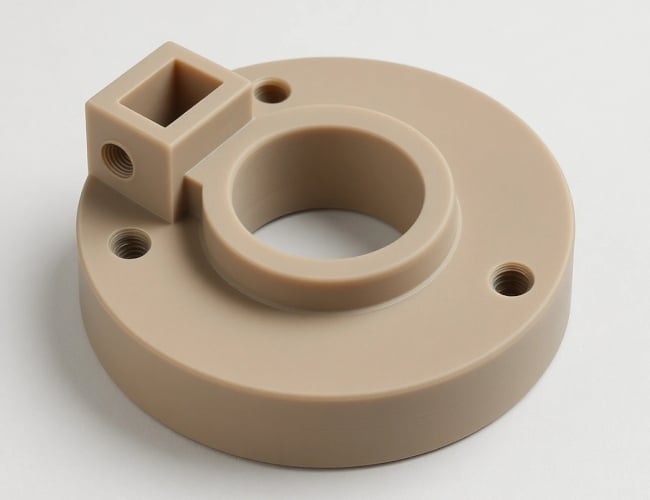
What is PPSU?
PPSU is a high-performance thermoplastic used in demanding aerospace, medical, fluid-handling, food-processing, and industrial applications. It offers strong heat, chemical, and impact resistance and withstands repeated sterilization and aggressive cleaning.
PPSU provides greater heat stability, toughness, and durability than commodity plastics such as ABS. It also offers low moisture absorption, strong hydrolytic stability, and inherent flame resistance.
Updated: 9/4/26
What are the key properties of PPSU?
PPSU (Polyphenylsulfone) is a high-performance, amorphous thermoplastic commonly used in aerospace, medical, fluid handling, food processing, and industrial applications where exceptional temperature resistance, chemical resistance, and impact strength are required. PPSU is frequently selected for machined components that must withstand repeated sterilization, aggressive cleaning chemicals, and demanding operating environments. Unlike commodity plastics such as ABS, PPSU belongs to the family of high-temperature engineering thermoplastics and provides significantly greater thermal stability, toughness, and long-term durability. PPSU is an amorphous material with high heat resistance, low moisture absorption, excellent hydrolytic stability, and inherent flame retardancy.
What are the key properties of PPSU?
PPSU is valued in CNC machining applications for its combination of mechanical toughness and thermal performance. Key characteristics include:
- Exceptional impact resistance
- Excellent heat resistance
- Outstanding chemical resistance
- Superior hydrolytic stability
- High dimensional stability
- Inherent flame retardancy
- Low moisture absorption
- Excellent electrical insulation properties
- Resistance to environmental stress cracking
- Long service life in demanding environments
Because PPSU is amorphous, it exhibits predictable machining behavior and excellent dimensional stability compared to many semi-crystalline engineering plastics. It also maintains mechanical properties across a wide temperature range.
Chemical Properties and Composition of PPSU
PPSU is a member of the polysulfone family of polymers. Its molecular structure contains aromatic rings linked by sulfone functional groups that contribute to its thermal stability, chemical resistance, and mechanical toughness. Key attributes of PPSU's chemical structure include:
- High-temperature aromatic backbone
- Sulfone groups that provide thermal stability
- Amorphous polymer morphology
- Excellent resistance to hydrolysis
- Resistance to many acids, bases, and cleaning agents
Chemical Composition of PPSU
| Component | Chemical Structure |
| Phenyl Ring (Benzene) |
C₆H₄
|
| Sulfone Group |
SO₂
|
| Ether Linkage | O |
| Repeat Unit (PPSU Polymer Backbone) |
[C₆H₄-SO₂-C₆H₄-O-C₆H₄-C(CH₃)₂-C₆H₄-O]ₙ
|
The molecular architecture of PPSU is responsible for its ability to withstand repeated steam sterilization cycles while maintaining toughness and dimensional stability.
What are the advantages of PPSU?
Exceptional Heat Resistance
PPSU performs reliably at temperatures that exceed the limits of many commodity and engineering plastics. Continuous service temperatures can approach 180°C (356°F) in appropriate applications.
Outstanding Impact Strength
PPSU maintains exceptional toughness even at elevated temperatures and after repeated sterilization cycles. It offers higher impact performance than many other high-temperature plastics.
Excellent Chemical Resistance
The material resists many cleaning agents, disinfectants, acids, bases, and industrial chemicals, making it well suited for medical and processing equipment.
Superior Hydrolytic Stability
Unlike many engineering thermoplastics, PPSU can withstand repeated exposure to hot water and steam without significant degradation. This makes it ideal for sterilizable components.
Flame Retardancy
PPSU is inherently flame resistant and is commonly available in grades meeting UL94 V-0 requirements without additional flame-retardant additives.
Excellent Dimensional Stability
The material maintains tight tolerances across changing environmental conditions, making it suitable for precision components.
What are the disadvantages of PPSU?
Higher Material Cost
PPSU is substantially more expensive than commodity plastics such as ABS, PVC, or polypropylene.
More Challenging Machining
Compared to ABS or acetal, PPSU requires greater attention to tooling, heat management, and machining strategy.
Lower Wear Resistance Than Some Specialty Plastics
While tough and durable, PPSU may not provide the wear characteristics of filled PEEK or certain bearing-grade materials.
Potential for Heat Buildup
Excessive cutting heat can affect surface finish and dimensional accuracy if feeds and speeds are not properly optimized.
Limited Availability in Some Forms
Depending on grade and stock shape requirements, lead times and material availability may be more restrictive than common plastics.
What are the types of PPSU?
Several grades are available to support different application requirements.
- General-Purpose PPSU: Balanced mechanical and thermal properties
- Medical-Grade PPSU: Designed for repeated sterilization and biocompatibility requirements
- Aerospace-Grade PPSU: Enhanced compliance with flame, smoke, and toxicity requirements
- Glass-Filled PPSU: Improved stiffness and dimensional stability
- Flame-Retardant PPSU: Enhanced fire performance for electrical applications
- FDA-Compliant PPSU: Suitable for food contact and beverage processing applications
- Custom Compounded PPSU: Modified with additives for specific performance requirements
What to know about CNC machining PPSU?
Tooling
Use sharp carbide tooling designed specifically for engineering plastics. Recommended practices include:
- Use polished carbide end mills for improved chip evacuation
- Minimize tool wear through sharp cutting edges
- Maintain adequate relief angles
- Use rigid toolholding systems
- Avoid dull tooling that generates excessive heat
- Use climb milling whenever practical
Feeds, Speeds, and Chips
Machining PPSU requires controlling temperature throughout the cutting process. Best practices include:
- Maintain adequate chip load
- Avoid rubbing or dwelling
- Reduce spindle speed when excessive heat develops
- Monitor chip color and consistency
- Clear chips continuously from pockets and deep cavities
- Use conservative finishing passes
Chip formation should remain clean and controlled. Excessive heat can cause surface discoloration or dimensional variation.
Cooling and Chip Evacuation
- Compressed air is often the preferred cooling method
- Ensure effective chip evacuation
- Verify coolant compatibility before use
- Prevent recutting of chips
- Monitor part temperature during extended machining cycles
Workholding
PPSU is relatively rigid but can still deform under excessive clamping pressure. Recommended practices include:
- Use evenly distributed clamping forces
- Support thin-walled features
- Avoid overtightening vises
- Use fixtures that minimize stress concentration
- Leave stock for final finishing operations when necessary
What are design considerations for PPSU?
When designing machined PPSU components, account for both manufacturing requirements and operational conditions.
Avoid Excessively Thin Features
Thin walls can increase machining difficulty and may distort under load.
Maintain Generous Internal Radii
Larger corner radii improve tool access, reduce machining time, and increase component strength.
Consider Thermal Expansion
Although dimensionally stable, PPSU still exhibits greater thermal expansion than metals.
Design Threads Carefully
Metal inserts should be considered for frequently assembled joints or applications requiring high clamp loads.
Account for Sterilization Environments
Medical and food-contact applications should consider repeated steam exposure and cleaning cycles during design.
Evaluate Operating Conditions
Review:
- Maximum operating temperature
- Exposure to steam or hot water
- Chemical compatibility
- Mechanical loading
- Flame-retardancy requirements
- Dimensional stability requirements
For applications requiring even greater temperature capability or wear resistance, materials such as PEEK may be appropriate alternatives
How can PPSU be modified?
PPSU can be compounded or reinforced to improve performance in specific applications. Common modifications include:
- Glass fiber reinforcement for increased stiffness
- Mineral reinforcement for dimensional stability
- Flame-performance enhancements
- Wear-resistant additives
- Custom color formulations
- FDA-compliant compounds
- Medical-grade formulations
- Aerospace-certified compounds
As with most engineering plastics, material modifications often improve certain properties while potentially affecting machinability, impact resistance, or cost.
Frequently asked questions about PPSU
What are the most common applications for PPSU machined components?
PPSU is commonly machined for reusable medical-device parts, fluid-handling fittings and manifolds, aerospace interiors and electrical components, and hot-water or food-service hardware. It is selected for applications that require resistance to steam, repeated sterilization, impact, chemicals, and hydrolysis rather than maximum stiffness.
How does PPSU compare to PEEK for machined components?
For machined components, PEEK is typically chosen for its higher strength, stiffness, wear resistance, and temperature capability. PPSU offers greater toughness and value for impact-prone, steam-sterilized, moderately loaded parts. Both can be CNC machined successfully, but PEEK is better suited to precision, load-bearing components, while PPSU fits rugged housings, handles, trays, and fluid-handling hardware.
What thermal stresses affect PPSU during CNC machining?
During CNC machining, PPSU can develop localized heat, uneven expansion, and stress release from extruded stock. Despite its heat resistance, PPSU conducts heat poorly and expands more than metals. Without proper heat control, parts may distort, smear, crack, or change dimensions after unclamping or later autoclave exposure.
What causes environmental stress cracking in machined PPSU parts?
Environmental stress cracking (ESC) occurs when a machined PPSU part is under tensile stress and exposed to an aggressive chemical. PPSU generally resists ESC, but residual stress from machining or stock, assembly stress, and incompatible solvents, cleaners, lubricants, or disinfectants can combine to cause crazing or cracks.
What types of surface finishes and post-machining operations can PPSU components take?
PPSU components support post-machining operations such as precision milling and turning, deburring, polishing for specific tribological requirements, light texture blasting, stress-relief annealing, hole and thread finishing, laser marking, and mechanical assembly.
Can PPSU components withstand medical autoclave sterilization?
Yes. PPSU is widely used for reusable medical components that undergo repeated steam sterilization, impact, and hot, wet conditions. Medical-grade PPSU is used for instrument handles, sterilization cases and trays, device housings, fluid manifolds, connectors, and dental components.
How does medical PPSU compare to PEEK for autoclave durability?
Both PPSU and PEEK are excellent choices for repeated steam autoclaving. PEEK offers greater heat resistance and mechanical strength, while PPSU provides better impact toughness, translucency, and more economical performance for housings, trays, and instrument handles. Because both materials are autoclavable, the best choice depends on load, tolerances, chemical exposure, part geometry, and cost.