
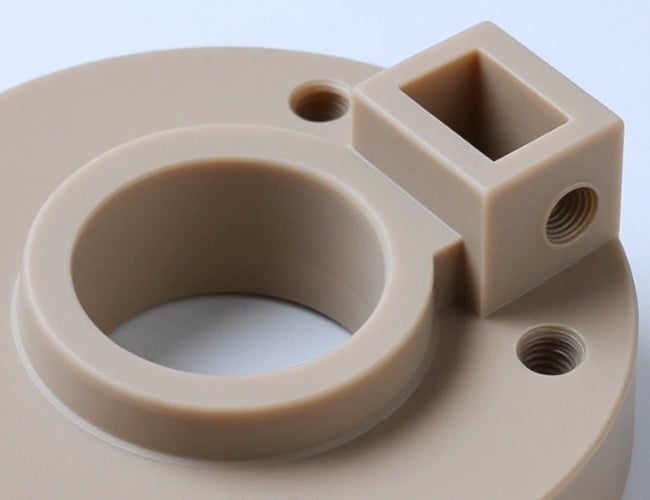
What is Polysulfone?
Polysulfone (PSU) is a high-performance amorphous thermoplastic commonly machined for aerospace, medical, fluid-handling, semiconductor, and industrial components. It offers high temperature resistance, dimensional and hydrolytic stability, and strong mechanical performance.
Polysulfone retains its mechanical strength across a wide temperature range and withstands repeated sterilization, making it suitable for demanding applications that exceed standard engineering plastics.
Updated: 9/4/26
What are the key properties of polysulfone?
Polysulfone is valued in CNC machining applications for its combination of high thermal performance, toughness, and dimensional stability. Key characteristics include:
- High continuous service temperature
- Excellent dimensional stability
- Good machinability
- High strength and stiffness
- Exceptional hydrolytic stability
- Repeated steam sterilization capability
- Good chemical resistance
- Excellent electrical insulation properties
- Naturally transparent amber appearance
- Good creep resistance
Because Polysulfone is an amorphous thermoplastic, it exhibits low and predictable shrinkage, excellent dimensional stability, and relatively uniform behavior during machining.
Chemical Properties and Composition of Polysulfone
Polysulfone is an aromatic polymer containing repeating sulfone groups within its molecular backbone. The combination of aromatic rings and sulfone linkages provides its characteristic thermal stability, stiffness, and resistance to long-term heat exposure. The polymer structure contains:
- Aromatic benzene rings for rigidity and strength<
- Sulfone groups for thermal stability and oxidation resistance
- Ether linkages for toughness and processability
Chemical Composition of Polysulfone
| Component | Chemical Structure |
|
Bisphenol A
|
HO-C₆H₄-C(CH₃)₂-C₆H₄-OH
|
|
Diphenyl Sulfone
|
C₆H₅-SO₂-C₆H₅
|
|
Ether Linkage
|
–O–
|
|
Polysulfone Repeating Unit
|
[–C₂₇H₂₂O₄S–]ₙ
|
What are the advantages of polysulfone?
Excellent Temperature Resistance
Polysulfone maintains mechanical performance at temperatures significantly higher than ABS, acetal, and many nylons. Continuous service temperatures approaching 300°F (149°C) are common.
Outstanding Hydrolytic Stability
PSU withstands repeated exposure to hot water, steam, and sterilization processes with minimal degradation, making it well suited for medical and laboratory equipment.
High Strength and Stiffness
The material offers an excellent combination of tensile strength, flexural strength, and dimensional stability across a wide temperature range.
Excellent Dimensional Stability
Low creep and predictable thermal behavior help maintain tolerances in precision-machined components.
Good Chemical Resistance
Polysulfone resists many aqueous solutions, detergents, and cleaning chemicals commonly encountered in medical and industrial environments.
Transparency
Natural PSU is translucent amber, allowing visual inspection of fluid flow or internal components in many applications.
Strong Electrical Properties
The material provides reliable dielectric performance for electrical and electronic applications operating at elevated temperatures.
What are the disadvantages of polysulfone?
Higher Material Cost
Polysulfone is substantially more expensive than commodity plastics such as ABS, PVC, or polyethylene.
Lower Impact Resistance Than Polycarbonate
Although tough, PSU generally exhibits lower impact strength than polycarbonate in highly abusive environments.
Limited Solvent Resistance
Certain ketones, chlorinated hydrocarbons, and aromatic solvents can attack or stress crack the material.
Stress Sensitivity
Improper machining practices, excessive clamping forces, or aggressive chemical exposure may induce stress cracking.
Abrasive to Tooling Compared to Commodity Plastics
Its higher strength and heat resistance can result in increased tool wear compared to materials such as ABS or HDPE.
What are the types of polysulfone?
Several grades are available to meet specific performance and machining requirements.
- General-Purpose Polysulfone: Provides a balanced combination of mechanical strength, thermal stability, dimensional stability, and chemical resistance for industrial and engineering applications.
- Medical-Grade Polysulfone: Formulated for healthcare and laboratory environments where biocompatibility, repeated sterilization, and long-term hydrolytic stability are critical.
- Glass-Filled Polysulfone: Reinforced with glass fibers to increase stiffness, strength, creep resistance, and dimensional stability, particularly in structural applications.
- High-Purity Polysulfone: Manufactured to minimize extractables and contaminants for semiconductor, pharmaceutical, filtration, and ultrapure fluid handling systems.
- FDA-Compliant Polysulfone: Meets regulatory requirements for food-contact applications and is commonly used in food processing, beverage handling, and commercial kitchen equipment.
- Flame-Retardant Polysulfone: Designed for electrical and electronic applications requiring enhanced fire-performance characteristics while maintaining high-temperature performance.
- Bearing and Wear-Grade Polysulfone: Modified with internal lubricants or wear-resistant additives to improve friction and wear performance in moving components.
- Carbon-Filled Polysulfone: Enhanced with carbon-based fillers to increase stiffness, improve dimensional stability, and provide conductive or antistatic properties when required.
What to know about CNC machining polysulfone?
Tooling
Use sharp tooling designed for engineering plastics:
- Use sharp carbide end mills with polished flutes
- Utilize high-helix cutters to improve chip evacuation
- Use rigid setups to minimize vibration
- Maintain proper tool relief angles to reduce rubbing
- Use sharp drills and reamers to minimize heat generation
- Avoid dull tooling that may induce stress and thermal damage
The objective is to produce clean chips while minimizing heat buildup and residual stress.
Feeds, Speeds, and Chips
There is no universal cutting parameter because performance depends on machine rigidity, tool geometry, and part geometry. Observe chip formation carefully:
- Produce continuous, controlled chips
- Avoid excessive spindle speed that generates heat
- Maintain adequate chip load
- Reduce tool engagement in deep pockets
- Minimize dwell time during finishing passes
- Monitor part temperature during long machining cycles
Machining trials should be conducted to optimize shop-specific parameters.
Cooling and Chip Evacuation
- Use compressed air to remove chips
- Use coolant only when material compatibility has been verified
- Prevent chip recutting
- Avoid excessive thermal cycling during machining
Because Polysulfone has a relatively high heat-deflection temperature, overheating during machining is less problematic than with ABS, but thermal management remains important for maintaining dimensional accuracy.
Workholding
Polysulfone is dimensionally stable but can still be affected by excessive clamping forces.
- Use broad support surfaces when possible
- Avoid overtightening fixtures
- Support thin-wall features during machining
- Allow stress-relief periods for highly precise components
- Use light finishing passes for tight-tolerance features
What are design considerations for polysulfone?
When designing machined Polysulfone components, consider both manufacturing requirements and long-term service conditions.
Avoid Sharp Internal Corners
Generous radii reduce stress concentrations and improve durability.
Account for Thermal Expansion
Although more stable than many plastics, PSU still expands more than metals.
Consider Sterilization Requirements
Repeated exposure to steam sterilization should be evaluated during material selection and design.
Use Metal Inserts for High-Load Fasteners
Metal inserts are preferred where components require repeated assembly or significant clamp loads.
Support Large Flat Surfaces
Even high-performance thermoplastics can deform under sustained loading if insufficiently supported.
Consider Operating Environment
Evaluate:
- Temperature exposure
- Steam exposure
- Chemical compatibility
- Mechanical loading
- Electrical requirements
- Regulatory requirements
- Dimensional stability requirements
For applications requiring even higher temperature resistance, improved chemical resistance, or greater wear performance, materials such as Polyetherimide (PEI), PEEK, PPS, or Torlon® PAI may be more suitable.
How can polysulfone be modified?
Polysulfone is frequently modified to improve performance for specialized applications. Common modifications include:
- Glass fiber reinforcement for increased stiffness and dimensional stability
- Carbon fiber reinforcement for improved strength and reduced thermal expansion
- PTFE additives for improved wear characteristics
- Conductive fillers for ESD protection
- FDA-compliant formulations
- Medical-grade compounds
- High-purity grades for semiconductor and filtration applications
- Custom color formulations
As with most engineered thermoplastics, improving one property often involves tradeoffs in machinability, toughness, transparency, or cost.
Frequently asked questions about polysulfone
What are the most common applications for polysulfone machined components?
Machined Polysulfone (PSU) is commonly used for hot-water and steam fluid systems, medical and laboratory equipment, filtration hardware, electrical insulation, and high-temperature industrial assemblies. It is a good choice when parts must remain rigid and dimensionally stable after exposure to hot water, steam, detergents, or repeated moderate sterilization.
What types of finishes and post-machining operations can polysulfone parts take?
Polysulfone is compatible with most standard CNC finishing operations, including deburring, mechanical polishing, vapor polishing, annealing, and coating.
What are the main limitations of polysulfone?
The main tradeoffs with polysulfone are limited solvent resistance, lower impact resistance, poor UV durability, and high material cost.
How does polysulfone compare to polycarbonate in performance?
Polysulfone (PSU) is generally better for sustained heat, hot water or steam exposure, and repeated sterilization. Polycarbonate (PC) is usually the better choice when impact resistance, optical clarity, and lower cost matter more than autoclave durability.
How does polysulfone compare to PEEK and PPSU in machined parts?
For CNC-machined parts, PSU, PPSU, and PEEK offer increasing performance at increasing cost. PSU is the economical choice for hot-water and steam service. PPSU provides greater toughness and sterilization durability. PEEK offers the highest temperature capability and the best chemical and wear resistance, but it is also the most expensive.
What mechanical properties make polysulfone ideal for fluid manifolds?
Polysulfone’s rigidity, low creep, dimensional stability, hydrolysis resistance, and retained strength at hot-water temperatures make it well suited for fluid manifolds. These properties help ports, threads, O-ring glands, sealing faces, and internal flow passages maintain their geometry under pressure and repeated hot-water or steam exposure.
How many autoclave cycles can machined polysulfone typically withstand?
For a standard machined PSU part, plan for several hundred steam-autoclave cycles at 121 °C (250 °F). Unless the specific resin grade and finished part have been qualified, use a conservative design limit of fewer than about 500 cycles. At 132–134 °C, service life can drop sharply, sometimes to a few dozen or about 100 cycles before crazing, embrittlement, or cracking becomes a concern.