
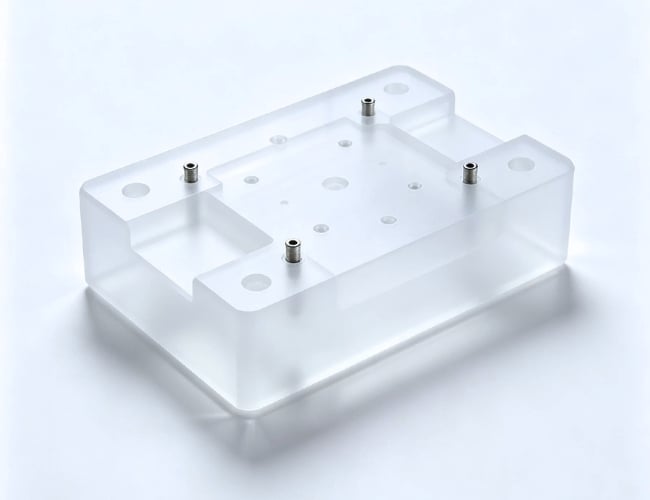
What is Polycarbonate?
Polycarbonate (PC) is a tough, impact-resistant thermoplastic with optical clarity and dimensional stability, making it ideal for machined transparent and industrial components.
Polycarbonate offers greater strength and durability than acrylic while remaining transparent, and it is well suited to low-volume and prototype machining.
Updated: 9/4/26
What are the key properties of polycarbonate?
Polycarbonate is valued in CNC machining applications for its combination of strength, toughness, transparency, and thermal performance. Key characteristics include:
- Exceptional impact resistance
- High toughness
- Excellent optical clarity
- Good dimensional stability
- Lightweight
- Good electrical insulation
- Good heat resistance
- Good creep resistance
- Good flame resistance
- Excellent transparency
Because polycarbonate is an amorphous thermoplastic, it maintains consistent dimensional behavior and does not exhibit the shrinkage characteristics commonly associated with semi-crystalline plastics such as nylon or acetal.
Chemical Properties and Composition of Polycarbonate
Polycarbonate is produced through polymerization of bisphenol compounds and carbonate groups to form a strong molecular structure with excellent toughness and transparency. Key contributing components include:
- Aromatic rings for rigidity and strength
- Carbonate groups for toughness and thermal performance
- Amorphous molecular structure for optical clarity
The exact formulation varies by grade and manufacturer, allowing optimization for impact strength, optical performance, flame resistance, UV stability, or medical compliance.
Chemical Composition of Polycarbonate
| Component | Chemical Structure |
| Bisphenol A (BPA) | C15H16O2 |
| Carbonate Group | CO3 |
| Repeating Polymer Unit | (C16H14O3)n |
What are the advantages of polycarbonate?
Exceptional Impact Resistance
Polycarbonate is one of the toughest commercially available engineering plastics. It can withstand significant impact loading without cracking or shattering.
Excellent Transparency
Polycarbonate offers glass-like transparency while providing far greater impact resistance, making it suitable for windows, guards, lenses, and protective shields.
Good Heat Resistance
Polycarbonate maintains mechanical properties at temperatures that exceed the capabilities of many commodity plastics including ABS.
Strong Dimensional Stability
Machined components maintain dimensional accuracy across varying environmental conditions and mechanical loads.
Good Electrical Properties
Polycarbonate provides reliable electrical insulation and is frequently used in electrical and electronic applications.
Flame Resistance
Many grades exhibit inherent flame-retardant characteristics and can be compounded to meet various regulatory requirements.
Easy Secondary Operations
Polycarbonate can be machined, bonded, painted, printed, threaded, and assembled using various fastening methods.
What are the disadvantages of polycarbonate?
Higher Material Cost
Polycarbonate is generally more expensive than commodity plastics such as ABS and polyethylene.
Susceptibility to Scratching
The material scratches more easily than glass and may require hard coatings in optical applications.
Moisture Sensitivity
Polycarbonate can absorb moisture, which may affect dimensional stability and processing performance.
Stress Cracking Concerns
Certain chemicals, solvents, and cleaning agents can cause environmental stress cracking.
More Challenging to Machine Than ABS
Due to its toughness and tendency to generate heat during cutting, machining parameters require closer control than those used for ABS.
UV Sensitivity
Unmodified polycarbonate can discolor and degrade under prolonged ultraviolet exposure. UV-stabilized grades are commonly used for outdoor applications.
What are the types of polycarbonate?
Several grades are available to satisfy different industrial requirements.
- General-Purpose Polycarbonate: balanced mechanical and optical performance
- Optical-Grade Polycarbonate: designed for maximum transparency and clarity
- UV-Stabilized Polycarbonate: improved outdoor weather resistance
- Flame-Retardant Polycarbonate: used in electrical and electronic applications
- Glass-Filled Polycarbonate: increased stiffness and dimensional stability
- Medical-Grade Polycarbonate: suitable for healthcare and medical devices
- Polycarbonate/ABS (PC/ABS): combines PC toughness with ABS processability
- Conductive or ESD Polycarbonate: protects sensitive electronic components
- FDA-Compliant Polycarbonate: suitable for selected food-contact applications
What to know about CNC machining polycarbonate?
Tooling
Use sharp, polished tooling specifically designed for plastics:
- Use single- or two-flute high-helix carbide end mills
- Use polished O-flute cutters when surface finish is critical
- Use sharp drills with proper point geometry
- Minimize tool wear to reduce heat generation
- Maintain proper cutter engagement to reduce stress and vibration
The objective is to shear material cleanly while controlling heat buildup that can cause melting, surface defects, or internal stress.
Feeds, Speeds, and Chips
There is no universal feed and speed combination. Performance depends on machine rigidity, tool geometry, stock condition, and finish requirements. Use chip formation as the primary indicator:
- Produce consistent, well-formed chips
- Avoid excessive RPMs that create unnecessary heat
- Increase feed before increasing spindle speed
- Clear chips frequently from pockets and deep features
- Avoid prolonged tool dwell
Observe chips, part temperature, transparency retention, and dimensional accuracy during setup optimization.
Cooling and Chip Evacuation
Compressed air is commonly used for cooling and chip removal. If coolant is used:
- Verify chemical compatibility
- Avoid aggressive solvents
- Prevent coolant contamination that may contribute to stress cracking
Proper chip evacuation is essential because recutting chips can quickly increase part temperature.
Workholding
Polycarbonate is tougher and less brittle than acrylic but can still distort under excessive clamping forces.
- Use broad support surfaces
- Avoid overtightening fixtures
- Support thin sections
- Use vacuum fixtures or soft jaws when appropriate
- Leave material for final finishing passes when flatness is critical
- Balance material removal across both sides of the part when possible
What are design considerations for polycarbonate?
When designing machined polycarbonate components, consider both the material's strengths and manufacturing limitations.
Use Adequate Corner Radii
Generous internal radii improve machinability and reduce stress concentration.
Account for Thermal Expansion
Polycarbonate expands more than metals and should be considered in tightly constrained assemblies.
Protect Transparent Surfaces
Cosmetic and optical surfaces should be isolated from fasteners, abrasion points, and handling damage.
Consider Long-Term Loading
Although polycarbonate exhibits good durability, sustained loading may result in creep over time.
Reinforce Threads When Necessary
Metal inserts should be considered for repeated assembly cycles or high clamp loads.
Evaluate the Operating Environment
Assess:
- Temperature exposure
- UV exposure
- Chemical compatibility
- Mechanical loading
- Optical requirements
-
Regulatory requirements
For applications requiring higher stiffness, wear resistance, or chemical resistance, materials such as acetal (POM), nylon, glass-filled engineering plastics, or PEEK may be more appropriate
How can polycarbonate be modified?
Polycarbonate is frequently compounded to enhance performance in demanding applications. Common modifications include:
- Glass fiber reinforcement for increased stiffness
- UV stabilizers for outdoor durability
- Flame-retardant additives
- Hard-coat systems for scratch resistance
- Conductive and ESD-safe fillers
- Impact modifiers
- Antimicrobial additives
- Optical enhancement packages
- Custom color compounds
Material modifications typically improve specific performance characteristics but may affect transparency, machinability, toughness, dimensional stability, or cost.
Frequently asked questions about polycarbonate
What are the most common applications for polycarbonate machined components?
The most common applications for CNC-machined polycarbonate components are transparent protective parts, optical/light-management parts, enclosures, and functional prototypes. Engineers choose PC when a component needs high impact toughness, moderate heat resistance, electrical insulation, dimensional stability, and—often—glass-like visibility without the fragility of glass.
What types of surface finish or post-machining operations can polycarbonate components take?
Polycarbonate can accept a broad range of post-machining finishes, from a practical as-machined matte surface to optically clear polished edges. Practical finish options include as-machined, deburring, wet sanding, mechanical polishing, vapor polishing, annealing, hard coating, and media blasting.
How does polycarbonate compare to acrylic in impact resistance?
Polycarbonate is far more impact-resistant than acrylic (PMMA). At the same thickness, polycarbonate typically flexes and deforms under a hard impact, while acrylic is more rigid and may crack, craze, chip, or shatter.
What are the limitations of polycarbonate regarding chemicals and UV?
Polycarbonate can be damaged by solvents and may develop stress cracks. Without UV protection, outdoor exposure can cause it to yellow, reduce light transmission, and weaken its surface and mechanical performance.
What specific conditions cause environmental stress cracking in polycarbonate?
Environmental stress cracking (ESC) occurs when polycarbonate is under tensile stress and exposed to a chemical. Either condition alone may not cause damage, but together they can make the part craze or crack.
Which alternative plastics offer better resistance to solvents than polycarbonate?
Several plastics offer substantially better solvent resistance than polycarbonate. The best choice depends on whether you need near-universal chemical inertness, structural strength at temperature, stiffness and machinability, low cost, or transparency . The best alternatives include PTFE, PVDF, PEEK, HDPE, UHMW, and PVC.