
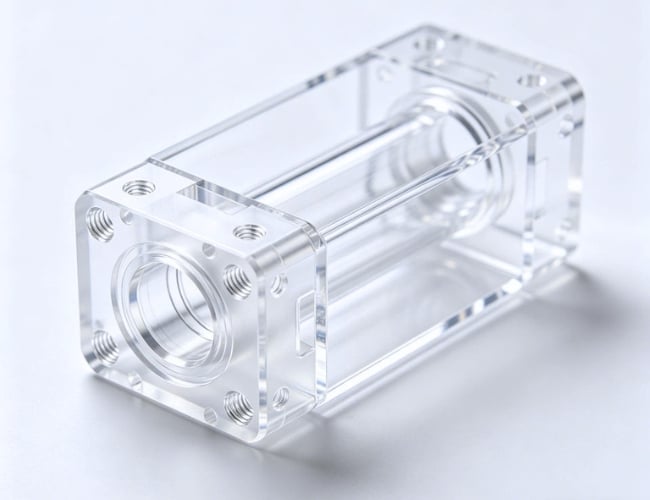
What is PET?
PET (Polyethylene Terephthalate) is a versatile thermoplastic polyester used in packaging, consumer products, industrial applications, and engineered components. It combines a high strength-to-weight ratio with dimensional stability, clarity, chemical resistance, and recyclability.
PET is a widely produced plastic identified by Resin Identification Code #1. It is commonly used in beverage bottles, food containers, packaging, textiles, and some engineered components.
Updated: 9/8/26
What are the key properties of PET?
PET is valued in CNC machining applications for its combination of strength, stiffness, and dimensional stability. Key characteristics include:
- Good machinability
- High strength and stiffness
- Excellent dimensional stability<
- Low moisture absorption
- Good wear resistance
- Good chemical resistance
- Good electrical insulation
- Food-contact compliance in many grades
- Smooth surface finish capability
- Good fatigue resistance
Because PET is semi-crystalline, it provides excellent mechanical performance and dimensional consistency. Its low moisture absorption allows it to maintain tighter tolerances than materials such as nylon in humid environments.
Chemical Properties and Composition of PET
PET is a polyester formed from:
- Ethylene glycol
- Terephthalic acid (or dimethyl terephthalate)
These compounds react through polycondensation to create long polymer chains that provide PET with its characteristic strength, chemical resistance, and stability.
Chemical Composition of PET
| Component | Chemical Structure |
| Ethylene Glycol |
HO-CH₂-CH₂-OH
|
| Terephthalic Acid |
C₆H₄(COOH)₂
|
| PET Repeat Unit |
(C₁₀H₈O₄)n
|
The degree of crystallinity and molecular weight can vary by grade, affecting stiffness, machinability, wear characteristics, and thermal performance.
What are the advantages of PET?
Excellent Dimensional Stability
PET absorbs very little moisture, helping parts maintain dimensional accuracy across changing environmental conditions.
High Strength and Stiffness
PET provides superior rigidity and load-bearing capability compared to many commodity plastics and can often replace metal in lightweight applications.
Good Wear Resistance
PET exhibits low friction and good abrasion resistance, making it suitable for bushings, guides, rollers, and sliding components.
Good Chemical Resistance
PET resists many oils, greases, fuels, and industrial chemicals commonly encountered in manufacturing environments.
Food-Contact Compatibility
Many PET grades comply with food-contact regulations, making them suitable for food-processing equipment and packaging-related applications.
Good Electrical Properties
PET provides reliable electrical insulation and dielectric performance for electrical and electronic applications.
What are the disadvantages of PET?
Limited Impact Resistance
PET is generally less impact resistant than ABS, polycarbonate, or some modified engineering plastics.
Potential Brittleness
Sharp corners, aggressive loading, or stress concentrations may lead to cracking in certain applications.
Moderate Heat Resistance
While PET performs better than many commodity plastics, it is not intended for continuous high-temperature environments where materials such as PEEK or PPS may be required.
Difficult Bonding
PET can be more challenging to bond or paint than materials such as ABS due to its chemical characteristics.
Reduced Performance Under Shock Loads
Applications involving repeated impact or sudden loading may require alternative materials with greater toughness.
What are the types of PET?
Several grades are available to address specific application requirements:
- Unfilled PET: General-purpose grade for machining and industrial use
- Bearing Grade PET: Enhanced wear resistance and lower friction
- Food-Grade PET: Suitable for food-contact applications
- Glass-Filled PET: Increased stiffness and dimensional stability
- Reinforced PET: Improved strength and mechanical performance
- ESD-Safe PET: Static-dissipative grades for electronics manufacturing
- Lubricated PET: Improved sliding and wear characteristics
- PET Blends: Modified formulations for specialized performance requirements
What to know about CNC machining PET?
Tooling
Use sharp, polished tooling intended for engineering plastics:
- Use high-helix carbide end mills for efficient chip evacuation
- Use polished O-flute cutters for improved surface finish
- Use sharp drills and minimized dwell time
- Use rigid setups to reduce vibration and dimensional variation
- Maintain proper chip load to avoid rubbing
The objective is to generate clean chips while minimizing heat buildup. Excessive heat may cause localized melting or dimensional instability.
Feeds, Speeds, and Chips
No single feed and speed combination applies to every setup. Results depend on tooling, machine rigidity, stock geometry, and finish requirements. Monitor chip formation as the primary process indicator:
- Produce well-formed chips rather than dust
- Use adequate feed rates to prevent rubbing
- Avoid excessive spindle speeds that generate heat
- Remove chips frequently from pockets and deep features
- Use consistent finishing passes
Validate parameters through shop-specific testing and monitor heat, chip quality, burr formation, and dimensional accuracy.
Cooling and Chip Evacuation
Use compressed air to remove chips and maintain cutting temperature.
- Verify coolant compatibility before use
- Prevent recutting of chips
- Minimize thermal buildup during deep-pocket machining
- Avoid prolonged cutter dwell
Proper chip evacuation helps maintain accuracy and surface quality.
Workholding
PET can deform if improperly fixtured:
- Use broad support surfaces
- Avoid excessive clamping pressure
- Support thin sections during machining
- Machine balanced features when possible
- Leave material for a light finishing pass when critical flatness is required
Careful workholding improves both dimensional accuracy and surface finish.
What are design considerations for PET?
When designing machined PET components, consider both manufacturing requirements and application conditions.
Avoid Sharp Internal Corners
Generous radii reduce stress concentrations and improve mechanical performance.
Minimize Stress Concentrations
Use smooth transitions between features to reduce the likelihood of cracking during operation.
Consider Thermal Expansion
PET expands more than metals and should be accommodated in precision assemblies.
Use Threaded Inserts for Repeated Assembly
Metal inserts may improve long-term durability where components are assembled and disassembled frequently.
Account for Mechanical Loading
Evaluate expected loads and deflection requirements when substituting PET for metal components.
Consider Operating Environment
Evaluate:
- Temperature exposure
- Chemical exposure
- Moisture conditions
- Mechanical loading
- Wear requirements
- Dimensional stability requirements
Applications requiring extreme temperatures, superior impact resistance, or exceptional chemical resistance may require alternative materials such as PEEK, PPS, polycarbonate, or acetal.
How can PET be modified?
PET is frequently modified to improve performance in specialized applications. Common modifications include:
- Glass fiber reinforcement for increased stiffness
- Lubricant additives for reduced friction
- Wear-resistant fillers
- UV stabilization for outdoor applications
- ESD-safe additives
- Conductive fillers
- Impact modifiers
- Custom color compounds
Material modifications often improve specific properties while reducing others, particularly machinability, impact resistance, or surface finish quality. Careful grade selection is recommended to balance performance requirements with manufacturing objectives.
Frequently asked questions about PET
What are the most common applications for PET machined components?
Machined PET is typically semi-crystalline PET-P, not amorphous bottle-grade PET. It is used for dimensionally stable wear parts, food-processing and fluid-handling components, electrical insulation, and general machine parts. PET-P is a practical choice when a part needs low moisture absorption, good stiffness, wear resistance, and clean machinability.
What types of finishes and post-machining operations can PET parts stake?
Machined PET components can be as-machined, deburred, media blasted, mechanically polished, vibratory deburred, and annealed.
How does environmental stress cracking affect PET?
Environmental stress cracking (ESC) can cause PET parts to crack prematurely when tensile stress and chemical exposure occur together, even when the stress is well below PET’s short-term tensile strength. In PET, alkaline liquids can hydrolyze the polyester’s ester bonds, reduce its molecular weight, and cause local surface damage to develop into crazing and eventually cracks.
What chemicals degrade PET?
PET is most vulnerable to chemicals that break down its ester bonds, including strong alkalis, hot water or steam, concentrated acids, phenolic compounds, and some chlorinated, halogenated, aromatic, and strongly polar solvents. The risk increases sharply with higher concentrations and temperatures, longer exposure times, and applied mechanical stress.