
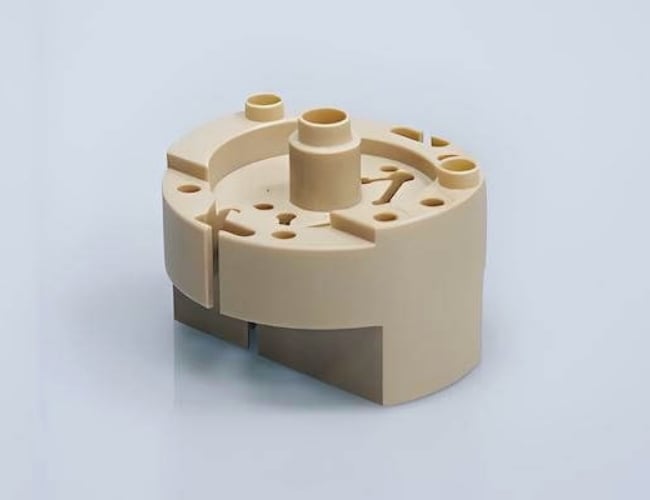
What is PEEK?
PEEK is a high-performance thermoplastic used in aerospace, medical, semiconductor, oil and gas, and industrial applications. It provides exceptional strength, wear resistance, chemical resistance, dimensional stability, and temperature performance.
With proper tooling and process controls, PEEK machines well and suits critical components where performance justifies its cost.
Updated: 8/31/26
What are the key properties of PEEK?
PEEK is valued in CNC machining applications for its exceptional mechanical and thermal performance. Key characteristics include:
- Excellent strength-to-weight ratio
- High temperature resistance
- Outstanding chemical resistance
- Excellent wear resistance
- Low moisture absorption
- Good dimensional stability
- High creep resistance
- Excellent fatigue resistance
- Good electrical insulation
- Biocompatibility in medical grades
Because PEEK is semi-crystalline, it exhibits excellent mechanical strength and chemical resistance while maintaining dimensional stability across a wide temperature range.
Chemical Properties and Composition of PEEK
PEEK belongs to the polyaryletherketone (PAEK) family of thermoplastics and consists of repeating aromatic rings connected by ether and ketone functional groups. The polymer structure provides:
- Ether groups for processability and toughness
- Ketone groups for thermal stability and strength
- Aromatic rings for rigidity and chemical resistance
The molecular structure gives PEEK its unique combination of high-temperature performance, mechanical durability, and chemical resistance.
Chemical Composition of PEEK
| Component | Functional Group |
| Aromatic Ring | C6H4 |
| Ether Linkage | -O- |
| Ketone Linkage | -CO- |
What are the advantages of PEEK?
Exceptional Temperature Resistance
PEEK maintains mechanical properties at temperatures far beyond those tolerated by most engineering plastics. Continuous service temperatures of approximately 250°C (482°F) are possible in many applications.
Outstanding Chemical Resistance
PEEK resists a wide range of chemicals, including hydrocarbons, oils, fuels, acids, solvents, and cleaning agents.
High Strength and Stiffness
PEEK offers mechanical properties approaching those of light metals while remaining significantly lighter.
Excellent Wear Resistance
The material performs exceptionally well in sliding, bearing, seal, and wear applications where long-term durability is required.
Low Moisture Absorption
PEEK absorbs very little moisture, helping maintain dimensional stability and consistent mechanical properties in humid environments.
Biocompatibility
Medical grades of PEEK are widely used in surgical instruments and implantable devices due to their biocompatibility and sterilization resistance.
What are the disadvantages of PEEK?
High Material Cost
PEEK is one of the most expensive commercially available thermoplastics and is generally reserved for demanding applications where its performance advantages justify the cost.
More Challenging to Machine Than Commodity Plastics
Although machinable, PEEK requires careful control of heat generation and cutting parameters compared to materials such as ABS or acetal.
Potential for Thermal Expansion
Like all plastics, PEEK exhibits higher thermal expansion than metals, although it performs better than many thermoplastics.
Limited Availability in Some Forms
Certain grades, colors, and reinforced variants may require longer procurement times than more common engineering plastics.
Reinforced Grades Increase Tool Wear
Glass-filled and carbon-filled PEEK grades can significantly accelerate tool wear during machining operations.
What are the types of PEEK?
Several grades are available to meet specific machining and performance requirements.
- Unfilled PEEK: General-purpose grade offering balanced strength, toughness, and machinability.
- Glass-Filled PEEK: Increased stiffness, dimensional stability, and creep resistance.
- Carbon-Filled PEEK: Enhanced strength, wear resistance, thermal conductivity, and dimensional stability.
- Bearing Grade PEEK: Contains PTFE, graphite, or carbon fiber additives for low friction and wear.
- Medical Grade PEEK: Designed for medical and healthcare applications.
- FDA-Compliant PEEK: Suitable for food processing and related environments.
- ESD and Conductive PEEK: Formulated for semiconductor and electronics applications.
What to know about CNC machining PEEK?
Tooling
Use sharp, high-quality tooling intended for engineering plastics:
- Use polished carbide end mills designed for plastic machining
- Use sharp drills with proper relief geometry
- Minimize tool deflection by using the shortest practical tool length
- Prefer rigid setups to maintain accuracy
- Use coated tooling when machining abrasive reinforced grades
- Consider reduced radial engagement in deep-pocket applications
The goal is to remove material efficiently while minimizing heat buildup. Excessive heat can distort the workpiece and reduce dimensional accuracy.
Feeds, Speeds, and Chips
There is no single correct RPM or feed rate because results depend on machine rigidity, tooling, workpiece geometry, and grade. Use chip formation as the process indicator:
- Produce consistent chips rather than dust
- Avoid excessive spindle speeds that generate heat
- Maintain sufficient feed rates to keep cutting edges engaged
- Clear chips frequently from pockets and holes
- Use conservative finishing passes for critical tolerances
- Monitor workpiece temperature during long machining cycles
Test shop-specific parameters and optimize based on chip control, dimensional accuracy, and surface finish.
Cooling and Chip Evacuation
Use compressed air to remove chips and reduce cutting-zone temperatures. In demanding applications:
- Use compatible flood coolant or mist systems when appropriate
- Maintain continuous chip evacuation
- Avoid heat accumulation in deep cavities
- Monitor temperatures when machining thick sections
Workholding
PEEK offers good rigidity but can still deform if improperly fixtured.
- Use stable, evenly distributed clamping forces
- Avoid excessive clamping pressure
- Support thin-wall features
- Use vacuum fixtures when appropriate
- Leave stock for a final finishing pass on precision components
- Consider stress-relief machining strategies for high-tolerance parts
What are design considerations for PEEK?
When designing machined PEEK components, consider both material performance and manufacturing requirements.
Avoid Excessively Thin Walls
Thin sections can increase machining complexity and may reduce dimensional stability.
Maintain Generous Internal Radii
Larger radii improve machinability, reduce machining time, and minimize stress concentrations.
Account for Thermal Expansion
Although PEEK is dimensionally stable, thermal expansion should be evaluated in high-temperature applications and metal-to-plastic assemblies.
Consider Thread Engagement
PEEK threads perform well, but threaded inserts should be considered for repeated assembly or high-load fastening applications.
Design for Wear Applications
PEEK excels in bushings, seals, bearing components, and wear surfaces where low friction and long service life are required.
Consider Operating Environment
Evaluate:
- Operating temperature
- Chemical exposure
- Mechanical loading
- Wear requirements
- Sterilization requirements
- Regulatory compliance requirements
- Dimensional stability requirements
For applications requiring lower material cost, engineering plastics such as ABS, acetal (POM), nylon, or polycarbonate may provide sufficient performance.
How can PEEK be modified?
PEEK is frequently modified to enhance performance in specialized applications. Common modifications include:
- Glass fiber reinforcement for increased stiffness
- Carbon fiber reinforcement for improved strength and reduced thermal expansion
- PTFE additives for lower friction
- Graphite fillers for wear resistance
- Conductive fillers for ESD protection
- Carbon nanotube formulations for advanced electrical properties
- Medical-grade formulations for healthcare applications
- Custom compounds for aerospace, semiconductor, and industrial environments
Material modification can substantially improve specific performance characteristics but may affect machinability, toughness, surface finish, or tooling requirements.
Frequently asked questions about PEEK
What are the main applications of PEEK?
PEEK is used for critical components exposed to high temperatures, chemicals, wear, electrical demands, or weight limits. It is commonly machined or molded as a replacement for metal, thermosets, or lower-performance plastics.
How does PEEK compare to metals like titanium or aluminum?
PEEK is much lighter than aluminum and titanium and offers excellent insulation, chemical resistance, and high-temperature performance. However, it is less stiff and strong, expands more with heat, and can creep under load, making it a functional—not structural—metal replacement.
What are the differences between PEEK and PEKK?
PEEK and PEKK are related high-performance thermoplastics. PEKK generally handles higher temperatures and crystallizes more slowly, reducing warpage and enabling greater manufacturing control. PEEK is more established and widely available.
How is PEEK processed and machined into parts?
PEEK parts are produced by molding, extrusion, additive manufacturing, or CNC machining. The best method depends on volume, design, tolerances, material grade, and crystallinity. Close-tolerance parts are often machined from annealed extruded or compression-molded stock.
What are carbon-fiber filled PEEK composites used for?
PEEK parts can be molded, extruded, 3D printed, or CNC machined. The best process depends on the part’s design, volume, tolerances, and material grade; precision parts are often machined from annealed stock.
How does carbon-fiber PEEK compare to glass-filled PEEK?
Carbon-fiber-filled PEEK offers high stiffness, wear resistance, low thermal expansion, and good heat dissipation. Glass-filled PEEK combines stiffness with electrical insulation and chemical resistance. Both are more rigid and dimensionally stable than unfilled PEEK, but each suits different applications.