
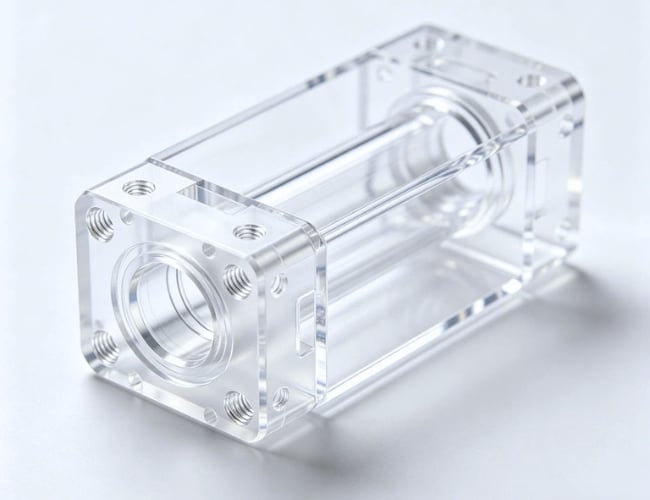
What is PCTFE?
PCTFE is a high-performance fluoropolymer valued for its dimensional stability, chemical resistance, low moisture absorption, and low gas permeability. It is commonly machined for seals, valves, cryogenic equipment, and semiconductor components.
With proper tooling, PCTFE machines well and is ideal for high-purity, aerospace, cryogenic, and industrial sealing applications.
Updated: 8/31/26
What are the key properties of PCTFE?
PCTFE is valued in CNC machining applications for its unique balance of physical, mechanical, and chemical properties. Key characteristics include:
- Excellent chemical resistance
- Extremely low moisture absorption
- Low gas permeability
- Outstanding cryogenic performance
- High dimensional stability
- Good machinability
- Excellent electrical insulation
- High purity capability
- Good compressive strength
- Broad service temperature range
Because PCTFE is a semi-crystalline fluoropolymer, it provides greater rigidity and dimensional stability than PTFE while maintaining exceptional chemical resistance.
Chemical Properties and Composition of PCTFE
PCTFE is produced through the polymerization of chlorotrifluoroethylene (CTFE) monomers. The chlorine atom incorporated into the polymer chain gives PCTFE several advantages compared to PTFE, including:
- Lower permeability to gases and moisture
- Improved dimensional stability
- Higher rigidity
- Better load-bearing capability
- Enhanced sealing performance
Chemical Composition of PCTFE
| Component | Chemical Structure |
| Chlorotrifluoroethylene (CTFE) |
C₂ClF₃
|
| Repeating Polymer Unit |
(C₂ClF₃)n
|
What are the advantages of PCTFE?
Excellent Chemical Resistance
PCTFE exhibits outstanding resistance to most acids, bases, oxidizers, solvents, and corrosive chemicals, making it suitable for aggressive operating environments.
Extremely Low Moisture Absorption
PCTFE absorbs virtually no moisture compared to many engineering plastics. This characteristic supports dimensional stability and performance in humid environments.
Low Gas Permeability
One of PCTFE's most significant advantages is its extremely low permeability to gases. It is commonly used in sealing applications where leak prevention is critical.
Outstanding Cryogenic Performance
PCTFE maintains mechanical integrity and dimensional stability at very low temperatures, making it a preferred material for cryogenic valves, seals, and aerospace systems.
High Dimensional Stability
Compared to PTFE and many other fluoropolymers, PCTFE exhibits reduced creep and deformation under load.
Excellent Electrical Properties
PCTFE provides strong dielectric performance and is frequently used in electrical insulation and high-purity electronic applications.
What are the disadvantages of PCTFE?
Higher Material Cost
PCTFE is significantly more expensive than commodity plastics and many engineering thermoplastics.
Limited Temperature Capability Compared to PTFE
Although PCTFE performs well at elevated temperatures, its maximum service temperature is generally lower than PTFE.
Lower Impact Resistance
PCTFE can be more brittle than materials such as polyethylene, nylon, or polycarbonate, particularly in thin sections.
Potential for Stress Cracking
Improper machining practices, sharp internal corners, or excessive assembly stresses can contribute to cracking.
Limited Material Availability
PCTFE is a specialty material and may have longer lead times or limited stock availability compared to more common plastics.
What are the types of PCTFE?
Several grades of PCTFE are available to address specific performance requirements.
- General-Purpose PCTFE: Suitable for most sealing and structural applications
- Virgin PCTFE: High-purity material frequently used in semiconductor, aerospace, and cryogenic systems
- Compression-Molded PCTFE: Commonly used for larger billets and custom-machined components
- Extruded PCTFE: Available in rod, sheet, and tube forms for machining applications
- High-Purity PCTFE Grades: Manufactured to minimize contamination and outgassing
- Cryogenic-Service Grades: Optimized for extremely low-temperature applications
What to know about machining PCTFE?
Tooling
Use sharp, polished tooling specifically intended for plastics:
- Use polished carbide end mills with high rake geometry
- Utilize O-flute cutters for finishing operations
- Employ sharp drills to reduce heat generation
- Use positive cutting geometries whenever possible
- Maintain clean cutting edges and avoid dull tooling
PCTFE machines more rigidly than PTFE but still requires attention to heat generation and chip control.
Feeds, Speeds, and Chips
There is no single correct RPM or feed rate because machining parameters depend on machine rigidity, tooling geometry, and part design. Monitor the machining process by observing chip formation:
- Produce clean, continuous chips
- Avoid excessive heat buildup
- Increase chip evacuation in deep features
- Reduce radial engagement when heat rises
- Maintain steady cutting conditions
- Avoid rubbing or dwelling
Process validation should be performed using production-specific tooling and fixturing.
Cooling and Chip Evacuation
- Use compressed air to remove chips
- Maintain consistent chip evacuation
- Verify coolant compatibility before use
- Minimize heat buildup in deep pockets and drilled features
- Avoid thermal shock from incompatible cooling methods
Workholding
PCTFE can deform if clamping pressure is excessive. Recommended practices include:
- Use broad contact surfaces
- Avoid overtightening fixtures
- Support thin walls and flexible features
- Leave finishing stock for final cleanup passes
- Use vacuum fixtures or compliant workholding when practical
- Consider stress relief during multi-operation machining
What are design considerations for PCTFE?
When designing machined PCTFE components, both functional and manufacturing requirements should be evaluated.
Avoid Sharp Internal Corners
Generous radii reduce stress concentrations and improve machinability.
Minimize Thin-Wall Features
Thin sections can deform during machining and may reduce long-term part stability.
Account for Thermal Expansion
Like most plastics, PCTFE expands more than metals and should be accommodated in assembled systems.
Consider Creep Under Load
Although more dimensionally stable than PTFE, PCTFE can still deform under sustained loading.
Evaluate Sealing Requirements
PCTFE is frequently selected for its sealing performance and low permeability. Surface finish and dimensional tolerances should be carefully specified.
Consider Operating Environment
Evaluate:
- Temperature range
- Chemical exposure
- Pressure requirements
- Moisture exposure
- Vacuum performance
- Cryogenic conditions
- Regulatory requirements
For applications requiring higher temperature capability, PTFE, PFA, FEP, PEEK, or polyimide materials may be considered depending on operating conditions.
How can PCTFE be modified?
PCTFE may be compounded or formulated to improve specific performance characteristics. Common modifications include:
- Glass fiber reinforcement for increased stiffness
- Wear-resistant fillers
- Specialty additives for dimensional stability
- Semiconductor-grade purity formulations
- Low-outgassing formulations
- Application-specific compounds for aerospace and cryogenic environments
Material modification may improve certain properties while affecting machinability, purity, toughness, or dimensional performance.
Frequently asked questions about PCTFE
How does PCTFE compare to PTFE in chemical resistance?
PTFE has the broader and more robust chemical-resistance envelope. PCTFE is still highly resistant to most corrosive media at ordinary temperatures, but it is less universally inert—most notably with certain organic solvents and as temperature rises. The key reason is structural: PTFE is fully fluorinated, whereas PCTFE has a chlorine substituent in each repeat unit.
What are the primary applications for PCTFE components?
PCTFE components are used where chemical resistance, dimensional stability, low creep, effective sealing, and cryogenic performance are essential. Common applications include cryogenic systems, aerospace hardware, high-integrity seals, electrical and optical components, and moisture-barrier packaging.
What manufacturing processes are used for melt-processing PCTFE?
PCTFE can be processed by injection molding, extrusion, compression molding, thermoforming, and melt coating. Its high viscosity and sensitivity to overheating require precise tooling and temperature control.
How does PCTFE behave in extreme cryogenic environments?
PCTFE remains strong, stable, and damage-tolerant at cryogenic temperatures. Its low gas permeability and moisture absorption make it ideal for seals, valve seats, and insulating hardware used with liquid nitrogen, LNG, LOX, hydrogen, and helium.
Why does PCTFE have the lowest water vapor transmission rate?
PCTFE has an exceptionally low water-vapor transmission rate because its hydrophobic, fluorinated structure absorbs very little water, while its dense, semi-crystalline matrix slows water vapor from passing through. In simple terms, both water solubility and diffusion are low, resulting in excellent moisture-barrier performance.
How does film thickness impact the water vapor transmission rate of PCTFE?
For a uniform, defect-free PCTFE film tested under the same conditions, increasing thickness reduces water-vapor transmission. Doubling the thickness approximately halves the WVTR because water vapor must travel twice as far through the material. The film’s inherent moisture-barrier properties remain unchanged.