
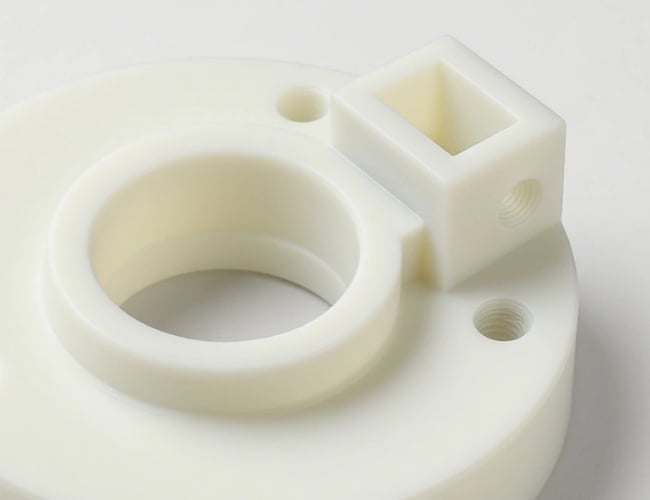
What is Nylon?
Nylon is a widely used engineering plastic for machined parts, gears, bushings, rollers, and structural components. It combines strength, toughness, wear resistance, and chemical resistance.
Nylon machines well and is ideal for prototypes, replacement parts, and low-volume production. Its durability and low friction suit moving, load-bearing components.
Updated: 8/31/26
What are the key properties of nylon?
Nylon is valued in CNC machining applications for its combination of mechanical strength and wear resistance. Key characteristics include:
- Excellent wear resistance
- High mechanical strength
- Good toughness and impact resistance
- Low coefficient of friction
- Lightweight
- Good chemical resistance
- Good fatigue resistance
- Excellent bearing properties
- Good electrical insulation
- Moderate temperature resistance
Because nylon is a semi-crystalline thermoplastic, it exhibits higher strength and wear resistance than many commodity plastics. However, it also absorbs moisture from the environment, which can influence dimensions and mechanical properties.
Chemical Properties and Composition of Nylon
Nylon belongs to the polyamide family of polymers. Several formulations exist, with Nylon 6 and Nylon 6/6 being the most common grades used in machining applications. Polyamides are formed through polymerization reactions that create repeating amide groups throughout the molecular structure, providing the material with its characteristic strength, toughness, and abrasion resistance.
Chemical Composition of Nylon
| Type | Repeating Structure |
| Nylon 6 | (C6H11NO)n |
| Nylon 6/6 | (C12H22N2O2)n |
| Nylon 12 | (C12H23NO)n |
Different nylon formulations provide varying balances of strength, moisture absorption, dimensional stability, and temperature performance.
What are the advantages of nylon?
Excellent Wear Resistance
Nylon performs exceptionally well in applications involving sliding contact, abrasion, and repetitive motion. It is frequently used to replace metal components in wear applications.
High Strength-to-Weight Ratio
Nylon provides excellent mechanical strength while remaining significantly lighter than metals, making it useful in equipment where weight reduction is desired.
Low Friction Properties
The natural lubricity of nylon reduces friction and wear between mating surfaces, often eliminating the need for additional lubrication.
Good Fatigue Resistance
Nylon withstands repeated loading and flexing better than many plastics, making it suitable for dynamic applications.
Chemical Resistance
Nylon offers good resistance to oils, fuels, greases, and many industrial chemicals encountered in manufacturing environments.
Easy Machining
Nylon can be machined efficiently using standard carbide tooling and generally produces good surface finishes when proper machining practices are followed.
What are the disadvantages of nylon?
Moisture Absorption
Nylon readily absorbs moisture from the atmosphere. This can lead to dimensional changes and variations in mechanical properties over time.
Reduced Dimensional Stability
Compared to materials such as acetal (POM), nylon is more susceptible to dimensional changes resulting from humidity and temperature fluctuations.
Lower UV Resistance
Unmodified nylon can degrade and discolor when exposed to prolonged sunlight or outdoor weathering conditions.
Thermal Expansion
Like many plastics, nylon expands and contracts significantly more than metals when exposed to temperature changes.
Potential Warping
Machined nylon components may experience distortion if residual stresses are present or if material is machined unevenly.
What are the types of nylon?
Several nylon grades are available to meet specific performance requirements.
- Nylon 6: General-purpose grade with excellent toughness and wear resistance.
- Nylon 6/6: Higher strength and temperature resistance than Nylon 6.
- Cast Nylon (MC Nylon): Superior dimensional stability and lower internal stress compared to extruded grades.
- Oil-Filled Nylon: Enhanced wear resistance and reduced friction.
- MoS₂-Filled Nylon: Improved bearing and sliding performance.
- Glass-Filled Nylon: Increased stiffness, strength, and heat resistance.
- Heat-Stabilized Nylon: Improved performance in elevated-temperature environments.
- Nylon 12: Lower moisture absorption and improved dimensional stability.
What to know about CNC machining nylon?
Tooling
Use sharp tooling designed specifically for plastics:
- Use high-helix carbide end mills for efficient chip evacuation.
- Employ polished cutting edges to reduce friction and heat generation.
- Use sharp drills with proper relief geometry.
- Minimize rubbing by maintaining proper chip loads.
- Use rigid setups to maintain dimensional accuracy.
The objective is to remove material efficiently while minimizing heat buildup. Excessive friction can soften the material and reduce dimensional accuracy.
Feeds, Speeds, and Chips
There is no universal feed and speed recommendation because results vary depending on machine rigidity, cutter geometry, material grade, and part geometry. Monitor chip formation closely:
- Maintain adequate chip loads
- Avoid excessive spindle speeds
- Produce clean, continuous chips
- Prevent chip recutting
- Reduce heat buildup during long cuts
- Use consistent finishing passes
Shop-specific testing is recommended to optimize surface finish, dimensional accuracy, and cycle time.
Cooling and Chip Evacuation
Use compressed air to assist chip removal and cooling. Flood coolant is generally unnecessary but can be used if compatible with the material and machining process. Effective chip evacuation is critical because trapped chips can generate heat and negatively affect surface finish.
Workholding
Nylon can deform under excessive clamping pressure:
- Use broad fixturing surfaces
- Avoid overtightening clamps
- Support thin walls and unsupported sections
- Leave material for final finishing passes
- Machine opposite sides evenly when possible
- Consider vacuum or fixture plate systems for thin components
What are the design considerations for nylon?
When designing machined nylon components, consider both material performance and manufacturing requirements.
Account for Moisture Absorption
Environmental humidity may influence dimensions over the life of the component. Critical-tolerance applications should account for moisture conditioning.
Maintain Adequate Wall Thickness
Thin sections may deform during machining or under service loads.
Use Generous Internal Radii
Larger radii reduce tool loading, improve strength, and minimize stress concentrations.
Consider Thermal Expansion
Nylon expands more than metals and should be designed with appropriate clearances in assembled products.
Evaluate Wear Conditions
Nylon performs well in sliding applications, but load, speed, temperature, and lubrication must be considered during design.
Limit Thread Loading
For frequently assembled joints or high clamping forces, metal inserts are often recommended instead of relying on plastic threads alone.
Consider Operating Environment
Evaluate:
- Humidity exposure
- Temperature exposure
- UV exposure
- Chemical compatibility
- Mechanical loading
- Wear requirements
- Dimensional stability requirements
For applications requiring lower moisture absorption and tighter dimensional control, materials such as acetal (POM), PET, or PEEK may be more suitable.
How can nylon be modified?
Nylon is frequently compounded to improve performance in demanding applications. Common modifications include:
- Glass fiber reinforcement for increased stiffness and strength
- Carbon fiber reinforcement for improved rigidity and dimensional stability
- Oil-filled formulations for reduced friction
- MoS₂ additives for improved bearing performance
- Heat stabilizers for elevated-temperature applications
- UV stabilizers for outdoor exposure
- Flame-retardant additives
- Conductive or ESD-safe fillers
- Custom color compounds
Material modifications often improve specific performance characteristics but may affect machinability, moisture absorption, toughness, or dimensional stability. Carefully evaluate tradeoffs when selecting a modified nylon grade.
Frequently asked questions about nylon
Does nylon make a good metal replacement?
Yes—nylon can be a very good metal replacement for the right parts, particularly low-to-moderate-load, wear, sliding, corrosion-resistant, or noise-sensitive components. It is not a direct substitute for metal in stiffness-critical, high-temperature, precision, high-preload, or long-term high-load applications because nylon absorbs moisture and can creep.
How is nylon manufactured?
Nylon is manufactured in two stages: first, chemical producers polymerize small molecules into a polyamide resin; then converters melt-process that resin into fibers, pellets, molded components, extruded stock, or cast shapes. The exact chemistry depends on the nylon family—especially whether it is nylon 6 (PA6) or nylon 6,6 (PA66).
What are the common applications for nylon?
Nylon is used wherever designers need a low-cost material with a good balance of toughness, wear resistance, low friction, electrical insulation, and moldability. Its most common applications are textile fibers, industrial wear components, automotive under-hood parts, and electrical hardware.
How do nylon 6 and nylon 66 differ in performance?
Nylon 6 (PA6) and nylon 66 (PA66) are both strong, semicrystalline engineering polyamides, but PA66 generally provides higher heat resistance, stiffness, hardness, and creep/wear resistance. PA6 is generally tougher, easier to process, and often preferred for large cast wear parts or applications where impact resistance and cost matter more than elevated-temperature performance.