
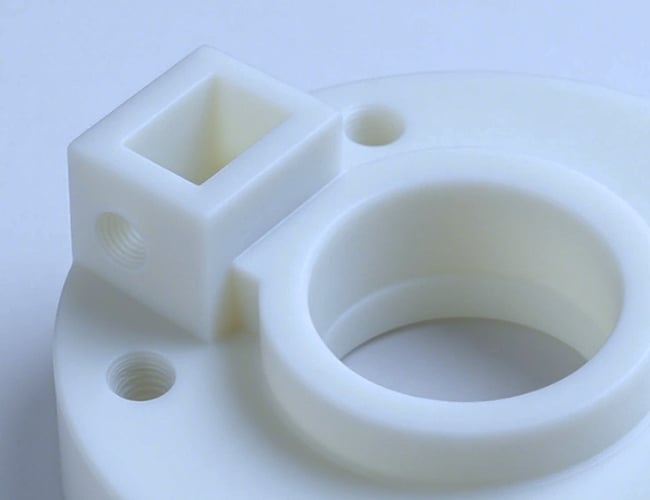
Noryl for CNC Machining
Noryl is a modified PPE engineering thermoplastic, often blended with polystyrene, that offers dimensional stability, low moisture absorption, electrical insulation, and heat resistance. It is used in structural parts, electrical enclosures, fluid-handling systems, automotive components, and industrial equipment.
Noryl combines low weight, mechanical strength, heat resistance, and dimensional stability for both machined and molded parts.
Updated: 9/8/26
What are the key properties of Noryl?
Noryl is valued in engineering and manufacturing applications for its balanced mechanical, thermal, and electrical performance. Key characteristics include:
- Excellent dimensional stability
- Low moisture absorption
- High dielectric strength
- Good machinability
- High heat resistance
- Good hydrolytic stability
- Lightweight
- Good chemical resistance
- Excellent electrical insulation
- Low thermal expansion
Because Noryl exhibits very low moisture uptake compared to nylon and other engineering plastics, it maintains dimensional accuracy and electrical performance even in humid environments.
Chemical Properties and Composition of Noryl
Noryl is typically composed of:
- Polyphenylene Ether (PPE) for heat resistance, dimensional stability, and electrical properties
- Polystyrene (PS) for processability and cost efficiency
Depending on the grade, Noryl may also contain:
- Glass fiber reinforcement
- Flame-retardant additives
- Mineral fillers
- Impact modifiers
- Specialty performance additives
The formulation varies by application requirements, allowing manufacturers to optimize stiffness, thermal stability, flame resistance, or chemical performance.
Chemical Composition of Noryl
| Component | Chemical Structure |
|
Polyphenylene Ether (PPE)
|
(C6H3(CH3)2-O-)n
|
|
Polystyrene (PS)
|
(CH2-CH(C6H5))n
|
What are the advantages of Noryl?
Excellent Dimensional Stability
Noryl exhibits minimal shrinkage and low thermal expansion, making it suitable for precision components that require consistent dimensions across varying temperatures and humidity levels.
Low Moisture Absorption
Unlike many engineering plastics, Noryl absorbs very little water, helping maintain mechanical properties, dimensional accuracy, and electrical performance.
Outstanding Electrical Properties
Noryl provides excellent dielectric strength and insulation performance, making it a preferred choice for electrical and electronic components.
Good Heat Resistance
Many Noryl grades maintain mechanical performance at elevated temperatures and offer higher heat resistance than commodity plastics.
Lightweight
Noryl provides a favorable strength-to-weight ratio, making it useful in weight-sensitive applications such as transportation and industrial equipment.
Broad Chemical Resistance
Noryl resists water, aqueous solutions, and many common industrial chemicals, contributing to long service life in demanding environments.
What are the disadvantages of Noryl?
Higher Material Cost
Noryl is generally more expensive than commodity plastics such as ABS or polypropylene.
Limited Solvent Resistance
Certain hydrocarbons, chlorinated solvents, and aromatic compounds may cause stress cracking or degradation.
Lower Wear Resistance
Although mechanically strong, Noryl is not typically selected for severe wear applications when compared to materials such as acetal or UHMW.
Potential Brittleness in Some Grades
Certain unmodified grades may exhibit lower impact strength than materials specifically designed for high-impact applications.
Processing Sensitivity
Some grades require careful control of cutting conditions and processing temperatures to achieve optimal results.
What are the types of Noryl?
Several Noryl grades are available to meet different performance requirements:
- General-Purpose Noryl: Balanced mechanical and thermal properties for industrial applications
- Glass-Filled Noryl: Increased stiffness, strength, and dimensional stability
- Flame-Retardant Noryl: Designed for electrical and electronic components requiring fire-performance compliance
- High-Heat Noryl: Enhanced thermal resistance for demanding environments
- Impact-Modified Noryl: Improved toughness for applications subject to shock loading
- Specialty Fluid-Handling Grades: Engineered for water management and plumbing systems
- Conductive and ESD Grades: Used in electronic manufacturing environments
What to know about CNC machining Noryl?
Tooling
Use sharp tooling designed for engineered plastics:
- Use polished carbide end mills with high helix geometry
- Utilize O-flute cutters when superior finish quality is required
- Use sharp drills with proper clearance to prevent heat buildup
- Minimize tool wear through adequate chip evacuation
- Reduce cutter engagement in deep pockets and contours
The objective is to remove material efficiently while minimizing heat generation and preventing localized softening.
Feeds, Speeds, and Chips
Machining parameters vary based on machine rigidity, tooling, grade, and part geometry. Monitor chip formation and temperature during cutting:
- Produce clean, continuous chips
- Avoid excessive spindle speeds that generate heat
- Maintain adequate chip load
- Clear chips frequently from pockets and holes
- Avoid dwelling in one area
Cooling and Chip Evacuation
- Use compressed air for cooling and chip removal
- Verify coolant compatibility when using mist systems
- Prevent excessive cutting temperatures
- Remove chips before recutting occurs
Workholding
Noryl's dimensional stability reduces distortion risk, but proper fixturing remains important:
- Support thin sections adequately
- Avoid excessive clamping pressure
- Use broad-contact fixtures where possible
- Machine symmetrically when tight tolerances are required
What are design considerations for Noryl?
When designing machined Noryl components, consider both manufacturing requirements and long-term performance.
Maintain Adequate Wall Thickness
Thin sections may still flex during machining or under service loading.
Use Generous Internal Radii
Larger radii improve strength and reduce stress concentrations.
Consider Thermal Exposure
Although Noryl offers excellent heat resistance, operating temperatures should remain within grade-specific limits.
Account for Chemical Environment
Verify compatibility with fuels, solvents, cleaning agents, and process chemicals.
Evaluate Threaded Features
Metal inserts may be preferred when repeated assembly or high clamp loads are expected.
Design for Dimensional Stability
Noryl is often selected specifically for applications requiring tight tolerances in changing environmental conditions. Evaluate:
- Operating temperature
- Humidity exposure
- Chemical exposure
- Mechanical loading
- Electrical performance requirements
- Regulatory requirements
How can Noryl be modified?
Noryl is frequently compounded to improve performance characteristics. Common modifications include:
- Glass fiber reinforcement for greater stiffness and strength
- Flame-retardant systems for electrical applications
- Impact modifiers for enhanced toughness
- Mineral fillers for dimensional control
- Conductive additives for ESD protection
- UV stabilizers for outdoor exposure
- Custom color compounds
Material modification can significantly improve specific properties but may also affect machinability, toughness, surface finish, or processing requirements.
Frequently asked questions about Noryl
What are the most common applications for Noryl machined components?
Machined Noryl is commonly used for electrical insulators and housings, precision water- and fluid-handling parts, and stable structural components. Its low moisture absorption, electrical insulation, hydrolytic stability, heat resistance, and machinability help parts maintain tight dimensions in humid, electrically demanding, or moderately hot service.
What types of finishes and post-machining operations can Noryl parts take?
Noryl parts can take a range of finishing and secondary operations, including deburring, as-machined finish, polishing, media blasting, powder coating, and electroplating.
How does Noryl compare to ABS and polycarbonate?
Noryl typically falls between ABS and polycarbonate in cost and processing difficulty. It offers better moisture resistance, electrical insulation, and dimensional stability. ABS is usually the simplest and least expensive option for general housings, while polycarbonate offers the greatest toughness. Noryl is often the better choice for parts that need electrical insulation, resist humidity or heat, and maintain tight dimensions.
How does the low moisture absorption affect machining Noryl?
Because Noryl absorbs very little moisture, it is easier to machine accurately and consistently. The material changes very little with humidity, so machined parts can maintain their fit, bore size, thread engagement, and electrical clearances from production through humid service conditions. This gives Noryl an advantage over moisture-sensitive plastics such as nylon.
What are the advantages of glass-filled Noryl grades?
Glass-filled Noryl adds 10%, 20%, or 30% glass fiber by weight to the base PPE/PS blend. The reinforcement increases stiffness and strength, reduces creep and thermal expansion, and improves dimensional stability under heat and load. It also retains Noryl’s low moisture absorption, hydrolytic stability, and electrical-insulation performance.