What is machining cost?
Machining cost is the combined cost of all the fixed and variable costs associated with an individual machined component.
Updated: 8/17/2026
What are the key drivers for machining cost?
In CNC machining, costs vary for each project. Machining cost goes beyond just the number of parts bought (or order volume); it's impacted by design, equipment, materials, and inspection needs all factor into the price tag.
- Part design
- Material
- NRE and programming
- Machining process
- Tooling
- Post-processing
- Volume
How does design impact machining cost?
Of all the cost drivers, a part's design is the most impactful.
The more complex a part is, the higher the manufacturing cost. Complex parts often need more advanced machines (e.g., if a part requires 5-axis milling, those hours of machining time will cost more than if a part was run on a 3-axis mill), more machining time, multiple setups, additional resources, and thorough inspections -- all of which increase costs.
Certain design features can also increase costs. These include:
- Sharp internal corners
- Thin walls
- Deep cavities
- Non-standard hole sizes
- Lettering
Such features should be avoided unless necessary. Additionally, design specifications like surface roughness or tolerancing may need multiple passes and inspections, further raising costs.
Large parts cost more to produce because they need more raw materials, resources, and manufacturing time and effort.
What are fixed costs?
Fixed costs represent the foundational expenses incurred at the start of a CNC machining project, and primarily include setup and programming. Regardless of the quantity of parts ordered, these costs are amortized across the entire production run.
This means that as the number of machined parts increases, the fixed cost per unit decreases, offering greater cost efficiency and value for larger orders. Understanding this distribution can help businesses optimize their budgets and make informed decisions about production volumes.
Programming and NRE
Programming and non-recurring engineering activities for machining jobs incur a significant one-time cost. For complex prototype parts, this can make up a large part of the total job cost. Further, the more complex features lead to more complex programming. Aim for the simplest machining strategy and workholding setups that use standard tools whenever possible.
Setup
Job setup is the process of preparing the machine and the workpiece for the machining operation, and is a fixed cost spread over the total number of parts produced. To lower these costs, follow DFM guidance similar to reducing programming expenses. Designing for simple or standard setups helps cut job setup costs in both prototypes and production.
What are scaled costs?
Unlike their fixed counterparts, scaled costs correspond directly to order volume. If you place a high volume order, you'll naturally spend more on these things compared to a low volume run.
Material
The material used to make a part is a key factor in its cost. There are various costs linked to machining a material, with the primary one being raw material cost. Material prices vary based on their availability, desirable properties, and production costs.
Besides material costs, machinability significantly affects expenses. Materials that are difficult to machine require more time and effort, and in CNC machining, time equates to money. The longer it takes to machine a part, the higher the cost. Additionally, challenging materials use more resources, such as cutting fluids, electricity, and tools.
Related Read: What to Consider when Calculating Material Cost
Machining Process
The chosen machining process is another key cost driver that you should keep in mind when approaching a CNC machining project. Costs related to a machining process include:
- Machine type and capabilities (i.e., 3-axis mill vs. 5-axis mill-turn machine)
- Machine time (i.e., spindle time, setup time, changeover time)
- Labor costs (i.e., required programming, setup, and operator costs; location has an impact here, as well)
Tooling
Cutting tools also influence total equipment cost and scale accordingly with the volume of your order. Material, coating, and geometry all affect tooling cost, and costs are further extrapolated based on tool wear and/or breakage. For example, cemented carbide tools, which are harder, more heat resistant, and able to withstand extreme speeds, cost over two times more than tool steel tools.
Related Read: How to Build a Streamlined Toolkit
Post-Processes
Most machined components require additional steps like heat treatment or a particular surface finish like anodize or chem-film to enhance their performance, features, and appearance after the machining operation. These extra processes add to the part's cost, and obviously, those costs correspond to order volume.
What is cost per unit?
Taking part design, as well as fixed and scaled factors into account, keep in mind that there is an inverse relationship between per-unit cost and production volume, often referred to as economies of scale.
While overall costs may be lower for low-volume production, the per-unit cost will be higher. Concurrently, there are more upfront costs associated with high-volume production, but the per-unit cost is much lower.
Let’s take a closer look at the relationship between production volume and cost.
Low Volume Production
Low-volume production is an essential and often necessary phase in the manufacturing process and product lifecycle. Low-volume production requires minimal initial investment and is ideal for testing a product's viability before moving to large-scale production. However, optimizing these processes can be challenging since the cost benefits of mass production are not yet applicable.
Small order quantities often come with higher costs, and many CNC machining suppliers have minimum order requirements that might be more than you need for low-volume production.
High Volume Production
As you increase the number of identical parts produced, the cost per unit drops significantly. This cost reduction happens because you only need to handle the CAD design, CAM preparation, and machine set-up once for all parts.
Generally, ordering in larger quantities leads to cost savings throughout the supply chain. This includes savings on raw materials, castings, machined parts, post-processing, and more.
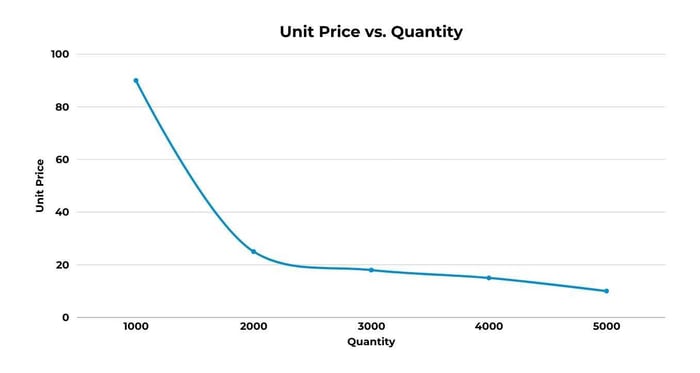
The unit price decreases significantly as production volume increases. For example, increasing production from one to five units can halve the unit price. Ordering in very large quantities, such as over 1,000 parts, can reduce the unit price by five to ten times. A simple way to reduce cost is to take advantage of these economies of scale by ordering higher quantities.
You should also aim to keep your part simple. You pay extra for complexity in the world of CNC machining, and geometries that need specialized tooling, custom fixtures, or multiple setups will incur additional costs accordingly.
Frequently asked questions about machining cost
How does material selection affect machining cost?
The cost of raw material inherently affects machining cost, but there are other important variables. A material that's more difficult to source, or more difficult to machine, can raise costs beyond a material's sticker price.
How does part complexity influence machining cost?
Complex parts need more machining steps, longer setup, and detailed programming, which increases time, labor, and costs.
How does cycle time affect a part's unit cost?
Longer cycle times increase costs because more machine hours are required. Optimized part designs allow for more efficient machining strategies that can reduceboth time and costs.
How does batch or lot size affect machining cost?
Producing larger batches can lower the cost per part. This is because setup costs are divided among more parts, and buying materials in bulk can be cheaper.
How can design optimization help reduce machining cost?
To optimize design, simplify part shapes, minimize machining steps, and choose affordable materials. Working with engineers and machinists early in the design process can save costs significantly.