
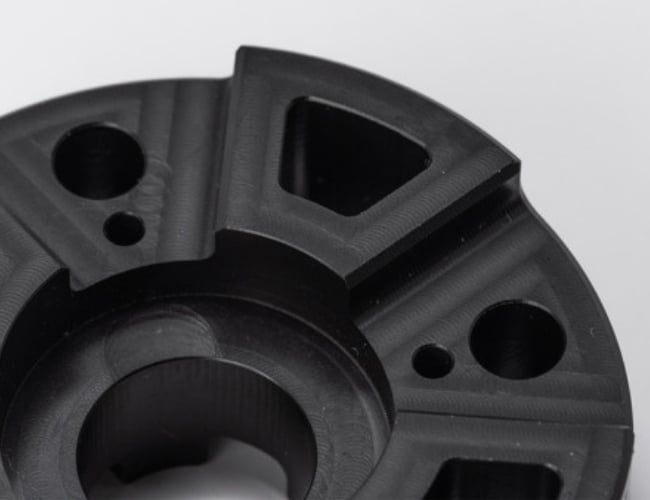
What is HDPE?
HDPE is an affordable, durable thermoplastic valued for its chemical resistance, low moisture absorption, and impact performance. It is commonly used for machined parts, wear components, tanks, and industrial equipment when high stiffness or tight tolerances are not required.
HDPE is easy to machine with standard CNC equipment, making it ideal for prototypes, replacement parts, and low-volume production when injection molding is impractical.
Updated: 9/1/26
What are the key properties of HDPE?
HDPE is valued in CNC machining applications for its toughness, chemical resistance, and ability to perform in demanding industrial environments. Key characteristics include:
- Excellent chemical resistance
- Outstanding moisture resistance
- High impact resistance
- Low coefficient of friction
- Lightweight
- FDA-compliant grades available
- Good electrical insulation properties
- Excellent wear resistance
- Low material cost
- Easy machinability
Because HDPE is a semi-crystalline thermoplastic, it exhibits excellent chemical resistance and toughness but may experience greater thermal expansion and dimensional movement than more rigid engineering plastics.
Chemical Properties and Composition of HDPE
HDPE is a polyethylene polymer made from the polymerization of ethylene monomers. Its high-density structure results from minimal branching along the polymer chain, creating stronger intermolecular bonding and higher strength compared to low-density polyethylene (LDPE). The molecular structure contributes to:
- Excellent resistance to water absorption
- High resistance to many acids, bases, and chemicals
- Good impact strength
- Low friction characteristics
- Superior corrosion resistance
Chemical Composition of HDPE
| Component | Chemical Structure |
| Ethylene Monomer |
C₂H₄
|
| Repeating Polymer Unit |
(C₂H₄)ₙ
|
What are the advantages of HDPE?
Excellent Chemical Resistance
HDPE resists a wide range of chemicals, including acids, alkalis, detergents, and many industrial fluids. This makes it a popular material for tanks, piping, and processing equipment.
Outstanding Moisture Resistance
HDPE absorbs virtually no water, allowing it to maintain performance in wet environments and submerged applications.
High Impact Strength
HDPE maintains toughness even at lower temperatures and withstands repeated impact loading without cracking.
Low Friction and Wear Resistance
The material's naturally slippery surface reduces friction and makes it suitable for wear strips, guides, rollers, and conveying systems.
Cost-Effective Material
Compared to engineering plastics such as UHMW, acetal, polycarbonate, or PEEK, HDPE provides an economical solution for many industrial applications.
Food and Medical Compatibility
FDA-compliant grades are available for food processing equipment, cutting boards, and certain healthcare applications.
What are the disadvantages of HDPE?
Limited Temperature Resistance
HDPE is not suitable for continuous high-temperature environments and begins to soften at relatively moderate temperatures compared to engineering plastics.
Low Rigidity
HDPE is less stiff than acetal, nylon, polycarbonate, and many filled engineering thermoplastics.
Higher Thermal Expansion
HDPE expands and contracts significantly with temperature changes, which can affect dimensional accuracy in precision applications.
Difficult Bonding
Due to its low surface energy, HDPE is challenging to bond using conventional adhesives and often requires specialized surface treatments.
Surface Scratching
While durable, HDPE can scratch more easily than harder engineering plastics.
What are the types of HDPE?
Several grades of HDPE are available to meet specific performance requirements:
- General-Purpose HDPE: Standard industrial applications and fabricated components.
- FDA-Compliant HDPE: Food processing and packaging applications.
- UV-Stabilized HDPE: Improved weatherability for outdoor use.
- Marine HDPE: Enhanced durability for marine and outdoor environments.
- Conductive HDPE: Static-dissipative or electrically conductive applications.
- Colored HDPE Grades: Custom appearance and product identification.
- Recycled HDPE Grades: Cost-conscious and sustainability-focused applications.
What to know about CNC machining HDPE?
Tooling
Use sharp tooling designed specifically for plastics:
- Use high-helix carbide end mills for efficient chip evacuation
- Use polished O-flute cutters for smooth surface finishes
- Use sharp drills with proper clearance angles
- Avoid dull cutters that may smear material
- Maintain proper chip load to ensure clean cutting
The objective is to shear the material cleanly rather than generate heat through friction.
Feeds, Speeds, and Chips
Machining performance depends on tooling, machine rigidity, and part geometry. Monitor chip formation throughout the process:
- Maintain sufficient feed rates to avoid melting
- Reduce spindle speed if excessive heat develops
- Clear chips regularly from slots and pockets
- Avoid rubbing and dwell marks
- Use light finishing passes for improved surface quality
HDPE generally tolerates aggressive material removal rates when chips are evacuated effectively.
Cooling and Chip Evacuation
Compressed air is often sufficient for cooling and chip removal.
- Keep cutting zones clear of chips
- Minimize heat buildup
- Verify coolant compatibility before use
- Prevent chips from rewelding to machined surfaces
Workholding
HDPE is relatively soft and can deform under excessive clamping pressure.
- Use broad contact surfaces when fixturing
- Avoid overtightening vises
- Support thin walls and large flat sections
- Leave finish stock for final machining operations
- Consider vacuum fixturing for large sheet applications
What are design considerations for HDPE?
When designing machined HDPE components, consider both material behavior and manufacturing requirements.
Avoid Unsupported Thin Walls
Thin features may flex during machining and in service.
Account for Thermal Expansion
HDPE experiences greater thermal movement than metals and many engineering plastics, particularly in outdoor environments.
Design for Load Distribution
Large bearing surfaces help reduce localized stresses and deformation.
Maintain Generous Radii
Larger radii improve durability and reduce machining complexity.
Limit High-Clamp-Load Threads
Machined plastic threads are suitable for light- to moderate-duty applications. Threaded inserts should be considered where frequent assembly is required.
Consider Long-Term Creep
HDPE can deform gradually under constant loads. Structural applications should account for creep over time.
Evaluate Operating Environment
Consider:
- Temperature exposure
- Chemical exposure
- UV exposure
- Mechanical loading
- Wear requirements
-
Dimensional stability expectations
Applications requiring greater rigidity, tighter tolerances, or higher temperature capability may be better served by acetal (POM), nylon, polycarbonate, UHMW, or PEEK
How can HDPE be modified?
HDPE is often compounded or modified to improve performance for specific applications. Common modifications include:
- UV stabilizers for outdoor use
- Carbon black additives for weather resistance
- Glass fiber reinforcement for increased stiffness
- Conductive and ESD-safe fillers
- Color concentrates
- Antimicrobial additives
- Wear-enhancing additives
As with most modified polymers, improvements in one property may result in trade-offs in machinability, toughness, flexibility, or dimensional stability.
Frequently asked questions about HDPE
What causes HDPE creep under continuous loads?
HDPE can creep under a constant load because its polymer chains slowly shift over time. Unlike metals, it may deform noticeably even at room temperature.
What peak temperatures can HDPE safely withstand?
HDPE can briefly withstand unloaded peaks of 100–120 °C (212–248 °F), but loaded parts are typically designed for 60–80 °C (140–176 °F). The exact limit depends on the grade, stress, service life, and environment.
What are the lowest temperatures HDPE can withstand?
HDPE remains tough below freezing, with a general lower service limit of about −40 °C (−40 °F). Some qualified grades and piping systems may perform near −60 °C (−75 °F), but limits depend on the application and material.