
What is elasticity?
Elasticity refers to a material’s ability to deform under stress and return to its original shape once the stress is removed.
Updated: 8/25/26
Why is elasticity important?
Elasticity is a foundational mechanical property that defines how a material responds to stress and strain — specifically, its ability to return to its original shape after deformation. It is a measure of how “springy” or “stiff” a material is, and it’s quantified by the modulus of elasticity, also known as Young’s modulus.
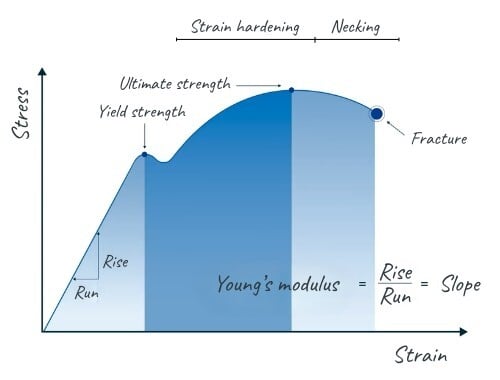
This modulus is defined as the ratio of stress (force per unit area) to strain (deformation per unit length) in the linear, elastic region of a material’s stress-strain curve.
Elasticity is crucial for ensuring that components can withstand operational loads without undergoing permanent deformation. For example, in aerospace or precision instrumentation, even slight elastic deflection can affect performance or alignment.
A high modulus of elasticity indicates a stiffer material that resists deformation, while a lower modulus suggests a more flexible material.
What factors affect elasticity?
Several factors affect a metal’s elasticity, including composition, heat treatment, grain size, and work hardening.
Composition
Alloying elements affect a metal’s stiffness by changing its atomic bonding. Pure copper and aluminum are generally less stiff, while elements such as chromium, nickel, and molybdenum can increase stiffness.
Heat Treatment
Heat treatment changes a metal’s microstructure and elastic response. Annealing, normalizing, and tempering can relieve residual stress and improve consistency. Annealing may reduce stiffness but increase ductility and recovery.
Grain Size
Grain size affects elastic behavior by influencing stress distribution. Fine grains generally provide a more consistent response, while coarse grains can cause uneven deformation and reduce dimensional stability.
Work Hardening
Work hardening increases strength but can reduce elasticity and make recovery less consistent. Forming and machining can cause this effect, so stress relief or annealing may help prevent distortion.
For machined parts, engineers should consider whether post-machining operations — such as stress relief or annealing — are needed to restore consistent elastic behavior and prevent distortion during service.
How is elasticity measured?
Elasticity is measured using tensile testing, where a specimen is subjected to a controlled tensile force while its elongation is recorded.
The slope of the initial, linear portion of the stress-strain curve obtained from this test represents the Young’s modulus. This value is typically expressed in gigapascals (GPa) and varies significantly between materials — for instance, steel has a modulus around 200 GPa, while aluminum is closer to 70 GPa.
The process involves gripping the material in a universal testing machine, applying a gradually increasing tensile load, and measuring the resulting elongation. The key is to capture the elastic region — the portion of the curve where deformation is reversible.
Once the material yields and enters plastic deformation, it no longer behaves elastically. This method is standardized under ASTM E111 and ISO 6892, ensuring consistency across industries.
Dynamic mechanical analysis (DMA) uses oscillating forces to measure elastic behavior, especially as temperature changes. It is useful for advanced research and high-precision applications, including some metal testing.
What are the failure modes associated with elasticity?
When discussing elasticity in metals, it’s important to understand how different types of failure can occur when a material is stressed beyond its elastic limit.
Plastic Deformation
Metals return to their original shape when stress stays within the elastic limit. When stress exceeds that limit, they deform permanently, which can compromise dimensional accuracy in precision-machined parts.
Fracture
Fracture can be brittle or ductile. Brittle fracture occurs suddenly with little deformation, while ductile fracture involves stretching before failure.
Buckling
Buckling occurs when slender or thin-walled structures deform sideways under compression, even before the material yields. It is a key design concern for aerospace and medical components.
Creep
Creep is another time-dependent failure mode where metals deform slowly under constant stress, particularly at elevated temperatures.

Though the initial deformation may be elastic, prolonged exposure leads to permanent strain. This is a major concern in high-temperature environments such as turbine engines or sterilization equipment.
Fatigue
Lastly, fatigue failure arises from repeated cyclic loading. Even if each individual load is within the elastic range, the accumulation of microstructural damage over time can lead to crack initiation and eventual fracture.
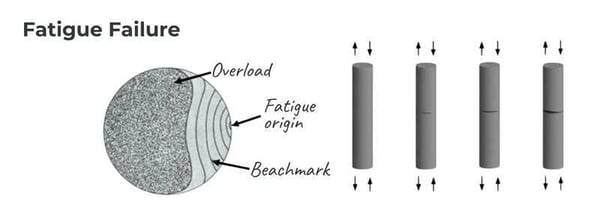
This makes fatigue analysis essential for components subjected to vibration or rotation, such as shafts, fasteners, and surgical tools.
What is the elasticity of metals?
Elasticity influences not only how a part performs in service but also how it behaves during machining. For example, metals with low elasticity (high stiffness) resist deflection during cutting, which can improve dimensional accuracy but may also increase tool wear.
Conversely, more elastic metals may deflect under cutting forces, requiring careful fixture design and slower feed rates to maintain tolerances.
|
Metal |
Young's Modulus (GPa) |
Machining Considerations |
|
~70 |
Easy to machine; low stiffness can cause chatter in thin sections; sharp tools recommended. |
|
| ~110 |
Good machinability; ductile and elastic; may require coolant to manage heat. |
|
|
~115 |
Tough to machine; elastic recovery can cause spring-back; use rigid setups and slow feeds. |
|
|
~190 |
Moderate machinability; work hardening and spring-back are common; use coated tools. |
|
|
~200 |
Generally good machinability; higher stiffness improves dimensional control. |
|
|
~210 |
Very stiff; excellent dimensional stability; requires high-speed tooling and coolant. |
How does elasticity affect CNC machining?
Elasticity significantly influences how metals behave during CNC machining, affecting everything from tool wear to surface finish and overall machinability. When a metal has a low Young’s modulus—meaning it is more elastic—it tends to deflect more under cutting forces. This deflection can lead to dimensional inaccuracies, especially in thin-walled or slender parts.
For example, aluminum, known for its relatively low stiffness, is prone to chatter and vibration during machining. These vibrations can degrade surface finish and accelerate tool wear if not properly managed.
Tool Wear
Stiff metals limit deflection and improve dimensional stability during cutting, but they may increase tool wear and require stronger tooling and cooling. Elastic recovery in materials such as titanium can cause spring-back, affecting tolerances and requiring tool-path or finishing adjustments.
Surface Finish
More elastic materials may produce rougher finishes because they can spring back during cutting. Controlling feed rate, tool geometry, and stepover can reduce this effect and improve surface quality.
Machinability
Materials with moderate elasticity and good thermal conductivity, including some copper and aluminum alloys, are generally easy to machine. Because they can deform under cutting forces, secure fixturing and adequate support are important.
How to choose the right material for elastic applications?
1. Define the functional need
When elasticity is a key performance requirement in a machined component, begin by clarifying the role it plays in the part’s function. This could mean ensuring the part flexes and returns to its original shape, or that it resists deflection under load to maintain dimensional accuracy.
2. Determine acceptable range of deformation
Once the functional need is defined, the next step is to quantify the acceptable range of elastic deformation. This often involves calculating or simulating the stresses the part will encounter and determining the minimum Young’s modulus required to keep deflection within tolerances.
3. Create a short list of potential materials
With those parameters in hand, engineers can begin matching material families to the elasticity profile they need. Metals like aluminum and copper offer high elasticity and are suitable for parts that need to flex or absorb energy.
On the other end of the spectrum, tool steels and tungsten alloys provide high stiffness and are ideal for components that must remain rigid under load. Within each family, specific alloys may vary, so it’s important to consult datasheets or supplier specifications to confirm the modulus values.
4. Filter potential materials based on machinability
Machinability must also be considered alongside elasticity. More elastic materials may deflect during cutting, which can lead to chatter, poor surface finish, and dimensional inaccuracies. These issues can be mitigated with sharp tooling, rigid fixturing, and optimized cutting parameters. Stiffer materials, while easier to machine accurately, often require more robust tooling and cooling strategies due to their hardness and tendency to wear down cutting tools more quickly.
5. Review surface finish requirements
Surface finish and tolerance requirements are also influenced by elasticity. Materials with high elastic recovery may spring back slightly after cutting, which can affect final dimensions and surface quality. Engineers may need to adjust tool paths or apply finishing operations to compensate for this behavior.
6. Consider cost
Finally, the selection process should factor in cost, availability, and secondary properties like corrosion resistance or thermal conductivity. Balancing elasticity with these practical considerations ensures the chosen metal meets both performance and manufacturing goals.