
What is ductility?
Ductility describes the extent to which a material can be elongated, stretched, or drawn into fine wires under tensile load without experiencing fracture.
Updated: 9/8/26
Why is ductility important?
Highly ductile metals can deform because their metallic bonds allow atoms to shift within the crystal structure without breaking it. This property is important in wire and cable manufacturing, where metal must be drawn into thin shapes without cracking. Metals with low ductility are more brittle and tend to fracture instead of deforming under stress.
A component’s ductility affects how well it performs in demanding conditions and over time. Construction, automotive, and aerospace applications often rely on ductile materials because they support efficient manufacturing and safe, reliable performance. Understanding ductility helps engineers select materials and manufacturing processes that produce strong, durable components and structures.
It quantifies a material’s ability to sustain plastic deformation before breaking—a critical consideration in the production of wires, rods, cables, and thin metal sheets for a variety of industial and engineering applications.
High Ductility
Metals with high ductility are more likely to undergo plastic deformation rather than fracture when subjected to stress. When a material possesses both substantialstrengthand ductility, it typically exhibits greater toughness, enabling it to absorb more energy before failure.
Low Ductility
Metals with low ductility are inherently brittle and tend to fracture with very little plastic deformation when exposed to tensile stress, making them susceptible to abrupt and catastrophic fracture under load.
Ductility differs significantly among metals and is influenced by several variables, including material purity and crystalline structure. Metals possessing tightly packed atomic arrangements—such as gold and silver—demonstrate notably higher ductility.
What factors affect ductility?
In addition to understanding the specific types of ductility found in metals, it's important to note the other factors that influence ductility and why one material might be better than the other for your project.
Composition
Metal composition directly affects ductility. Alloying elements can increase strength and hardness but may reduce ductility, while impurities can cause embrittlement. The effect depends on the type and amount of each element.
Heat Treatment
Heat treatment can change a metal’s ductility. Annealing usually increases ductility, while quenching and tempering help balance strength and ductility. Poorly controlled precipitation hardening can reduce ductility, especially when over-aging creates coarse precipitates.
Grain Size
Grain size affects the balance between strength and ductility. Fine grains generally increase strength but may reduce ductility, while coarse grains can improve ductility but lower strength and fatigue resistance. Grain boundaries also affect how a material responds to stress corrosion.
Work Hardening
Work hardening boosts strength but reduces ductility, making the material more brittle. In manufacturing, cold working operations like bending or machining can introduce localized hardening, which may lead to cracking if not addressed. Post-process annealing is often used to restore ductility by allowing recovery and recrystallization, especially in components that require further forming or are subject to dynamic loads.
How is ductility measured?
Ductility is typically quantified by how much a material can deform plastically before fracture, and the most common way to measure it is through a tensile test.
In this test, a standardized specimen is pulled apart in a controlled manner until it breaks. The two primary indicators of ductility from this test are elongation and reduction of area.
Elongation
Elongation is calculated by measuring the change in length of the specimen after fracture compared to its original gauge length. It’s usually expressed as a percentage, and it gives a direct sense of how much the material stretched before breaking. The higher the percentage, the more ductile the material.

Reduction of Area
Reduction of area, on the other hand, is determined by measuring the cross-sectional area at the fracture point and comparing it to the original area. This metric reflects how much the material necked down before failure, which is another hallmark of ductile behavior.
It's calculated by the following equation, using the tensile test.

Both of these measurements are influenced by factors like strain rate, temperature, and specimen geometry, so it’s important to follow standardized testing procedures — typically outlined in ASTM E8ISO 6892— to ensure consistency.
In CNC machining and post-machining inspection, ductility measurements can help determine whether a material will perform reliably under load, especially in applications where deformation or impact resistance is critical.
What are the failure modes associated with ductility?
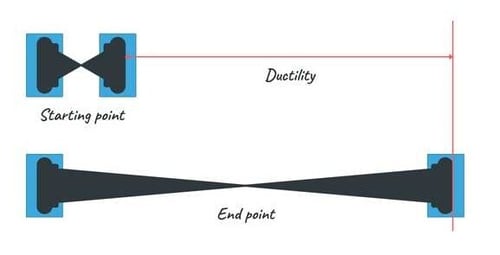
Ductile failure occurs when a material undergoes significant plastic deformation prior to fracturing.
Unlike brittle failure, ductile failure often shows warning signs such as necking or stretching and may leave a cup-and-cone fracture surface. Because ductile materials absorb more energy before breaking, they are often used where toughness and impact resistance are important.
Ductile failure can still occur when a part is overloaded. Stress beyond the material’s yield strength causes plastic deformation and eventual failure, especially in improperly sized components or unexpected service conditions.
Deformation can concentrate around thin sections, notches, or other stress concentrators, causing premature failure. Cold working can also reduce ductility and make a part more likely to fail under load unless annealing restores its ductility.
Temperature, design, and machining conditions all affect ductile failure. Heat can increase ductility but reduce yield strength, while thin sections, residual stress, over-machining, or poor material selection can increase failure risk. Careful design and manufacturing help prevent severe failure.
What is the ductility of metals?
Ductility plays a crucial role in how metals behave during CNC machining and directly influences both machinability and design decisions.
In commonly machined metals like aluminum, stainless steel, titanium, and various steels, ductility determines how a material will deform under cutting forces, how it responds to stress concentrations, and how it tolerates post-machining operations like bending or assembly.
|
Metal |
Typical Ductility |
Notes on Machinability and Design Considerations |
|
Tool Steel |
Very low |
Prone to cracking during machining; requires careful stress management |
|
Titanium |
Low to moderate |
Heat buildup during machining can affect surface finish; generous radii and stress relief are recommended |
|
Stainless Steel |
Moderate |
Prone to work hardening; sharp tools and slower feeds help manage machining stress |
|
Bronze |
Moderate to high |
Excellent machinability; good for wear-resistant parts and bushings |
|
Alloy Steel |
Moderate to high |
Good balance of strength and ductility; suitable for structural parts; heat treatment affects final ductility. |
|
Brass |
High |
Easy to machine; ideal for fittings and decorative parts; excellent chip control. |
|
Mild Steel |
High |
Easy to machine and form; ideal for welded or press-fit assemblies |
|
Aluminum |
Very high |
Highly ductile; smooth chip formation; ideal for thin-walled or complex geometries; tolerates aggressive machining |
|
Copper |
Very high |
Excellent thermal and electrical conductivity; soft and easy to machine but requires care to avoid smearing. |
Ultimately, understanding the ductility of the chosen metal helps mechanical engineers anticipate how a part will behave during and after machining. It informs decisions about tolerances, surface finishes, and post-processing steps, ensuring that the final component meets both functional and manufacturing requirements.
How does ductility affect CNC machining?
Ductility is crucial in CNC machining, as it determines how materials handle cutting forces and deformation. For example, highly ductile metals like aluminum and copper can be machined into complex shapes without cracking, allowing for smoother geometries, improved surface finishes, and lower risk of fracture during bending or forming.
During machining, ductile materials stretch on the outside and compress on the inside when bent—useful for forming or assembly processes like press fits or snap features. However, high ductility can cause issues such as material smearing, poor chip formation, and built-up edge on tools, which may affect surface quality and increase tool wear.
Ductility should guide choices around wall thickness, fillet radii, and tolerances. Highly ductile materials—especially in thin-walled sections—may deflect under tool pressure, leading to dimensional variances. To prevent localized deformation or failure, it is best to use generous radii and avoid sharp internal corners, promoting even stress distribution.
How to choose the right material for ductile applications?
Selecting the right metal for a ductile application requires a strategic approach that balances material properties, machining behavior, and end-use performance. The strategy begins with understanding the functional requirements of the part — including load conditions, environmental exposure, and desired mechanical performance — and then aligning those needs with the ductility profile of candidate materials.
1. Start by identifying the mechanical demands of the component
If the part will undergo significant deformation, impact, or dynamic loading, prioritize metals with higher ductility (e.g., aluminum, copper, or mild steel). These materials can absorb energy and deform without fracturing, making them ideal for applications where toughness and flexibility are critical.
2. Evaluate the material's machinability
Highly ductile materials are generally easier to machine, producing smooth finishes and predictable chip formation. However, excessive ductility can lead to issues like material smearing or edge build-up on cutting tools. In such cases, selecting the right tooling and optimizing cutting parameters — including feed rate, speed, and coolant strategy — becomes essential to maintain surface integrity and dimensional accuracy.
3. Consider the design geometry and tolerances
Ductile metals are more prone to deflection during machining, especially in thin-walled or complex features. Engineers should incorporate generous radii, avoid sharp internal corners, and ensure adequate wall thickness to prevent distortion. These DFM principles help maintain part stability and reduce the risk of post-machining failures.
4. Factor in post-processing and assembly requirements
If the part will be welded, bent, or press-fit after machining, ductile metals offer greater flexibility and reliability. Mild steel and aluminum, for example, respond well to forming operations and are less likely to crack under stress. For high-performance applications, consider how heat treatment or surface finishing might affect ductility and plan accordingly.
By integrating these considerations — functional performance, machinability, geometry, and post-processing — engineers can confidently select ductile metals that align with both design intent and manufacturing efficiency.
Frequently asked questions about ductility
How does high ductility affect chip formation in CNC machining?
Highly ductile materials tend to form long, continuous chips instead of breaking into short pieces. This can improve surface finish but may make chip control more difficult and increase burr and built-up-edge risks, especially during CNC turning, drilling, and deep-pocket milling.
How do built-up edges (BUE) form when machining ductile metals?
Built-up edge (BUE) forms when ductile workpiece material adheres and pressure-welds to the tool’s rake face and cutting edge as chips flow. The adhered material strain-hardens, creating a temporary wedge that changes the effective cutting edge before breaking away and reforming in a repeating cycle.
What alternative tests measure ductility for brittle metals?
Because brittle metals may fracture before they show meaningful tensile elongation, engineers often use bend, notched-impact, and fracture-toughness tests as additional measures. These tests do not measure ductility directly. Instead, they show how the material responds to low ductility, including its sensitivity to cracking, resistance to crack growth, and performance under impact or constrained loading.
What methods improve wear resistance in ductile metal alloys?
Wear resistance in ductile metal alloys can be improved by hardening the surface, reducing adhesive friction, supporting it against contact loads, and controlling the operating environment. The core should remain tough and ductile when impact or fatigue resistance is important. In most cases, the best result comes from selecting the right material and surface treatment together rather than simply hardening the entire part.
How does high ductility affect machinability?
High ductility can make metal easier to shear, but it can also make CNC machining more difficult to control. Although it supports smooth chip flow and can produce a good surface finish, it also increases the risk of long stringy chips, burrs, material adhesion, built-up edge, smearing, and workpiece distortion.