What is CNC Milling?
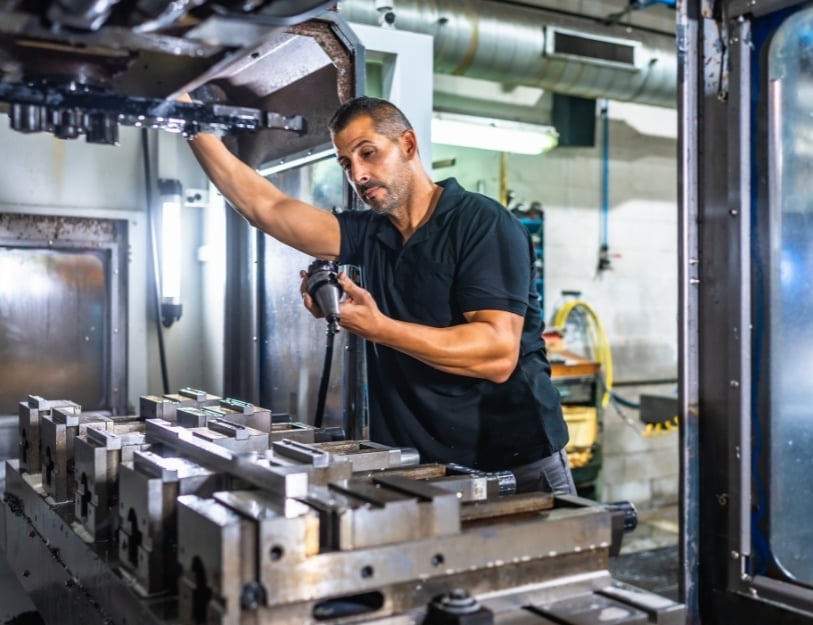
CNC milling uses a rotating cutting tool to shape stationary workpieces with high precision. Unlike turning, it can produce complex shapes and contours in difficult-to-machine materials.
Updated: 9/8/26
How does CNC milling work?
CNC milling removes material from a clamped workpiece by moving a rotating cutting tool along computer-controlled paths.
A CNC controller executes a program that coordinates axis motion, spindle speed, feed rate, tool changes, and auxiliary functions such as coolant.
Model-to-machine workflow
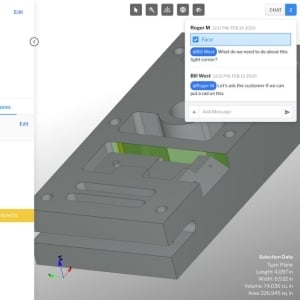
Create the part model
The component is designed in CAD, defining its geometry, dimensions, datums, holes, pockets, contours, and tolerances.
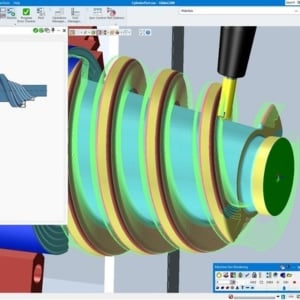
Plan machining in CAM
CAM software selects tools and creates machining operations—such as facing, adaptive roughing, pocketing, drilling, contouring, and finishing. It generates toolpaths: the precise trajectories the cutter will follow.
Post-process the program
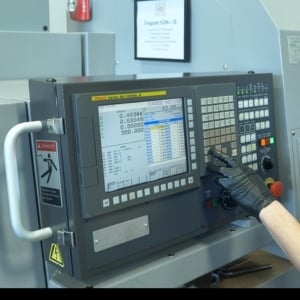
CAM output is converted into G-code. The code contains motion commands plus process information including coordinates, feed rates, spindle commands, and tool changes.
Set up the machine
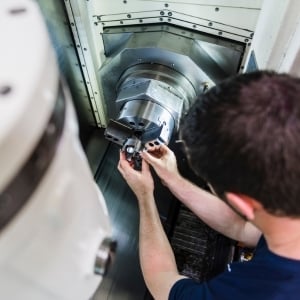
The machinist mounts and indicates the workpiece or fixture, loads tools, measures tool lengths/radii, establishes work coordinate offsets, and verifies clearance. This aligns the digital program’s coordinate system with the physical stock.
What's the difference between 3-axis and 5-axis machining?
The main difference between a 3-axis and a 5-axis machine is motion. A 3-axis mill moves only linearly along the X, Y, and Z axes, while a 5-axis mill adds two rotary axes. This means that the tool, part, or both, can tilt and rotate.
The extra axes improve access to complex geometry and can reduce setups. The downside is that machining, programming, setup, and verification get more complex. Machining hours on a 5-axis machine are also more expensive than those on a 3-axis machine.
|
Capability |
3-axis machining |
5-axis machining |
|
Linear axes |
X, Y, Z |
X, Y, Z |
|
Rotary axes |
None |
Two, commonly designated A/B, A/C, or B/C depending on kinematics |
|
Tool orientation |
Usually fixed vertically relative to the machine table |
Can be indexed or continuously varied relative to the workpiece |
|
Part access |
Primarily top-side; other faces require reclamping or alternate fixtures |
Multiple faces and angled regions can often be reached in one clamping |
|
Typical work |
Plates, blocks, pockets, holes, profiles, prismatic housings |
Impellers, blisks, turbine components, molds, medical components, complex aerospace structures |
|
Hourly rate |
$75 - $125/hr |
$125 - $200/hr |
|
Setups |
2-6 |
1-2 |
|
Fixture cost |
Low-medium |
Medium (but fewer fixtures required) |
|
Scrap risk |
Higher (re-clamping errors, tolerance stack) |
Lower (single setup) |
|
Surface finish |
Good |
Excellent |
How does 3-Axis machining work?
A 3-axis CNC mill moves the cutting tool along the X, Y, and Z axes—left to right, front to back, and up and down—while the workpiece remains fixed on the table. This limits tool access to the top side of the part.
Three-axis machining is well suited for flat parts and top-access pockets. Because the tool cuts primarily from above, machining other sides requires the part to be flipped, re-clamped, and re-zeroed.
- Best for flat plates, simple brackets, and components with top-access pockets
- Tolerances typically range between +/-0.002" to +/-0.005"
How does 5-Axis machining work?
A 5-axis machine adds two rotary axes, allowing the table or spindle head to tilt and swivel. This gives the cutting tool access to complex features from multiple angles.
5-axis machining typically uses either 3+2 or simultaneous motion. In 3+2 machining, the rotary axes are positioned and locked before cutting begins. Simultaneous 5-axis machining moves all five axes at once, making it ideal for sculpted surfaces and complex contours.
- Best for multi-sided parts, compound angles, and contoured surfaces
- Tolerances typically range between +/-0.0005" to +/-0.002"
When to choose CNC milling?
CNC mills produce flat surfaces, pockets, slots, and holes. With 5-axis capability, they can also machine complex angles and contours.
- Tool spins at high speed (up to 20,000+ RPM)
- Part stays mostly still on the table
- Common machines: 3-axis VMC, 5-axis mill
Mills vs. Lathes
The shape of your part is the most important determining factor in choosing a CNC machining process. If the part is prismatic (i.e., looks like a box), you should use a mill. If the part is round or cylindrical, you should use a lathe.
In addition to part shape, part features also indicate which machining process you should use.
|
Part Feature |
Best Process |
|
Flat surfaces, pockets |
Milling |
|
Round OD, bores |
Turning |
|
External threads |
Turning |
|
Slots, keyways |
Milling |
Mill-Turn Machines
Many parts, like turbine blades and impellers, are complex enough to require milling and turning operations. One option is to complete the first operation on one machine and then move it to the next; however, this could result in alignment issues.
Your other option is to combine both operations into one, which is achievable with a mill-turn machine.
A mill-turn machine combines a mill and a lathe into one machine and one operation. The machine’s spindle spins the part for turning operations, but it can be locked and milled with live tooling.
Choose a mill-turn machine when:
- You want to avoid concentricity and alignment issues by moving your part between machines
- The part’s features require milling and turning operations
While machining hours are more expensive on a mill-turn machine than a mill or a lathe, the reduced setups and improved accuracy are worth the cost for the right part.
Choose a mill-turn machine when your part is cylindrical and has:
- Slots or keyways
- Cross holes (e.g., radial holes through the center)
- Flat features (e.g., hex shapes, flats)
Frequently asked questions about CNC milling
What is the difference between 3-axis and 5-axis milling?
The main difference is how the tool and workpiece are oriented. A 3-axis mill moves the cutter linearly along X, Y, and Z while the tool axis usually remains vertical. A 5-axis mill adds two rotary axes, allowing the tool, workpiece, or both to tilt and rotate for angled and complex surfaces.
How expensive is CNC milling?
The cost of CNC milling depends on whether you outsource the work or buy equipment. Outsourced milling typically costs $30–$150+ per hour, while purchasing a CNC mill can cost about $3,000 to more than $500,000.
What is the difference between 3+2 and simultaneous 5-axis machining?
In 3+2 machining, the rotary axes position the tool or workpiece at a fixed angle and then lock while cutting proceeds along X, Y, and Z. In simultaneous 5-axis machining, all three linear axes and both rotary axes move together, continuously adjusting the tool’s orientation during the cut. Use 3+2 machining for parts with features at several fixed angles, such as angled holes or inclined pockets, when continuous tool-axis movement is not needed. It provides many five-axis access and setup benefits with simpler programming and lower cost.
Why does 5-axis machining reduce the need for multiple setups?
5-axis machining reduces setups by reorienting the tool or workpiece while the part stays clamped in the same fixture. This lets the machine reach multiple faces under CNC control without removing, flipping, or re-clamping the part.
How does CNC milling differ from CNC turning?
CNC milling and CNC turning are both computer-controlled subtractive processes, but the rotating element is different. In milling, the cutting tool rotates while the workpiece is held in place. In turning, the workpiece rotates in a chuck or collet while a typically single-point tool feeds into it.
How does G-code control CNC milling machine tool paths?
G-code directs the CNC milling machine’s tool path. It specifies the tool’s movement, endpoint, and cutting conditions. The controller reads each block of code, applies the active coordinate system and offsets, and converts the instructions into synchronized X, Y, Z, and, when applicable, rotary-axis movements.