
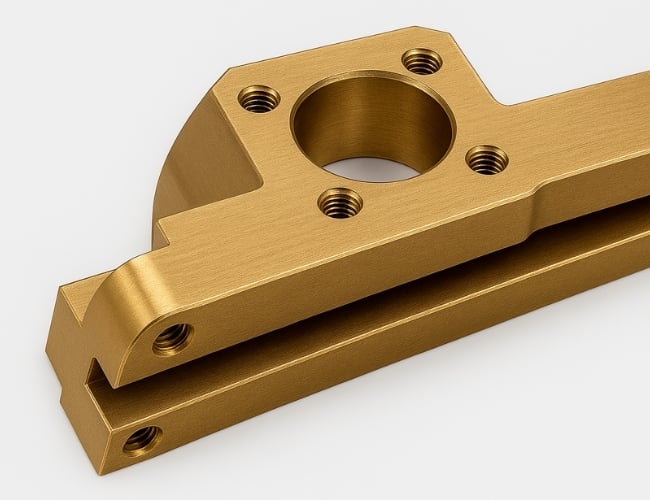
What to know about CNC machining bronze?
Bronze CNC machining is used when the part needs better sliding wear performance, anti-friction behavior, corrosion resistance, or bearing characteristics than aluminum or many steels provide.
Updated: 8/17/26
What is bronze CNC machining?
Bronze CNC machining is the computer-controlled cutting and shaping of bronze stock into finished, dimensionally precise components.
It is a subtractive process: CNC mills, lathes, drills, and related tools remove material from a bronze bar, plate, billet, or casting to produce features such as bores, threads, gears, contours, and bearing surfaces.
Bronze is usually selected for components that must withstand sliding contact, oscillating motion, or continuous loads where aluminum, brass, or even some steels would gall, seize, or wear out. These are parts where dimensional stability and surface integrity matter more than raw strength.
Leaded bearing bronzes can be particularly machinable, while aluminum bronzes trade some machinability for greater strength and resistance to wear and harsh environments.
What are the advantages of CNC machining bronze?
CNC machining bronze is especially advantageous when a part must resist sliding wear, carry load, avoid galling, or survive corrosive service.
It’s commonly chosen for bearings, bushings, gears, valve parts, and marine hardware—not simply because it can be machined, but because its in-service performance can extend component life.
The main advantages include:
- Low friction and anti-galling behavior
- Strong wear resistance
- Good corrosion resistance
- Good surface finishes
- Thermal and electrical conductivity
What are the challenges of CNC machining bronze?
The main challenges of CNC machining bronze are controlling tool wear, chips, heat, work hardening, and dimensional change. The severity depends heavily on the alloy: a soft leaded bearing bronze such as C93200 machines very differently from high-strength aluminum bronze such as C95400.
The main challenges include:
- Require high cutting forces
- Accelerated tool wear
- Long or stringy chips
- Work hardening
- Heat and thermal movement
- Surface-finish defects
- Part distortion and clamping damage
- Difficult to debur
What are the most common bronze grades?
The most common bronze grades for CNC machining are C93200 bearing bronze and C95400 aluminum bronze.
C932 is the common default for machined bushings and bearings, while C954 is selected when higher strength, wear resistance, and marine corrosion resistance are needed.
| Grade | Tensile (KSI) | Yield (KSI) | Hardness | Machinability | Weldability | Corrosion Resistance |
| C932 | 35 | 18 | 65 HB | Good | Poor | Moderate |
| C954 | 85 | 32 | 170 HB | Good | Good | Excellent |
| C544 | 65 | 8 | 86 HB | Excellent | Poor | Good |
| C510 | 70 | 13 | 87 HB | Poor | Good | Good |
| C655 | 56-108 | 21-60 | 125 HB | Moderate | Excellent | Excellent |
| C952 | 68 | 28 | 125 HB | Poor |
Good | Excellent |
| C863 | 110 | 62 | 223 HB | Poor | Poor |
Good |
| C958 | 85 | 35 | 139 HB | Moderate |
Good | Excellent |
*Please note that these are all ranges and should be used to inform research
How to pick the right bronze grade?
For most CNC machined parts, C932 is the best all-around brass grade. Alternatively, choose C954 or another aluminum bronze when strength, abrasive wear resistance, and corrosion resistance are more important than machinability.
In the case of bronze, you can identify the right bronze grade with a simple decision workflow:
- Define the contact condition
- Define the environment
- Set mechanical requirements
- Screen against compliance constraints
- Confirm manufacturability
- Specify the exact grade and product form
What are the best surface finish options for bronze?
As-machined finish is the best surface finish option for bronze CNC parts. Add honing or polishing only where a specific function—such as a close-running bearing bore, seal face, or cosmetic appearance—justifies it; overly smooth finishes can reduce lubricant retention and worsen bearing behavior.
Bronze can take a machined finish, media blasting, hand polish, electroplating, powder coating, bead blasting, electropolishing, and various chemical treatments as a surface finish option.
Important surface finish considerations:
- Tight tolerances increase cost significantly
- Thin or long parts are prone to distortion
- Surface finish affects wear and lubrication
- As‑machined finishes are often preferred
- Inspection strategy should match functional risk
What are the best practices for designing bronze parts?
Bronze is capable of holding tight tolerances, but not effortlessly. Dimensional stability depends heavily on geometry stiffness, fixturing strategy, and thermal control.
Use these best practices when designing bronze parts:
- Design to limit nonfunctional finishing passes and avoid long, constant‑contact contouring on large surfaces
- Place critical datums on stiff sections and keep them away from heavy stock removal so stress does not shift your stack‑up
- For critical bores, provide lead‑in and straight length so they can be reamed or honed, and avoid hiding them at the bottom of deep pockets
- Avoid wide areas that require ultra‑light finishing passes
- Call out edge breaks with max/min chamfer or radius so deburring does not change function
Engineers should assume that bronze behaves closer to cast iron than aluminum in terms of rigidity and closer to steel in terms of cutting force.