
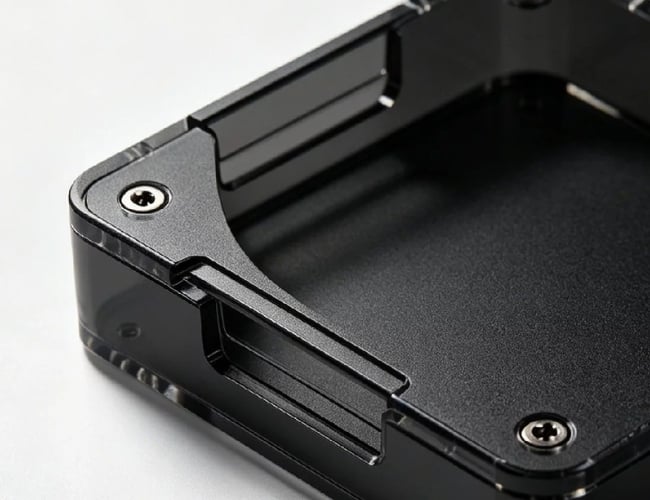
What is Acrylic?
Acrylic (PMMA) is a lightweight, weather-resistant thermoplastic valued for clarity and easy fabrication.
Acrylic machines well and offers a lightweight, cost-effective alternative to glass.
Updated: 8/27/26
What are the key properties of Acrylic?
Acrylic is widely used in CNC machining applications because of its excellent optical properties and predictable machining behavior. Key characteristics include:
- Exceptional optical clarity
- Lightweight
- Excellent weather and UV resistance
- Good dimensional stability
- Good machinability
- High surface hardness
- Excellent surface finish capability
- Good electrical insulation
- Moderate chemical resistance
- Limited impact resistance compared to polycarbonate
Because acrylic is an amorphous thermoplastic, it offers consistent machining characteristics and does not exhibit significant shrinkage or warping associated with some semi-crystalline plastics.
Acrylic is a synthetic polymer produced through the polymerization of methyl methacrylate (MMA) monomer. The polymer structure provides:
- Excellent transparency
- Good UV stability
- Strong resistance to environmental weathering
- Good rigidity and surface hardness
Chemical Composition of Acrylic
| Component | Chemical Structure |
| Methyl Methacrylate (MMA) | C5H8O2 |
| Polymer (PMMA) | (C5H8O2)n |
What are the advantages of Acrylic?
Excellent Optical Clarity
Acrylic offers over 90% light transmission and exceptional clarity.
Superior Weather Resistance
Acrylic stays clear and attractive outdoors.
Good Surface Finish
Proper machining produces polished surfaces for displays and cosmetic parts.
Lightweight Alternative to Glass
Acrylic offers glass-like clarity at half the weight.
Easy Secondary Operations
Acrylic supports polishing, bonding, engraving, thermoforming, and painting.
What are the disadvantages of Acrylic?
Brittle Material Behavior
Acrylic is brittle and may crack under high impact.
Susceptibility to Cracking During Machining
Poor settings, dull tools, or excess heat can cause cracks and chips.
Limited Solvent Resistance
Many solvents can damage or crack acrylic.
Lower Temperature Resistance
Acrylic can soften under prolonged heat.
Poor Wear Resistance
Repeated abrasion can scratch acrylic.
What are the types of Acrylic?
Several acrylic grades are available depending on performance and manufacturing requirements.
- Cast Acrylic: preferred for machining, optical applications, and superior finish quality
- Extruded Acrylic: lower cost, consistent thickness, and commonly used for signage
- Impact-Modified Acrylic: improved toughness compared to standard grades
- UV-Filtering Acrylic: designed for museum, display, and specialty glazing applications
- Colored Acrylic: available in a wide range of translucent and opaque colors
- Optical-Grade Acrylic: manufactured for lenses, light guides, and precision optical components
- Cell-Cast Acrylic: premium grade offering enhanced clarity and machinability
What to know about CNC machining Acrylic?
Tooling
Use sharp, polished tooling specifically designed for plastics:
- Use polished O-flute or single-flute carbide end mills
- Use razor-sharp drills designed for acrylic or plastics
- Minimize tool runout to reduce chipping
- Use polished cutting edges to prevent material adhesion
- Avoid dull tools that generate excessive heat
The primary machining objective is to maintain a clean shearing action while minimizing friction and heat buildup.
Feeds, Speeds, and Chips
There is no universal cutting parameter because results depend on equipment rigidity, tooling, material thickness, and finish requirements. Use chip formation as the primary indicator:
- Produce continuous chips rather than fine powder
- Increase feed rates if material begins melting
- Reduce spindle speed when excessive heat develops
- Maintain consistent chip evacuation
- Avoid dwell marks and rubbing during finishing passes
Monitor part temperature, edge quality, and surface appearance throughout machining.
Cooling and Chip Evacuation
Use compressed air to remove chips and reduce heat accumulation.
- Keep chips clear of cutting edges
- Avoid recutting chips
- Verify chemical compatibility before using coolants
- Avoid aggressive solvents that may cause stress cracking
Workholding
Acrylic can be damaged by excessive clamping pressure:
- Use soft jaws or non-marring fixtures
- Distribute clamping forces evenly
- Support thin sections during machining
- Avoid excessive vacuum or clamp pressure
- Use protective masking when possible
What are design considerations for Acrylic?
When designing machined acrylic components, both material characteristics and manufacturing limitations should be considered.
Avoid Sharp Internal Corners
Sharp corners can concentrate stress and increase the likelihood of cracking.
Maintain Adequate Wall Thickness
Thin sections may chip, crack, or deform during machining and assembly.
Account for Thermal Expansion
Acrylic expands and contracts significantly more than metals and should be accommodated in assemblies.
Minimize Mechanical Stress
Avoid designs that introduce concentrated loads or high assembly stresses.
Consider Edge Finishing Requirements
Transparent components often require flame polishing, buffing, or vapor polishing to achieve desired optical quality.
Consider Operating Environment
Evaluate:
- UV exposure
- Temperature exposure
- Chemical compatibility
- Mechanical loading
- Optical requirements
- Long-term appearance expectations
For applications requiring greater impact resistance, materials such as polycarbonate may provide better performance.
How can Acrylic be modified?
Acrylic is frequently modified to improve performance in specialized applications. Common modifications include:
- Impact modifiers for improved toughness
- UV-filtering additives
- Anti-static coatings
- Abrasion-resistant hard coatings
- Optical enhancement additives
- Specialty color compounds
- Light-diffusing formulations
- Infrared-blocking additives
Material modifications may improve one property while reducing optical clarity, machinability, chemical resistance, or overall cost effectiveness.
Frequently asked questions about Acrylic
Does acrylic machine well?
Yes, acrylic machines exceptionally well when the right cutting tools and speeds are used.
What are common applications for acrylic?
Acrylic machined parts are best used for applications that require high optical clarity, UV resistance, and minimal load-bearing.
What tolerances can you hold when machining acrylic parts?
You can realistically achieve standards of ±0.004 in. to ±0.002 in.
Is Acrylic flexible?
No, acrylic has low ductility, meaning it is a stiff, rigid plastic.