
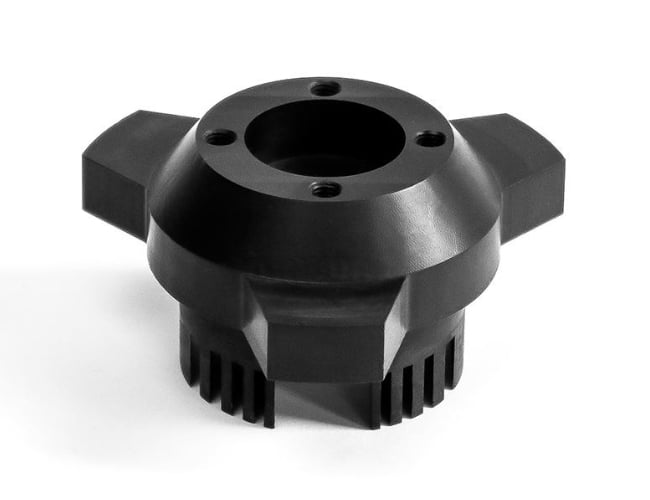
What is Acetal?
Acetal, also known as Polyoxymethylene (POM), is a semi-crystalline engineering thermoplastic commonly machined for precision components requiring high stiffness, low friction, tight tolerances, and excellent dimensional stability.
Acetal machines cleanly on mills, lathes, and routers, making it a preferred material for precision components where long-term dimensional stability is critical.
Updated: 8/20/26
What are the key properties of Acetal?
Acetal is valued in CNC machining applications for its excellent combination of strength, stiffness, wear resistance, and dimensional stability. Key characteristics include:
- Excellent machinability
- High stiffness and strength
- Low coefficient of friction
- Excellent wear resistance
- Low moisture absorption
- Outstanding dimensional stability
- Good fatigue resistance
- Good chemical resistance
- Good electrical insulation properties
- Lightweight
Because acetal is semi-crystalline, it maintains excellent mechanical performance and dimensional accuracy while resisting deformation from humidity and environmental changes. It is often selected as a replacement for metal in lightweight mechanical assemblies.
Chemical Properties and Composition of Acetal
Acetal belongs to the polyoxymethylene (POM) family of thermoplastics. The material consists of repeating formaldehyde-derived molecular units that form a strong, highly ordered polymer structure. Acetal is available in two primary forms:
- POM-H (Homopolymer), commonly known as Delrin®, offering higher stiffness and strength
- POM-C (Copolymer), offering improved chemical resistance and dimensional stability
Chemical Composition of Acetal
| Polymer | Chemical Structure |
| Polyoxymethylene (POM) | (CH₂O)n |
What are the advantages of Acetal?
Excellent Machinability
Acetal machines cleanly with low cutting forces and tool wear, even to tight tolerances.
Outstanding Dimensional Stability
Acetal maintains dimensional accuracy across changing environments.
High Strength and Stiffness
Acetal offers high strength and stiffness without added weight.
Low Friction and Wear Resistance
Acetal's low friction suits gears, bearings, guides, and bushings.
Good Chemical Resistance
Acetal resists many fuels, lubricants, solvents, and industrial chemicals.
Excellent Fatigue Resistance
Acetal withstands repeated loading in snap fits, springs, and moving parts.
What are the disadvantages of Acetal?
Poor UV Resistance
Unstabilized acetal can degrade and discolor in prolonged sunlight.
Limited Bonding Capability
Acetal is difficult to bond without surface preparation.
Moderate Temperature Resistance
Acetal is unsuitable for sustained high temperatures.
Susceptibility to Strong Acids and Oxidizers
Strong chemicals can damage acetal and reduce performance.
Thermal Expansion
Acetal expands more than metal; allow for movement in precision assemblies.
What are the types of Acetal?
Several acetal grades are available to address specific performance requirements:
- Acetal Homopolymer (POM-H/Delrin®): Higher stiffness, strength, and hardness.
- Acetal Copolymer (POM-C): Improved chemical resistance and dimensional stability.
- Glass-Filled Acetal: Increased stiffness and improved creep resistance.
- PTFE-Filled Acetal: Lower friction and improved wear characteristics.
- ESD Acetal: Static-dissipative grades for electronics and semiconductor applications.
- FDA-Compliant Acetal: Suitable for food-processing and medical applications.
What to know about CNC machining Acetal?
Tooling
Use sharp carbide tooling designed for plastics:
- Single- or two-flute high-helix carbide end mills
- Polished O-flute cutters for finishing operations
- Sharp drills with proper clearance geometry
- Minimized tool engagement during slotting operations
- Sharp boring and reaming tools for precision fits
Acetal cuts efficiently and generally produces well-formed chips without excessive heat generation.
Feeds, Speeds, and Chips
There is no universal RPM or feed rate suitable for every application. Performance depends on:
- Tool diameter
- Flute count
- Material grade
- Workholding rigidity
- Surface finish requirements
- Maintain sufficient chip load to carry heat away from the cut
- Avoid excessive spindle speed that may create melting
- Clear chips effectively from deep pockets and slots
- Use steady finishing passes without dwell marks
Cooling and Chip Evacuation
- Compressed air is often sufficient
- Mist coolant may be used if compatible
- Maintain effective chip evacuation in deep features
- Avoid excessive heat accumulation during prolonged machining cycles
Workholding
Acetal is relatively stable but can still deform under excessive clamping pressure.
- Use broad support surfaces
- Avoid overtightening vises
- Support thin sections during machining
- Leave stock for a final finish pass on critical surfaces
- Consider carrier plates for thin sheet components
What are design considerations for Acetal?
When designing machined acetal components, consider both manufacturing requirements and long-term performance.
Maintain Adequate Wall Thickness
Thin walls may deflect during machining and under service loads.
Use Generous Internal Radii
Larger corner radii improve strength and reduce machining time.
Account for Thermal Expansion
Acetal expands significantly more than metals and may require clearance in assemblies.
Consider Wear Applications
Acetal excels in sliding and bearing environments but should be evaluated for load, speed, and lubrication requirements.
Reinforce High-Load Threads
Metal inserts should be considered for frequently assembled joints or high clamping forces.
Evaluate Operating Environment
Review:
- Temperature exposure
- Chemical compatibility
- UV exposure
- Mechanical loading
- Wear requirements
- Dimensional tolerance requirements
For applications requiring higher temperatures, greater chemical resistance, or superior structural performance, materials such as PEEK, PTFE, PPS, or certain reinforced nylons may be more appropriate.
How can Acetal be modified?
Acetal is frequently compounded to improve performance for demanding applications. Common modifications include:
- Glass fiber reinforcement for increased stiffness
- PTFE additives for lower friction and improved wear resistance
- UV stabilizers for outdoor applications
- ESD and conductive additives
- FDA-compliant formulations
- Impact-modified grades
- Custom color compounds
Material modifications often improve specific properties while potentially affecting machinability, toughness, dimensional stability, or cost.
Frequently asked questions about Acetal
Are Delrin and acetal the same thing?
No, Delrin and acetal are not the same. Delrin is a specific, brand-name type of acetal. Think of it as a subset.
Is acetal cheaper than Delrin?
Yes, acetal is generally cheaper than Delrin.
Is acetal easy to machine?
Yes! Acetal machines very easily.
Does acetal absorb water?
Yes, acetal absorbs very small amounts of water, typically 0.2% moisture after 24 hours and has a saturation limit of 0.9%.
Is acetal UV stable?
No, generic acetal has poor UV resistance, and prolonged exposure will result in discoloration, micro-cracking, and loss of strength.
What is acetal used for?
Acetal is used to make strong, low-friction mechanical components (i.e., gears, valves, and bearings).