
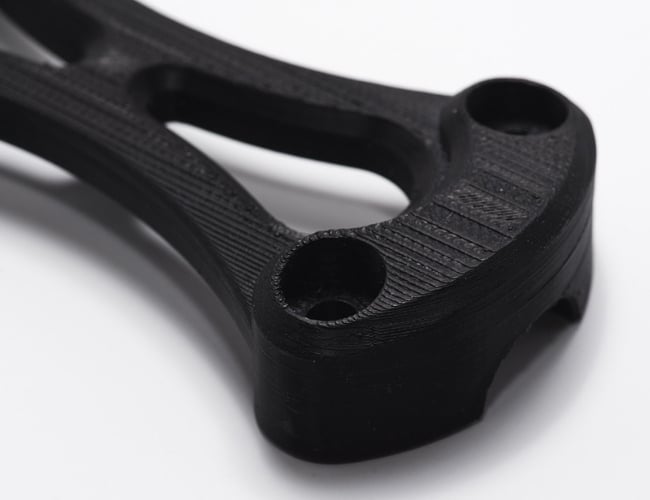
What is ABS?
ABS is a commodity engineering thermoplastic commonly machined for prototypes, fixtures, housings, and low-volume production components. It offers a favorable balance of toughness, dimensional stability, machinability, and cost compared to many engineering plastics.
ABS machines easily on mills, lathes, and routers, making it a popular choice when production quantities do not justify injection mold tooling.
Updated: 8/27/26
What are the key properties of ABS?
ABS (Acrylonitrile Butadiene Styrene) is valued in CNC machining applications for its predictable cutting behavior and balanced mechanical properties. Key characteristics include:
- Good machinability
- High impact resistance
- Low material cost
- Good dimensional stability
- Lightweight
- Good electrical insulation
- Moderate chemical resistance
- Moderate temperature resistance
- Excellent surface finish capability
Because ABS is amorphous, it exhibits relatively consistent behavior during machining and is less prone to internal stresses than some semi-crystalline plastics.
Chemical Properties and Composition of ABS
ABS is a terpolymer composed of:
- Acrylonitrile for chemical and heat resistance
- Butadiene for toughness and impact strength
- Styrene for rigidity and surface finish
The ratio of these components varies by grade, allowing manufacturers to optimize impact resistance, stiffness, or thermal performance.
Chemical Composition of ABS
| Monomer | Chemical Structure |
| Acrylonitrile | CH2=CHCN |
| Butadiene | CH2=CH-CH=CH2 |
| Styrene | C6H5CH=CH2 |
What are the advantages of ABS?
Excellent Machinability
ABS cuts cleanly using standard carbide tooling. Chips evacuate easily, tool wear is minimal, and machining parameters are generally forgiving.
Good Surface Finish
Proper tooling and feeds produce smooth surfaces suitable for cosmetic applications without extensive secondary finishing.
High Impact Strength
ABS withstands impact loading better than acrylic and many other low-cost plastics.
Cost-Effective Material
Compared to polycarbonate, PEEK, or acetal blends, ABS provides a low-cost solution for non-structural and moderately loaded components.
Easy Secondary Operations
ABS can be bonded, painted, threaded, heat-formed, and ultrasonically welded.
What are the disadvantages of ABS?
Limited Heat Resistance
ABS is not recommended for continuous elevated-temperature applications.
Poor UV Resistance
Unmodified ABS can become brittle and discolor when exposed to prolonged sunlight.
Lower Strength Than Engineering Plastics
ABS offers lower stiffness, strength, and wear resistance than materials such as acetal, nylon, or polycarbonate.
Susceptibility to Solvents
Certain solvents can cause swelling, cracking, or environmental stress failure.
What are the types of ABS?
Several grades are available to meet specific machining and performance requirements.
- General-Purpose ABS: balanced properties for prototype and industrial applications
- High-Impact ABS: increased toughness for components subject to shock loading
- High-Heat ABS: improved thermal performance for elevated-temperature environments.
- Flame-Retardant ABS: used in electrical and electronic applications requiring fire-performance compliance.
- ABS Blends
- PC/ABS for improved impact and heat resistance
- ABS/ASA for improved weatherability
- ABS/PVC for enhanced chemical resistance
What to know about CNC machining ABS?
Tooling
Use sharp, polished tooling intended for plastics:
- Use single- or two-flute, high-helix carbide end mills to improve chip evacuation and reduce recutting
- Use polished O-flute cutters for plastic finishing and slotting
- Use sharp, relieved drills to prevent rubbing and heat
- For reaming or boring, use sharp tools and light cuts; plastic may shift after unclamping
- Maintain consistent radial engagement instead of full-width slotting
The goal is to cut chips, not polish the material with the tool. A dull cutter or overly light feed can create friction faster than a more assertive feed with a sharp edge.
Feeds, speeds, and chips
There is no single correct RPM/feed because results depend on tool diameter, flute count, sheet versus billet stock, rigidity, and finish requirements. Use chip formation as the process indicator:
- Increase chip load to produce cool, discrete chips
- Reduce RPM if the cutter generates excess heat
- Clear chips from pockets, slots, holes, and deep contours
- Reduce tool engagement before slowing feed to control heat
- Use a steady finishing pass; avoid dwelling against walls
Test shop-specific milling settings; hobby-machine speeds may not transfer. Check chips, heat, burrs, and dimensions.
Cooling and chip evacuation
Use compressed air for chip removal and cooling; verify coolant compatibility before using mist.
Avoid questionable solvents on hot ABS; use sharp tools, controlled force, and compatible cooling to prevent cracking and overheating.
Workholding
ABS is easily distorted by workholding:
- Use broad, compliant fixturing or well-supported tape
- Avoid overtightening; parts may shift after unclamping
- Support thin walls and floors near the cut
- Machine both sides evenly to reduce residual stress
- Leave stock for a light final pass on thin or flatness-critical parts
- Use tabs, an onion skin, or a carrier for thin sheets instead of heavy clamping
What are design considerations for ABS?
When designing machined ABS components, consider both material limitations and manufacturing requirements.
Avoid Thin-Wall Features
Thin sections can flex during machining and may distort under load in service.
Maintain Generous Internal Radii
Larger radii reduce tool loading and improve part strength.
Account for Thermal Expansion
ABS exhibits higher thermal expansion than metals, which can affect tight-tolerance assemblies.
Limit Thread Loading
Machined plastic threads are suitable for light-duty applications. Metal inserts should be considered for repeated assembly or high-clamp-load joints.
Support Large Flat Surfaces
ABS is less rigid than aluminum or acetal and may deflect under load if unsupported.
Consider Operating Environment
Evaluate:
- Temperature exposure
- UV exposure
- Chemical compatibility
- Mechanical loading
- Dimensional stability requirements
For applications requiring higher temperature capability, greater stiffness, or improved wear resistance, materials such as acetal (POM), nylon, polycarbonate, or PEEK may be more suitable.
How can ABS be modified?
ABS is frequently compounded to improve performance in demanding applications. Common modifications include:
- Glass fiber reinforcement for increased stiffness
- UV stabilizers for outdoor exposure
- Flame-retardant additives
- Conductive or ESD-safe fillers
- Impact modifiers
- Custom color compounds
Material modification often improves one property at the expense of another, particularly machinability, toughness, or dimensional stability.
Frequently asked questions about ABS
Is ABS easy to machine?
Yes, ABS machines exceptionally well and is one of the most cost-effective plastics to use for machined components.
What tolerances can you hold when machining ABS?
Due to its high machinability, you can achieve standard and precision tolerances ( (±0.002 in to ±0.004 in).
What are common applications of ABS material?
ABS is used across a wide variety of industries, including consumer goods, electronics, automotive, and industrial.
Is ABS the strongest plastic?
ABS is durable and impact-resistant, but it is not the strongest plastic. Nylon, PEEK, and polycarbonate offer greater tensile strength, rigidity, and load-bearing capacity.
Can ABS melt?
Yes, ABS can be melted with solvents like Acetone and Methyl Ethyl Ketone (MEK).